




Gold Price Forecast: Global Bond Yields Surge — Can XAU/USD Hold Above $4,400?

How to Start Trading Gold CFDs in Australia
Gold prices are facing a critical test at the start of September as a renewed global bond sell-off puts pressure on non-yielding assets.
On Tuesday, September 1, US 10-year Treasury yields climbed towards 4.78%, their highest level since early 2025. At the same time, Japan's 10-year government bond yield briefly touched 3% for the first time in decades, while Germany's 10-year Bund yield climbed above 3.3%, reaching its highest level since 2011.
The move comes as higher energy prices and renewed Middle East tensions fuel concerns about inflation.
For gold traders, this creates a difficult environment.
Gold benefited significantly from falling rate expectations and a weaker US dollar during August. But that dynamic has now changed.
The key question for September is:
Can XAU/USD defend the US$4,400–US$4,430 area, or will rising global bond yields trigger a deeper gold correction?
Gold Price Today: Why Are Rising Bond Yields Pressuring Gold?
Gold is highly sensitive to movements in real yields and expectations for central-bank policy.
When Treasury yields rise, the opportunity cost of holding gold increases because the metal does not generate interest income.
The latest move in global bond markets is therefore an important warning sign for gold bulls.
The US 10-year Treasury yield reached approximately 4.78% on September 1, while the 30-year yield moved towards 5.27%. Japan's 10-year yield also touched 3%, while Germany's 10-year yield climbed to around 3.34%.
This is particularly important because the move is occurring across several major bond markets simultaneously.
The current gold market equation is becoming:
Higher oil prices → higher inflation expectations → higher rate expectations → higher bond yields → stronger pressure on gold
However, there is another side to the story.
If the bond sell-off eventually raises concerns about fiscal sustainability and government debt, investors could return to gold as an alternative store of value.
This means the current environment could remain highly volatile rather than simply bearish for gold.
Why Are Global Bond Yields Rising?
The latest bond sell-off is being driven by several factors.
1. Higher Energy Prices
Renewed US-Iran tensions have pushed oil prices higher.
Brent crude moved above US$91 a barrel, while WTI traded around the mid-US$80s. The rise reflects concerns that prolonged instability around the Strait of Hormuz could disrupt energy supplies.
Higher oil prices create an inflation problem for central banks.
If energy costs remain elevated, headline inflation could stay above target for longer.
That makes rapid monetary easing more difficult.
2. A More Hawkish Federal Reserve
The second major factor is the change in Fed expectations following Kevin Warsh's Jackson Hole speech.
Warsh emphasised the importance of bringing inflation back towards the Federal Reserve's 2% target, with markets interpreting his comments as hawkish.
As a result, traders have increased expectations for a potential September rate hike. Reuters reported that markets were pricing roughly a 65% probability of a September increase after Warsh's comments.
This is a major change from the market environment that supported gold earlier in August.
Higher Fed rate expectations can:
Push Treasury yields higher
Support the US dollar
Increase real yields
Reduce demand for non-yielding gold
US PCE Inflation Remains a Problem for Gold Bulls
The latest US inflation data also complicates the outlook.
July PCE inflation rose 0.2% month-on-month and 3.7% year-on-year, while core PCE inflation remained around 3.3% year-on-year.
Although core inflation was broadly in line with expectations, it remains well above the Fed's 2% target.
This gives the Fed less room to quickly ease monetary policy.
For gold traders, the implication is straightforward:
If inflation remains sticky while energy prices rise, the Fed may have to keep rates higher for longer.
That would create a significant headwind for XAU/USD.
Could the Fed and Treasury Stabilise the Bond Market?
Another important question is whether the US government can prevent long-term Treasury yields from rising too quickly.
The US Treasury has already taken measures aimed at improving liquidity in longer-dated government bonds.
However, these measures do not eliminate the underlying fiscal problem.
The US still faces:
Large budget deficits
High government borrowing requirements
Heavy Treasury issuance
Rising long-term financing costs
If investors continue demanding a larger term premium to hold long-dated US government debt, Treasury yields could remain elevated.
That would be negative for gold in the short term.
But there is a potentially bullish long-term interpretation.
If investors begin to worry that rising government debt could undermine confidence in the US dollar, gold could regain its role as a monetary hedge.
Is the US Dollar Still a Threat to Gold?
The US dollar has recently benefited from the repricing of Fed policy.
However, the relationship between the dollar and gold is not straightforward at the moment.
Normally:
Stronger USD → weaker gold
But if global bond-market stress becomes severe, investors may seek safe-haven liquidity in both the US dollar and gold.
This could create greater two-way volatility in XAU/USD.
For Australian traders, the AUD/USD exchange rate is especially important.
A weaker Australian dollar can partially offset a decline in the US-dollar gold price when gold is converted into Australian dollars.
Therefore, Australian investors should monitor:
XAU/USD + AUD/USD + US Treasury yields
rather than gold alone.
Gold Price Forecast: What Happens If Yields Keep Rising?
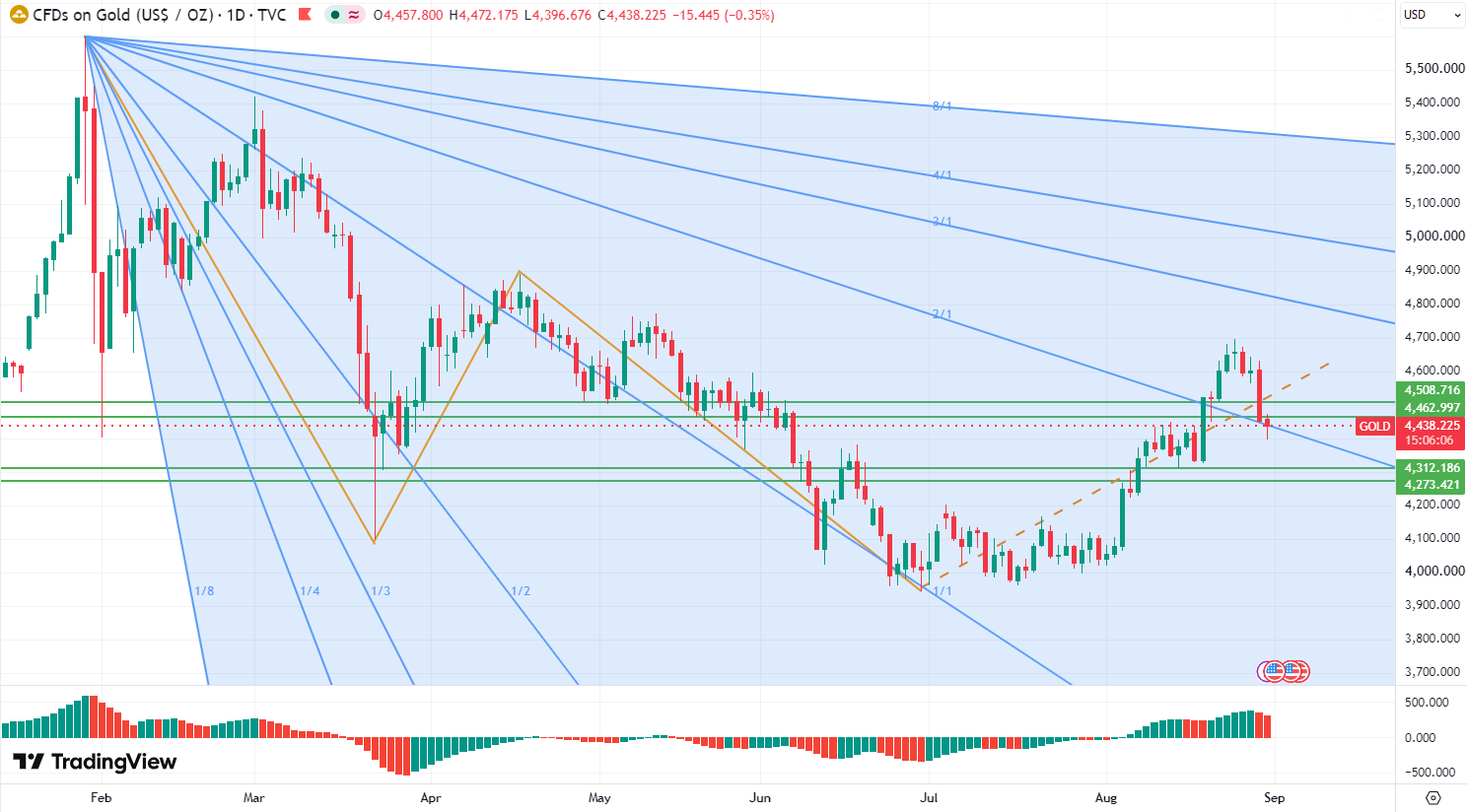
The technical structure has weakened considerably after gold's August rally.
XAU/USD is now trading around the US$4,400–US$4,450 region, with traders watching whether the metal can defend the former breakout area.
Current market analysis also identifies US$4,400 as a critical level for gold bulls.
Key XAU/USD levels
If XAU/USD decisively breaks below US$4,430, the technical structure would weaken further.
The next target could be around US$4,300.
A break below US$4,300 would increase the probability of a deeper correction towards US$4,100.
However, if gold holds US$4,400 and quickly recovers US$4,500, the latest decline could prove to be a temporary correction.
A move above US$4,600 would significantly improve the short-term technical picture and put US$4,700 back into focus.
How to Trade Gold CFDs in Australia
The current market is particularly suitable for traders who want flexibility because gold could move sharply in either direction depending on economic data and central-bank expectations.
With a Gold CFD, traders can speculate on both rising and falling XAU/USD prices without owning physical bullion.
For example:
Long Gold CFD: if you expect XAU/USD to rebound from US$4,400.
Short Gold CFD: if you expect a sustained break below US$4,400.
This flexibility can be useful around major events such as:
US Nonfarm Payrolls
Fed interest-rate decisions
CPI and PCE inflation data
Treasury yield movements
Geopolitical developments
Australian traders should nevertheless remember that CFDs are leveraged products, so losses can be magnified as quickly as gains.
Trade Gold CFDs with Mitrade
For traders looking for flexible exposure to XAU/USD, Mitrade provides access to gold CFDs alongside other global markets.
The current technical setup is particularly important: a defence of US$4,400 could create a rebound opportunity, while a decisive breakdown could open the door to a deeper correction.

Trade XAU/USD with Tight Spreads
What Does This Mean for Australian Gold Traders?
The current environment is particularly important for Australian investors because several markets are moving simultaneously.
Australian traders should monitor:
Gold
Watch whether XAU/USD holds US$4,400.
AUD/USD
A weaker AUD can support Australian-dollar gold prices.
US Treasury yields
A move towards 5% would increase pressure on gold.
Oil
Brent above US$90 could keep inflation expectations elevated.
Federal Reserve
Further hawkish signals would be negative for gold.
US Nonfarm Payrolls
A weak labour report could quickly reverse rate-hike expectations.
This combination makes September potentially one of the most volatile months for gold trading in 2026.
Disclaimer: The content presented above, whether from a third party or not, is considered as general advice only. CFD trading involves significant risk of loss. Past performance does not guarantee future results. This article serves informational purposes only and does not constitute financial advice. Consider your risk tolerance before trading.


