


Is Coca-Cola a Buy After Its Latest Earnings Report?
Key Points
Coca-Cola's stock has ripped this year.
The company continues to perform well despite consumers experiencing ongoing pressure.
After a strong year, can Coca-Cola continue to impress the market?
- 10 stocks we like better than Coca-Cola ›
The iconic consumer beverage giant Coca-Cola (NYSE:KO) reported stronger-than-expected third-quarter earnings and raised its full-year guidance.
Yet the good news wasn't enough to win the market's approval, as the stock dropped roughly 1.6% on Oct. 27, the day it reported earnings. Adjusted earnings per share of $0.91 beat Wall Street consensus estimates by $0.03, while revenue of $13.4 billion beat estimates by about $480 million.
Missed AI’s "Act 1"? Act 2 Could Be 15x Bigger. Most investors think they missed the AI boat because they didn't buy Nvidia in 2005. But according to our analysts, we’re only at the end of "Act 1"—the R&D phase. "Act 2" is the global rollout. Continue »
Meanwhile, management said it now expects at least 5% organic revenue growth this year, up from prior guidance of approximately 5%.
Management also expects at least 11% comparable earnings-per-share growth in 2026, up from prior guidance of 9%-10% growth. Finally, the company guided for at least $13 billion of free cash flow, up from prior guidance of $12.4 billion.
Is the stock a buy after its latest earnings report?

Image source: Getty Images.
Concerns about demand in North America
One might think that a beat-and-raise quarter would move the stock higher, but a few factors seemed to prevent it.
Coca-Cola plans to refranchise, or sell its Coca-Cola Beverages Africa (CCBA) bottling franchise in the fourth quarter, which is expected to result in a 4% headwind to comparable net revenue in the quarter and an 8% headwind in 2027.
Additionally, North American unit case volume came in flat in the quarter, disappointing investors given the segment's stronger performance in the first half of the year.
Coca-Cola's CFO John Murphy said on the earnings call that the restaurant industry continues to experience pressure, largely due to consumer pressures that management expects to persist through the remainder of the year and into 2027.
"Overall, we expect consumer behavior to remain largely unchanged, with value being a very important consideration across all markets and income groups," Murphy said.
Management did, however, express optimism about North America, noting that volume would have grown had the July 4th holiday weekend not fallen in the second quarter.
Furthermore, management sees areas for improvement, including supply chain issues affecting several brands, such as Topo Chico and Sprite. North America experienced volume improvement sequentially each month in the quarter.
Is the stock a buy?
Despite a lukewarm market reception, Wall Street analysts came away from the quarter feeling largely optimistic.
Wells Fargo analyst Chris Carey maintained an overweight rating on the stock and raised his price target by $10 per share to $100, specifically citing expanding margins and strong guidance.
Coca-Cola's main hurdle will be trying to top what has been a phenomenal year for the stock, which is up roughly 32.5%. Rotation out of high-flying sectors like artificial intelligence has benefited best-in-breed consumer staple stocks like Coca-Cola.
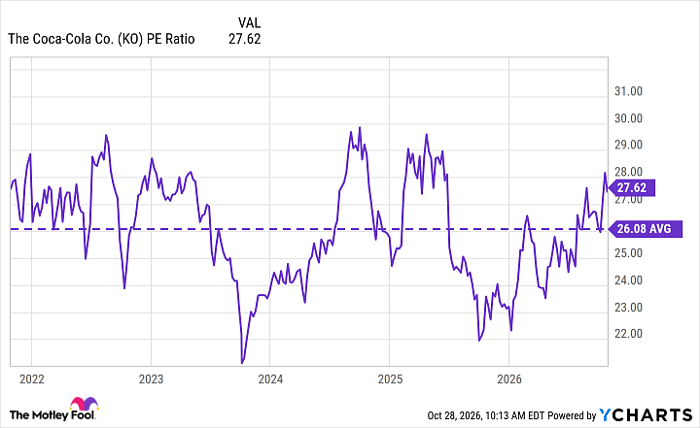
KO PE Ratio data by YCharts
Despite strong performance, Coca-Cola does not trade at a large premium to its average five-year trailing price-to-earnings ratio, so investors do not appear to have rewarded the stock with a premium valuation, at least compared to history.
Coca-Cola also offers a solid 2.3% trailing dividend yield and has increased its annual dividend for 64 years, a streak few others in the market have matched.
While the stock will likely remain range-bound in the near term, I still think it is a good long-term hold that will add diversity and protection to the standard portfolio.
Should you buy stock in Coca-Cola right now?
Before you buy stock in Coca-Cola, consider this:
The Motley Fool Stock Advisor analyst team just identified what they believe are the 10 best stocks for investors to buy now… and Coca-Cola wasn’t one of them. The 10 stocks that made the cut could produce monster returns in the coming years.
Consider when Netflix made this list on December 17, 2004... if you invested $1,000 at the time of our recommendation, you’d have $337,166!* Or when Nvidia made this list on April 15, 2005... if you invested $1,000 at the time of our recommendation, you’d have $1,339,143!*
Now, it’s worth noting Stock Advisor’s total average return is 904% — a market-crushing outperformance compared to 213% for the S&P 500. Don't miss the latest top 10 list, available with Stock Advisor, and join an investing community built by individual investors for individual investors.
See the 10 stocks »
*Stock Advisor returns as of October 28, 2026.
Wells Fargo is an advertising partner of Motley Fool Money. Bram Berkowitz has no position in any of the stocks mentioned. The Motley Fool has no position in any of the stocks mentioned. The Motley Fool has a disclosure policy.
Recommended Articles


