



A brokerage account is the starting point for anyone who wants to invest in or trade financial markets. Without one, there is no practical way to buy shares, trade currencies or gain exposure to gold, oil and stock indices.
The process is simpler than many beginners expect. Most brokers now let you apply online in minutes, verify your identity with a few documents, and fund your account with a bank card or transfer. The harder part is choosing the right type of account and the right broker for your goals.
This guide explains what a brokerage account is, the main account types, how to choose a broker, the requirements and documents you need, where you can open an account, and how much money you need to get started.
Open a Brokerage Account with Mitrade Now
*Start with just $50 and trade global markets with zero commission, competitive spreads.
What Is a Brokerage Account?
A brokerage account is an investment account held with a licensed broker that lets you buy and sell financial products. You deposit money into the account, place orders through the broker's platform, and the broker executes those orders in the market on your behalf.
It works much like a bank account in that it holds your cash, but its main purpose is different. A bank account is designed for saving and spending. A brokerage account is designed for investing and trading.
functions of a brokerage account
A brokerage account serves three main functions:
✅Access to markets: It connects you to stock exchanges and other markets that individuals cannot access directly, including shares listed on exchanges such as the DFM, ADX and NYSE, forex (currency pairs such as EUR/USD and USD/JPY), commodities such as gold and oil, stock indices such as the S&P 500, ETFs, bonds and, at some brokers, cryptocurrencies such as Bitcoin. The markets available to you depend on the broker and where it is licensed.
✅Order execution: The broker carries out your buy and sell orders at the best available price.
✅Record-keeping and custody: The account holds your cash and positions and keeps a record of every transaction, which you need for tracking performance and, in some countries, for tax reporting.
Types of brokerage accounts
Brokerage accounts come in several forms. The right one depends on how you plan to invest, how much risk you can accept, and who will own the account.
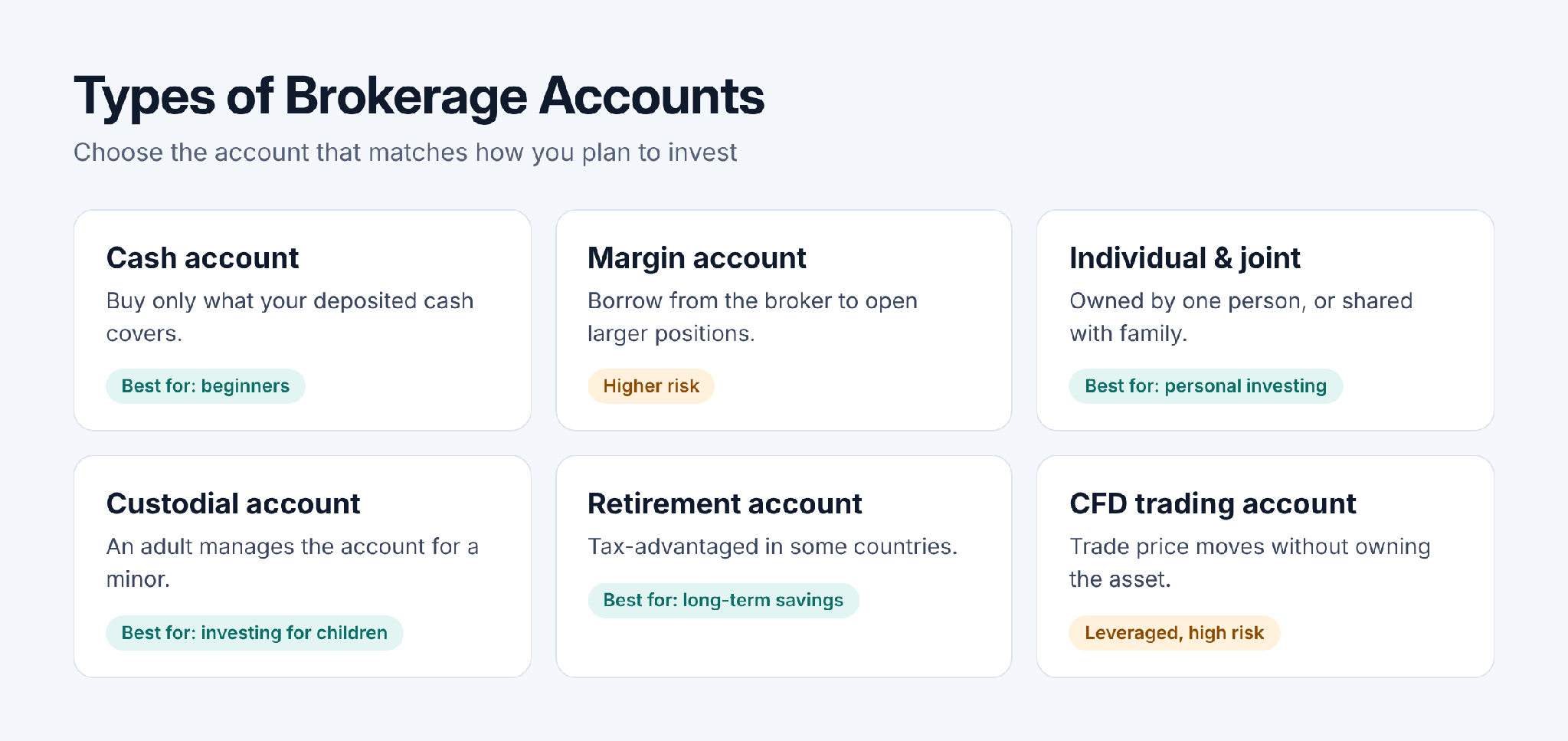
Main types of brokerage accounts and who they suit.
🔷Cash account: You can only buy what your deposited cash covers. It is the simplest and lowest-risk option for beginners.
🔷Margin account: The broker lends you money to buy or trade larger positions than your cash allows. Margin can increase gains, but it also increases losses.
🔷Individual and joint accounts: An individual account belongs to one person. A joint account is shared, often by spouses or family members, with each holder having access.
🔷Custodial account: An adult manages the account on behalf of a minor until the child reaches adulthood.
🔷Retirement accounts: Some countries offer tax-advantaged accounts designed for long-term retirement savings.
🔷CFD trading account: Instead of owning the underlying asset, you trade contracts for difference (CFDs) that track the price of shares, indices, currencies or commodities. CFDs allow you to trade rising and falling prices, but they are leveraged and carry a high risk of loss.
Many brokers in the region also offer Islamic (swap-free) accounts, which are designed to comply with Sharia principles by not charging overnight interest.
How to Choose a Brokerage Account?
Choosing a broker matters as much as choosing what to invest in. A good broker keeps your money safe, charges fair fees and gives you the tools you need. These are the main factors to compare:
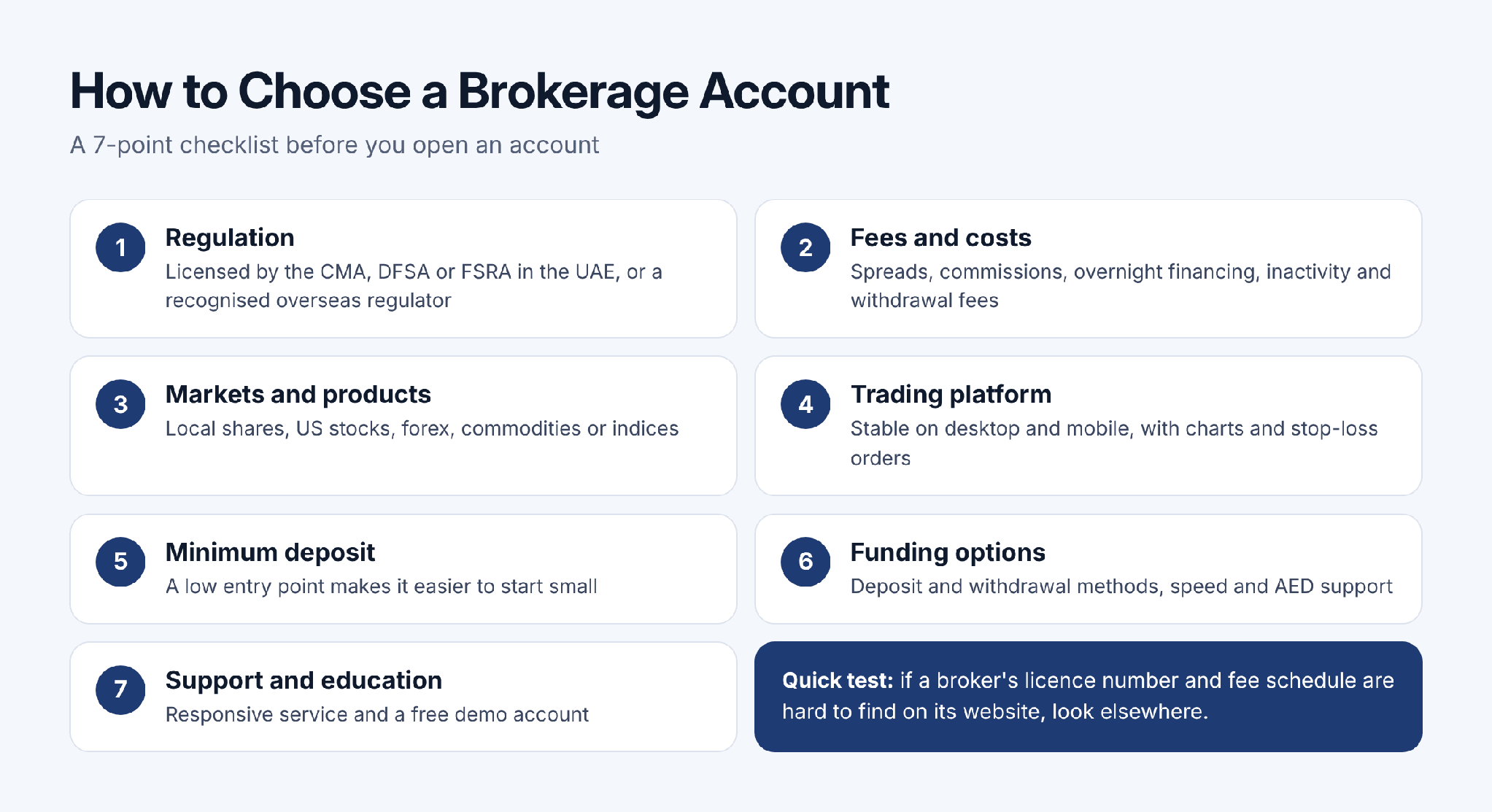
A 7-point checklist for choosing a brokerage account.
🔷Regulation: Choose a broker licensed by a recognised regulator. In the UAE, that means the Capital Market Authority (CMA, formerly the Securities and Commodities Authority) for mainland firms, the Dubai Financial Services Authority (DFSA) in the DIFC, or the Financial Services Regulatory Authority (FSRA) in ADGM.
🔷Fees and costs: Look beyond headline commissions. Check spreads, overnight financing charges, currency conversion fees, inactivity fees and withdrawal charges.
🔷Markets and products: Make sure the broker offers what you want to trade, whether local UAE shares, US stocks, forex, commodities or indices.
🔷Trading platform: The platform should be stable, easy to use and available on both desktop and mobile, with charts, alerts and risk-management tools such as stop-loss orders.
🔷Minimum deposit: Some brokers require thousands of dollars to start, while others accept small deposits. Beginners benefit from a low entry point.
🔷Funding options: Check which deposit and withdrawal methods are available, how long they take and whether they support UAE dirhams.
🔷Support and education: Responsive customer service, ideally in your language, and a free demo account make the learning curve much easier.
How to Open a Brokerage Account?
Opening an account follows the same basic path at almost every broker: check that you are eligible, prepare your documents, choose where to apply, and complete the verification process.
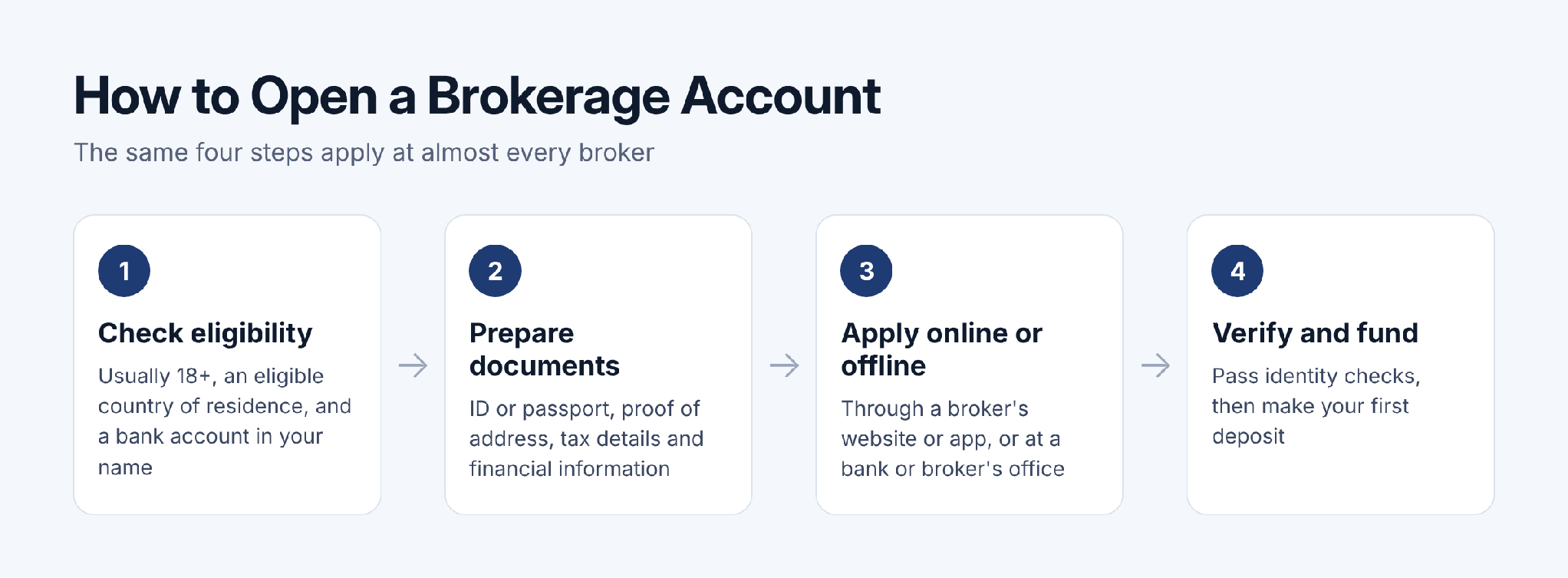
The four steps to opening a brokerage account.
Requirements you need to meet
Minimum age: You must usually be at least 18 years old to open an account in your own name. If you want to open a brokerage account for a minor, a parent or legal guardian can open a custodial account in the child's name and manage it on their behalf. Leveraged accounts, such as CFD trading accounts, are for adults only.
Eligibility: The broker must be allowed to accept clients from your country of residence.
Identity verification: Every regulated broker must confirm who you are under know-your-customer (KYC) and anti-money laundering (AML) rules.
Suitability assessment: Many brokers ask about your income, investment experience and knowledge, especially before offering leveraged products such as CFDs or margin trading.
A bank account or card in your name: Deposits and withdrawals normally have to come from, and return to, an account in the same name as the brokerage account.
Documents you need to prepare for
Having these documents ready before you apply can cut the process down to minutes:
Proof of identity: A valid passport or national ID. UAE residents usually provide their Emirates ID, and expatriates may also be asked for the residence visa page.
Proof of address: A recent utility bill, bank statement or tenancy contract showing your name and address, usually dated within the last three months.
Tax information: Your country of tax residence and tax identification number, which brokers collect under international reporting rules.
Financial details: Information about your employment, income and source of funds.
National Investor Number (NIN): Needed only if you plan to trade shares listed on the Dubai Financial Market (DFM) or Abu Dhabi Securities Exchange (ADX). It is not required for global CFD trading.
Where can you open a brokerage account?
There are two main ways to open a brokerage account: offline, in person at a bank or broker's office, or online through a broker's website or app. Both lead to the same type of account, but they differ in speed, cost and the range of markets you can access.
1. Offline
You can open an account in person at a bank that offers brokerage services, at a broker's office, or through an exchange service desk. A staff member guides you through the forms and checks your original documents on the spot.
This route suits investors who prefer face-to-face help or want to buy local shares through a traditional bank. The trade-offs are paperwork, limited office hours and longer processing times, which can stretch to several days.
2. Online
Most brokers now let you open an account entirely online through their website or mobile app. You fill in an application, upload photos or scans of your documents, and complete identity checks digitally. Many applications are approved the same day or within one to two business days if the documents are clear.
Online brokers also tend to offer lower minimum deposits, lower fees and access to more global markets, along with demo accounts for practice.
Online vs. offline account opening: Which is better?
For most beginners, opening an account online is the faster and more flexible choice. An offline account makes more sense if you specifically want to invest in local shares through your bank or prefer in-person service.


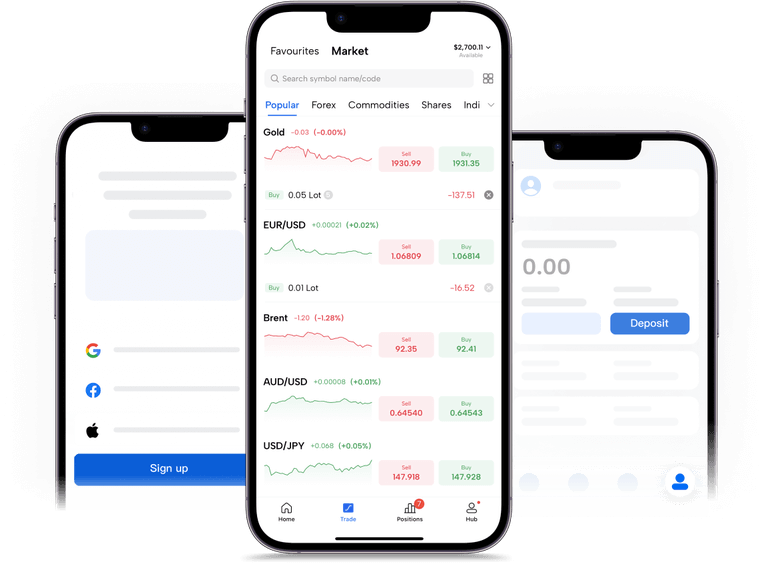
Why Choose Mitrade to Open a Brokerage Account?
For traders in the UAE, Mitrade combines local regulation with a low cost of entry and a platform built for beginners. These are the main advantages of opening your brokerage account with Mitrade:
✅Regulated in the UAE: Mitrade Financial Services LLC is authorised and regulated by the UAE Capital Market Authority (licence number 20200000397), and the wider Mitrade group is licensed by international regulators including ASIC in Australia and CySEC in Cyprus.
✅Zero commission: Mitrade charges no commission on trades. Your trading cost is built into competitive spreads, so you can see what a trade costs before you open it.
✅Low minimum deposit: You can start from $50, and deposits and withdrawals are available in US dollars or UAE dirhams through local banks.
✅Many markets in one account: Trade CFDs on forex, gold, oil, global stock indices, popular US shares and ETFs from a single account, including extended-hours trading on selected US shares and ETFs.
✅Built-in risk management: Stop-loss, take-profit and trailing stop orders help you control every position, and negative balance protection means you cannot lose more than the money in your account.
✅Easy-to-use platform: Trade on web, Windows, macOS, iOS and Android with the same account, and practise first with a free demo account.
✅Fast withdrawals and local support: Mitrade reports that 99% of withdrawal requests are processed within 24 hours, based on its internal 2025 data, and its customer service team is available 24/5 in Arabic and English.
Open a Live Brokerage Account Online in the UAE by Mitrade
Opening a live Mitrade account is done fully online and takes three steps.
Not ready to trade with real money? A free demo account with $50,000 in virtual funds lets you practice first and learn the platform without risk. Open a demo account now >>>
How Much Money Do You Need to Open a Brokerage Account?
There is no single answer, because every broker sets its own minimum deposit. Some traditional brokers and banks require several thousand dollars, while many online brokers accept much smaller amounts. At Mitrade, the minimum deposit starts from $50.
The more useful question is how much you should start with. A few guidelines help:
❶ Only invest money you can afford to lose: Keep an emergency fund and cover essential expenses first.
❷ Account for costs: Fees and spreads have a bigger impact on small balances, so check the cost of each trade before you start.
❸ Match the amount to your strategy: Long-term investing in shares can start small and grow through regular contributions. Leveraged trading needs extra caution, because a small deposit can still produce losses quickly.
❹ Start small and scale up: Begin with a modest amount, learn how the platform and markets behave, and add more only as your experience grows.
Can I open a brokerage account for my child?
In most countries, a minor cannot open a brokerage account in their own name. Instead, a parent or legal guardian can open a custodial account and manage it until the child reaches adulthood. In the UAE, a guardian can request a National Investor Number (NIN) on behalf of a child under 18 to hold local shares. Trading accounts for leveraged products such as CFDs, including Mitrade's, are available only to adults aged 18 and over.
Is it safe to open a brokerage account online?
Yes, as long as you choose a regulated broker. Check the broker's licence on the regulator's official register, use only the broker's official website or app, enable two-factor authentication, and never share your login details. Be cautious of unsolicited offers on social media or messaging apps that promise guaranteed returns.
Do I need a brokerage account to buy stocks?
In most cases, yes. Stock exchanges only accept orders from licensed brokers, so individual investors need a brokerage account to buy and sell shares. To buy shares listed on the DFM or ADX, you also need a National Investor Number. Alternatively, a CFD trading account lets you trade the price movements of stocks without owning the underlying shares.
* The content presented above, whether from a third party or not, is considered as general advice only. This article should not be construed as containing investment advice, investment recommendations, an offer of or solicitation for any transactions in financial instruments.


