


Samsung Electronics Q3 Earnings Preview: Operating Profit May Hit Record High; Can HBM4 Support Highest $542 Target Price?
TradingKey - Samsung Electronics will release its detailed third-quarter 2026 financial report on October 29. Preliminary results previously released by the company show that Q3 revenue is expected to reach 195 trillion Korean won (approximately $145.7 billion), up 126.6% year-on-year; operating profit is estimated at 107.4 trillion won, a surge of 782.5% year-on-year. If the final figures are confirmed, Samsung Electronics' quarterly operating profit will surpass 100 trillion won for the first time, setting a new earnings record for the fourth consecutive quarter.
This round of earnings growth was mainly driven by surging investment in artificial intelligence (AI) infrastructure. As big tech companies continue to expand data centers, demand for server DRAM, high-bandwidth memory (HBM), and NAND flash memory has grown in tandem, while tightening memory chip supply has further pushed up product prices. For Samsung, the strong performance of its memory business is becoming the core driver of the group's profit growth.
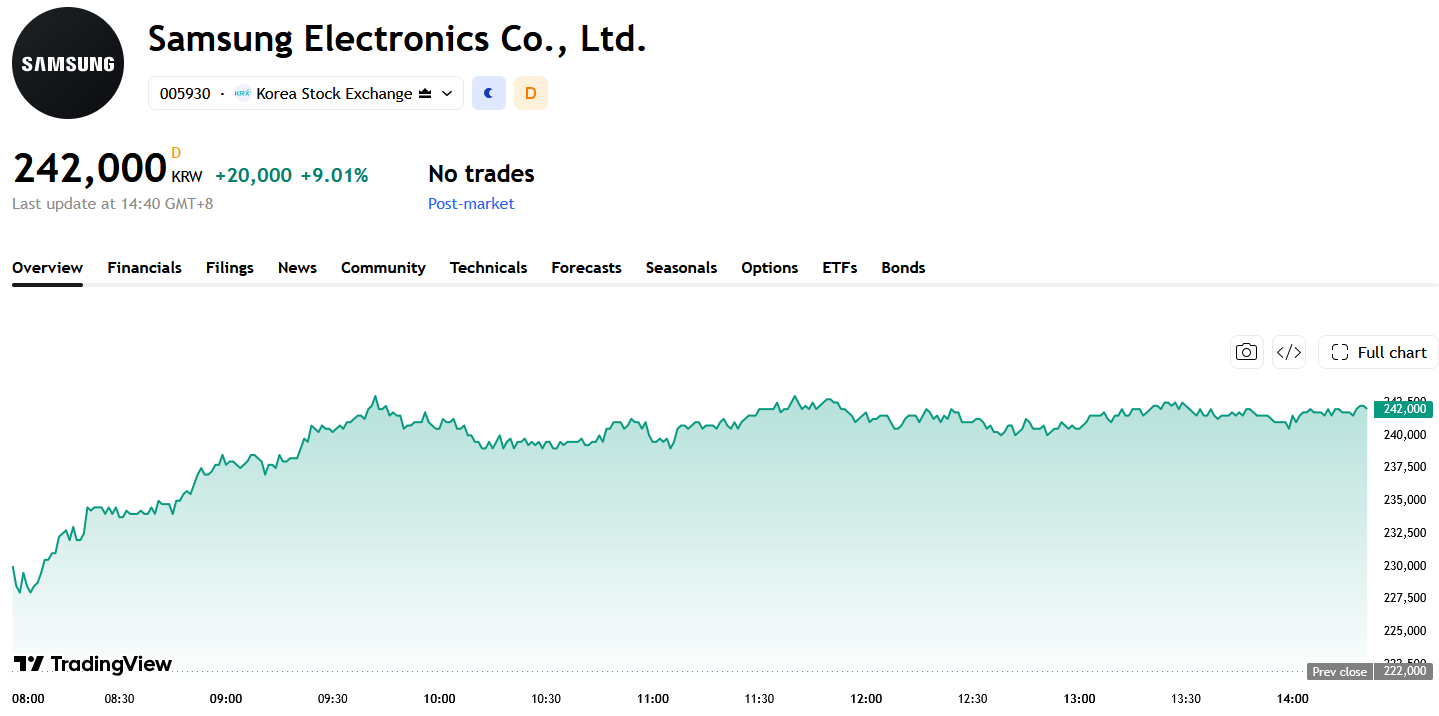
On October 28, SK Hynix reported record quarterly results and announced a large-scale shareholder return plan, further boosting sentiment in the AI memory sector. On the same day, Samsung Electronics shares closed up 9%, while SK Hynix rose nearly 11%, reflecting heightened market expectations for the memory chip industry cycle and Samsung's upcoming detailed financial report.
Source: TradingView
Memory Price Hikes Drive Profit Surge as HBM4 Dictates Growth Quality
Earnings growth in this period was primarily driven by AI data center expansion and rising memory chip prices. As major cloud computing enterprises continued to procure server DRAM, enterprise SSDs, and high-bandwidth memory, combined with relatively restrained industry supply, both the shipment mix and average selling prices of Samsung's memory business improved.
With preliminary results already disclosed, investors will focus on DRAM and NAND average selling prices, semiconductor division profit margins, and the share of server and AI products in memory revenue. If profit growth is driven mainly by high-value products and long-term orders rather than short-term spot price increases, the market may raise its assessment of future earnings sustainability.
HBM4 is key to whether Samsung can further narrow the gap with SK Hynix. As next-generation AI platforms such as Nvidia's Vera Rubin advance, customer demands for bandwidth, power efficiency, and capacity continue to rise. The market will closely watch Samsung's HBM4 customer qualification, mass-production yields, and actual shipment volume.
If HBM4 successfully enters the volume delivery stage, Samsung will not only be able to improve its product mix, but is also expected to capture a larger share of the AI chip supply chain. Conversely, if customer validation or yield ramp-up is slower than expected, even if conventional DRAM prices continue to rise, the company's valuation may still be constrained by insufficient competitiveness in high-end HBM.
30 Trillion Won Dividend and Highest Target Price of 725,000 Won
In addition to operational data, shareholder returns could serve as another catalyst in this earnings report. Samsung's board previously approved a shareholder return plan of approximately 90 trillion to 110 trillion Korean won through 2026, which includes a planned cash dividend of around 30 trillion won for the third quarter, with specific details expected to be finalized at the board meeting on October 29. The company also plans to buy back about 15 trillion won worth of shares and will determine how to allocate the remaining funds between dividends and buybacks in January 2027.
The current three-year shareholder return policy is set to end in 2026, and the market will also focus on whether Samsung discloses its next-stage free cash flow allocation plan. A consistent and clear dividend and share cancellation strategy would help bolster the company's valuation stability through memory cycle fluctuations.
According to forecasts from 36 analysts compiled by S&P Global, the average 12-month price target for Samsung Electronics is approximately 478,906 won, with a high of 725,000 won (around $542) and a low of 290,000 won, while the overall rating stands at "Strong Buy".
Overall, the substantial third-quarter earnings growth for Samsung Electronics has largely been confirmed by preliminary data. Whether the stock price can continue to gain momentum will depend more on the mass production progress of HBM4, the sustainability of memory prices, and the shareholder return plan.
Recommended Articles


