


Japan, South Korea Stocks Under Pressure Again After Rallying; Kospi Falls Nearly 5% as Samsung, SK Hynix Both Drop Over 6% While Kioxia Rises
TradingKey - During the Asian trading session on August 3, Japanese and South Korean stock markets fell back again after a sharp rebound last week, with the South Korean market experiencing a significantly larger decline than the Japanese market.
The South Korea Composite Stock Price Index (KOSPI) opened lower and continued to weaken, with its decline further expanding to 4.86% to report at 6,274.74 points; the Nikkei 225 Index also fluctuated downward, falling 1.12% to report at 63,643.61 points.
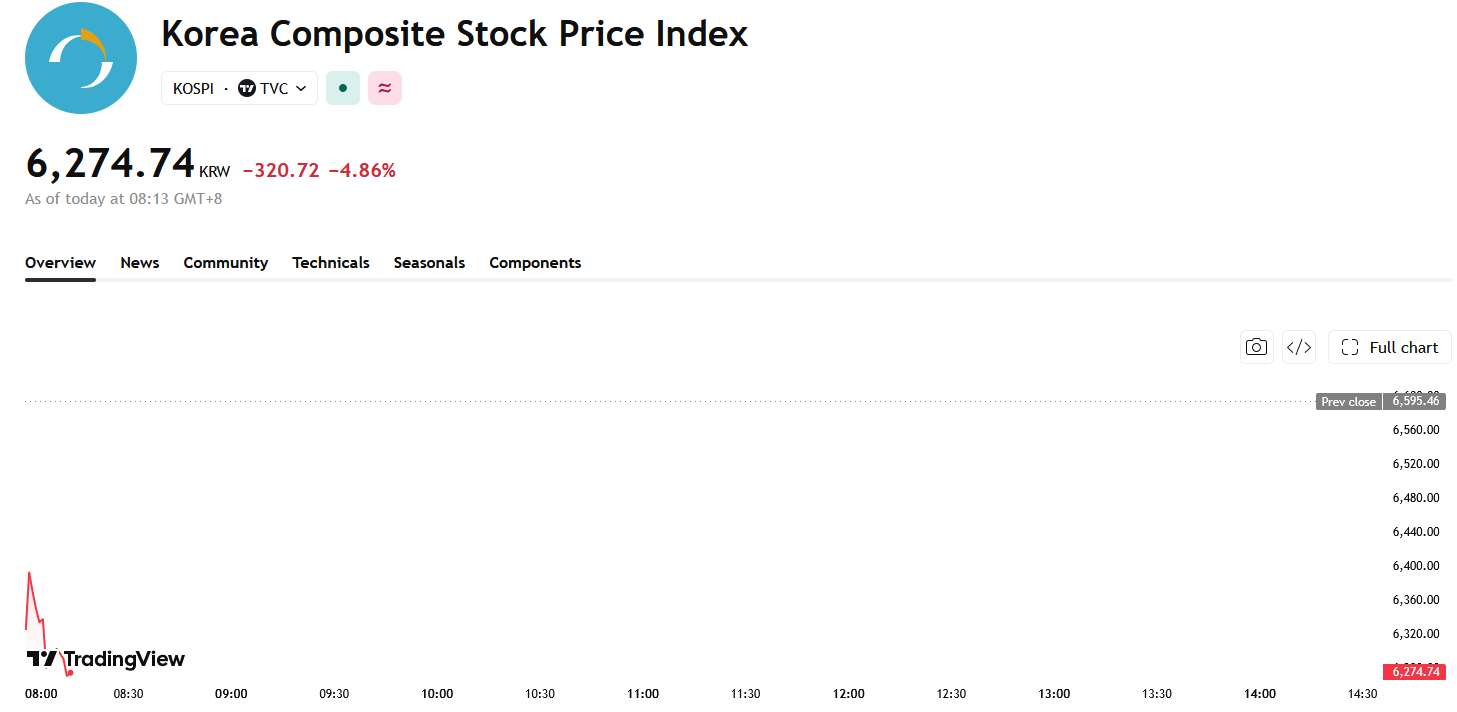
Source: TradingView
South Korean semiconductor leaders once again became the focus of selling, with SK Hynix falling 6.90% to temporarily report at 1,600,000 won (approximately $1,117); Samsung Electronics fell 7.52% to report at 243,000 won, as the weakness in these two heavyweights continued to drag on KOSPI.
Kioxia bucked the trend, rising 6.37% to report at 49,460 yen (approximately $317); SoftBank Group rose 0.97% to report at 5,311 yen, performing significantly stronger than South Korean chip stocks.
Although the three major US stock indexes all closed higher in the previous trading session, the semiconductor sector showed mixed performance, with Micron Technology ( MU) falling over 5%, and Qualcomm ( QCOM ), AMD ( AMD) and other chip stocks also generally pulled back, as sentiment in the AI industry chain failed to continue heating up.
Looking back at July, the South Korean stock market experienced one of its most severe corrections in nearly two decades. The KOSPI index fell 22.2% over the month, and the KOSDAQ index fell 21.4%, marking the largest single-month decline since October 2008. Cooling expectations for the semiconductor industry, rising geopolitical risks in the Middle East, and the concentrated realization of profit-taking after the KOSPI's previous cumulative surge of over 100% jointly drove the rapid market correction.
However, institutions remain optimistic about the medium-to-long-term outlook for the South Korean stock market. Morgan Stanley ( MS) has upgraded its rating on South Korean equities from "Neutral" to "Overweight", believing that the recent concentrated clearing of leveraged capital has created a more attractive entry point for investors to reposition in the AI industry chain and the industrial supercycle.
The bank expects that as the deleveraging process of leveraged ETFs, margin debt, and hedge funds continues to progress, the South Korean stock market is expected to gradually stabilize, with the KOSPI's future target set at 9,000 points, representing a potential upside of approximately 36% from current levels.
Morgan Stanley also pointed out that Samsung Electronics and SK Hynix will remain important pillars for the valuation recovery of the South Korean market, and continues to favor investment opportunities in sectors such as industrials, defense, and finance.
Recommended Articles


