


Warren Buffett Has Endorsed Passive Investing for Decades. Here's the Exact Investment He Recommends Most People Buy.
Key Points
Most large-cap funds underperform the S&P 500 in any given year.
A passively managed fund allows investors to keep more of their gains.
Buffett doesn't think most investors need to beat the market to retire with enough money.
- 10 stocks we like better than Vanguard S&P 500 ETF ›
Passive index investing has continued to gain popularity over the past few years, and it's easy to see why: It's hard to beat the market. However, there are many more reasons passive index investing is such a winner among investors, including Warren Buffett himself, who has beaten the market and has been recommending this model for decades.
Most people won't be able to replicate Warren Buffett's success. During his 60-year tenure leading Berkshire Hathaway, it gained 5,502,284% while the S&P 500 (SNPINDEX: ^GSPC) gained 39,054%. Buffett himself admitted that it's unlikely even Berkshire Hathaway could replicate those breathtaking gains at this point.
Where to invest $1,000 right now? Our analyst team just revealed what they believe are the 10 best stocks to buy right now, when you join Stock Advisor. See the stocks »
For most investors, Buffett recommends passive index investing, and he has advised investing in the Vanguard S&P 500 ETF (NYSEMKT: VOO). Here's why.
It's hard to beat the market
Buffett has advised investing in passive indexing vehicles even before the Vanguard ETF was created. As far back as 1993, when the first S&P 500 ETF was created and 17 years before the Vanguard ETF first came to market, Buffett said most investors should purchase an index-tracking fund. At the time, Vanguard had a mutual fund that tracked the S&P 500.
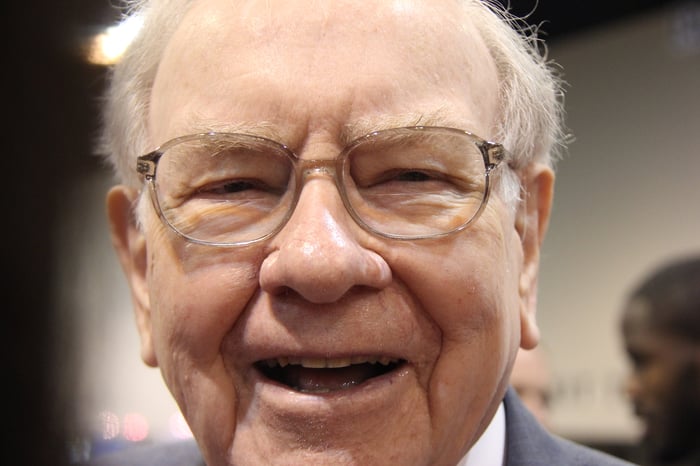
Warren Buffett. Image source: The Motley Fool.
"Index funds, overall, have delivered for shareholders a result that has been better than Wall Street professionals as a whole," he said at the 1993 shareholders meeting.
That reflects research from S&P Global, which releases an annual "scorecard" rating how large-cap, actively managed funds fare against the S&P 500. They overwhelmingly underperform; over the past 25 years, there have only been three years when the majority of them outperformed. Two of those years were 2007 and 2009, when the market plunged due to the mortgage crisis.
One logical conclusion from the results is that it's easier to outperform when the market dips. However, the vast majority of the time, it grows. In fact, Buffett himself made a bet in 2007 that an investment in the S&P 500 would outperform a basket of hedge funds over a decade, and in 2017, he won the bet.
Buffett gave a further explanation for why passive indexing is a great option for most retail investors in his 2013 shareholders letter, when he said that in an index fund, you don't fork over a large portion to management fees. He said that at his passing, he would be leaving all of his cash to his wife in trust, with the recommendation to "put 10% of the cash in short-term government bonds and 90% in a very low-cost S&P 500 index fund. (I suggest Vanguard's.)" He noted two reasons for the suggestion: the belief that it would outperform other instruments and the low fees.
The reason he likely recommends Vanguard is that it charges the lowest fees; the Vanguard S&P 500 ETF has an expense ratio of 0.03%, which is about the lowest you'll find for any ETF. Berkshire Hathaway itself owned the ETF for several years before closing out its position in the fourth quarter of 2025.
Finally, he also noted that most investors have a day job and aren't sitting around analyzing stocks all day, like he is. In that case, they're best off investing in an index fund.
The key to investing success
To make the most of index investing, investors should add money consistently and be prepared to hold for the long term. While someone with the time and skill to analyze and choose a broad portfolio of stocks does have a chance of beating the market, Buffett says that's not necessary for building wealth and retiring with enough money in the bank.
The key is to stay in the markets throughout all their cycles and continue adding funds to your investment, giving you a low-cost vehicle to benefit from market upcycles and growth over time.
Should you buy stock in Vanguard S&P 500 ETF right now?
Before you buy stock in Vanguard S&P 500 ETF, consider this:
The Motley Fool Stock Advisor analyst team just identified what they believe are the 10 best stocks for investors to buy now… and Vanguard S&P 500 ETF wasn’t one of them. The 10 stocks that made the cut could produce monster returns in the coming years.
Consider when Netflix made this list on December 17, 2004... if you invested $1,000 at the time of our recommendation, you’d have $394,601!* Or when Nvidia made this list on April 15, 2005... if you invested $1,000 at the time of our recommendation, you’d have $1,197,093!*
Now, it’s worth noting Stock Advisor’s total average return is 895% — a market-crushing outperformance compared to 206% for the S&P 500. Don't miss the latest top 10 list, available with Stock Advisor, and join an investing community built by individual investors for individual investors.
See the 10 stocks »
*Stock Advisor returns as of August 1, 2026.
Jennifer Saibil has positions in Vanguard S&P 500 ETF. The Motley Fool has positions in and recommends Berkshire Hathaway, S&P Global, and Vanguard S&P 500 ETF. The Motley Fool has a disclosure policy.
Recommended Articles


