


Coca-Cola: The Surprising Reason Investors Should Choose Its Stock Over PepsiCo's
Key Points
PepsiCo's lower P/E ratio and higher dividend yield could win over some investors.
Coca-Cola is an asset-light business compared to PepsiCo.
- 10 stocks we like better than Coca-Cola ›
Coca-Cola (NYSE: KO) stock is riding high following its second-quarter earnings report. The cola giant beat revenue and earnings estimates, and products like Diet Coke and Coke Zero delivered a particularly strong performance.
Nonetheless, a surface-level analysis of Coca-Cola versus archrival PepsiCo might persuade investors to choose the latter. After all, PepsiCo sells for a lower P/E ratio and its dividend yield is significantly higher. Also, even though Coca-Cola was one of Warren Buffett's most famous investments, Berkshire Hathaway has not purchased a single share since 1994.
Where to invest $1,000 right now? Our analyst team just revealed what they believe are the 10 best stocks to buy right now, when you join Stock Advisor. See the stocks »
Fortunately for Coca-Cola bulls, a surprising reason may keep investors in Coca-Cola stock.
Image source: Getty Images.
Why Coca-Cola is the beverage stock of choice
As previously mentioned, PepsiCo's 19 P/E ratio is well below Coca-Cola's earnings multiple of 27, a surprisingly high premium given the companies' similarities.
Also, PepsiCo's 4% dividend yield is well above Coca-Cola's return of 2.3%. Both stocks are Dividend Kings by virtue of having increased the dividend annually for more than 50 years. Thus, PepsiCo seems to have an advantage with income investors.
However, Coca-Cola stock has delivered higher overall returns despite those advantages. Moreover, this is not a temporary phenomenon. Thanks to a breakout in April, Coca-Cola's returns exceeded those of PepsiCo over the last year. Additionally, in nearly every time period going back to 1990, Coca-Cola has outperformed its archrival.
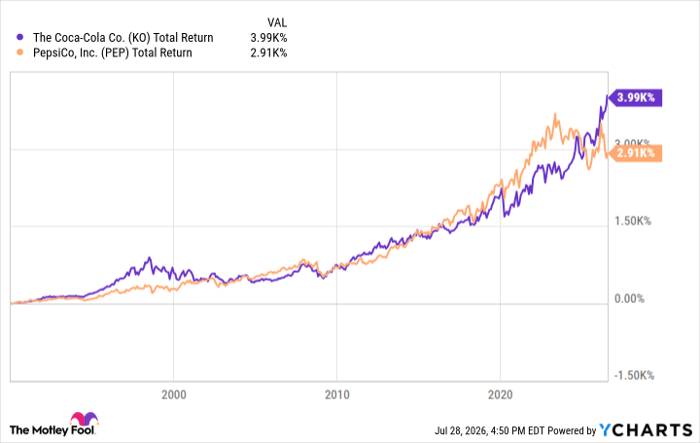
KO Total Return Level data by YCharts
Some subtle differences in Coca-Cola's business model may explain its outperformance. Unlike PepsiCo, Coca-Cola outsources all bottling, trucking, and distribution to third parties. That makes it a comparatively asset-light business, and without those expenses, it earns higher operating margins than PepsiCo.
Furthermore, despite its more than 200 brands, Coca-Cola remains exclusively a beverage business. In contrast, PepsiCo's ownership of food brands such as Frito-Lay and Quaker also places it in a business that has higher input costs.
Consumers have also turned against packaged foods in favor of more natural or organic options, which serves as another headwind that Coca-Cola does not face. In the minds of some investors, those advantages might justify Coca-Cola's higher premium.
Choosing Coca-Cola stock
Coca-Cola has attracted a premium valuation amid a comparatively asset-light business model that generates higher margins.
Admittedly, income-oriented investors should probably choose PepsiCo for its much higher dividend yield. Also, Coca-Cola trades at its steepest premium to PepsiCo in years.
However, in my view, Coca-Cola stock justifies that higher valuation. Ultimately, overall returns are what are important to most investors, and Coca-Cola has met that criterion nearly every time period.
Moreover, Coca-Cola's consistently higher margins make it less likely PepsiCo is going to fully close that valuation gap. Thus, investors should expect that outperformance to continue.
Should you buy stock in Coca-Cola right now?
Before you buy stock in Coca-Cola, consider this:
The Motley Fool Stock Advisor analyst team just identified what they believe are the 10 best stocks for investors to buy now… and Coca-Cola wasn’t one of them. The 10 stocks that made the cut could produce monster returns in the coming years.
Consider when Netflix made this list on December 17, 2004... if you invested $1,000 at the time of our recommendation, you’d have $394,601!* Or when Nvidia made this list on April 15, 2005... if you invested $1,000 at the time of our recommendation, you’d have $1,197,093!*
Now, it’s worth noting Stock Advisor’s total average return is 895% — a market-crushing outperformance compared to 206% for the S&P 500. Don't miss the latest top 10 list, available with Stock Advisor, and join an investing community built by individual investors for individual investors.
See the 10 stocks »
*Stock Advisor returns as of August 1, 2026.
Will Healy has positions in Berkshire Hathaway. The Motley Fool has positions in and recommends Berkshire Hathaway. The Motley Fool has a disclosure policy.
Recommended Articles


