


Pfizer Yields 6.8%, Trades at 8.5X Earnings, and Has a Promising Late-Stage Weight Loss Drug. Why Are So Many Investors Still Ignoring the Stock?
Key Points
Pfizer's financial results haven't been great, and upcoming patent cliffs could exacerbate the problem.
However, the company's large pipeline across multiple lucrative areas could allow it to bounce back eventually.
- 10 stocks we like better than Pfizer ›
At first glance, Pfizer (NYSE: PFE) looks like a great stock to buy. The company has a reliable dividend program and regularly raises its payouts, boasting a 6.8% forward yield, well above the S&P 500's average of 1.1%. Further, Pfizer trades at 8.5x forward earnings versus 18.8x for healthcare stocks. To top it all off, Pfizer's late-stage pipeline features MET-097i, a promising candidate in the fast-growing anti-obesity area. With all that going on, one might think that Pfizer is a no-brainer, but many investors disagree. The stock has moved sideways since the beginning of the year. What's going on?
Image source: The Motley Fool.
Missed Nvidia in 2009? This Rare Signal Is Flashing Again. In 2009, a "Double Down" signal flashed for a little-known chipmaker called Nvidia. For the first time in years, that same "Total Conviction" signal is flashing for a company 1/100th the size of Nvidia. Continue »
Diagnosing Pfizer's problems
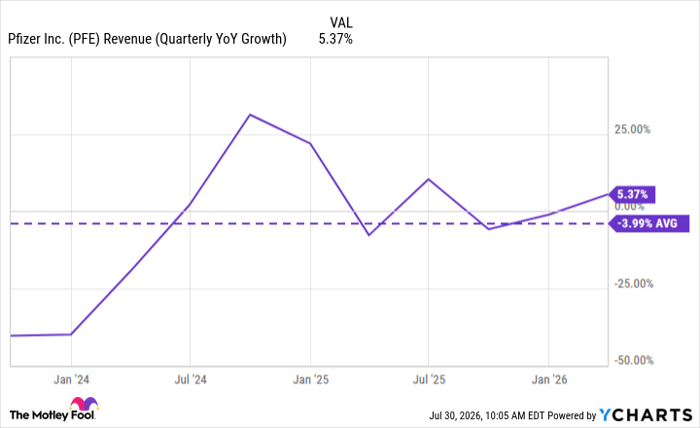
One of the reasons Pfizer is lagging the market is that its financial results haven't been great in recent years. Over the past three years, the company's top-line growth average has been negative.
PFE Revenue (Quarterly YoY Growth) data by YCharts
Pfizer's valuation makes more sense in light of this fact. A low forward price-to-earnings ratio doesn't necessarily mean that a stock is a bargain, especially if revenue and earnings aren't growing fast -- or at all. Further, Pfizer isn't out of the woods just yet. By the end of the decade, the company will lose patent exclusivity for several products, including Eliquis, an anticoagulant.
In the first quarter, Eliquis' revenue came in at $2.2 billion, up 13% compared to the year-ago period. It was Pfizer's single best-selling product and accounted for about 15% of its total revenue. This will be a monumental patent cliff for Pfizer. Meanwhile, the company's coronavirus portfolio isn't performing well due to lower vaccine demand and regulatory restrictions in the U.S. And while Pfizer has sought to turn things around with new launches, some of them haven't performed well and are unlikely to ever make a big enough impact on its financial results to fill the gap products like Eliquis will leave behind. That's why many investors remain skeptical about the company's future.
Why the stock might still rebound
The market is factoring in the possibility that Pfizer's leading pipeline candidates will fail in late-stage clinical trials. On the flip side, if they succeed, the stock will jump. By the time Pfizer launches brand-new products that are capable of replacing older medicines like Eliquis, the share price will likely already be much higher than it is now. And even though the risk of clinical failures is real, my view is that Pfizer's deep pipeline, particularly in weight management and oncology, gives the company enough room for error to overcome potential setbacks and still secure important regulatory approvals for drugs destined to be blockbusters.
Pfizer has more than 10 brand-new compounds in its late-stage pipeline. Even a 50% success rate, which is more than reasonable for a large pharmaceutical company, will lead to a much rejuvenated lineup. True, Pfizer could run into the same problem it has before: Brand-new launches that don't move the needle much at all. However, several of its medicines in development would almost certainly be meaningful growth drivers.
We have already mentioned MET-097i, but it's worth pointing out that this investigational anti-obesity drug completed phase 2 studies in which it demonstrated strong efficacy and tolerability, with the potential for monthly dosing. Pfizer's PF'4404 is another promising candidate in oncology. It is a bispecific antibody, a newer class of drugs that could become a major pillar in the cancer drug market.
Pfizer hopes that PF'4404 has pipeline-in-a-drug potential and earns approval across multiple indications. Even beyond these pipeline candidates, Pfizer has products that are helping it improve its financial results, including Padcev, a cancer drug. And the company has also made a conscientious effort in recent years to keep expenses in check through various cost-cutting initiatives. Pfizer won't rebound overnight, but investors who initiate positions today could be handsomely rewarded in five years. The stock is still a buy for income-seeking investors focused on the long game.
Should you buy stock in Pfizer right now?
Before you buy stock in Pfizer, consider this:
The Motley Fool Stock Advisor analyst team just identified what they believe are the 10 best stocks for investors to buy now… and Pfizer wasn’t one of them. The 10 stocks that made the cut could produce monster returns in the coming years.
Consider when Netflix made this list on December 17, 2004... if you invested $1,000 at the time of our recommendation, you’d have $394,601!* Or when Nvidia made this list on April 15, 2005... if you invested $1,000 at the time of our recommendation, you’d have $1,197,093!*
Now, it’s worth noting Stock Advisor’s total average return is 895% — a market-crushing outperformance compared to 206% for the S&P 500. Don't miss the latest top 10 list, available with Stock Advisor, and join an investing community built by individual investors for individual investors.
See the 10 stocks »
*Stock Advisor returns as of July 31, 2026.
Prosper Junior Bakiny has no position in any of the stocks mentioned. The Motley Fool has positions in and recommends Pfizer. The Motley Fool has a disclosure policy.
Recommended Articles


