


KOSPI Surged 17.9% in a Single Day - The Largest One-Day Gain in Its History
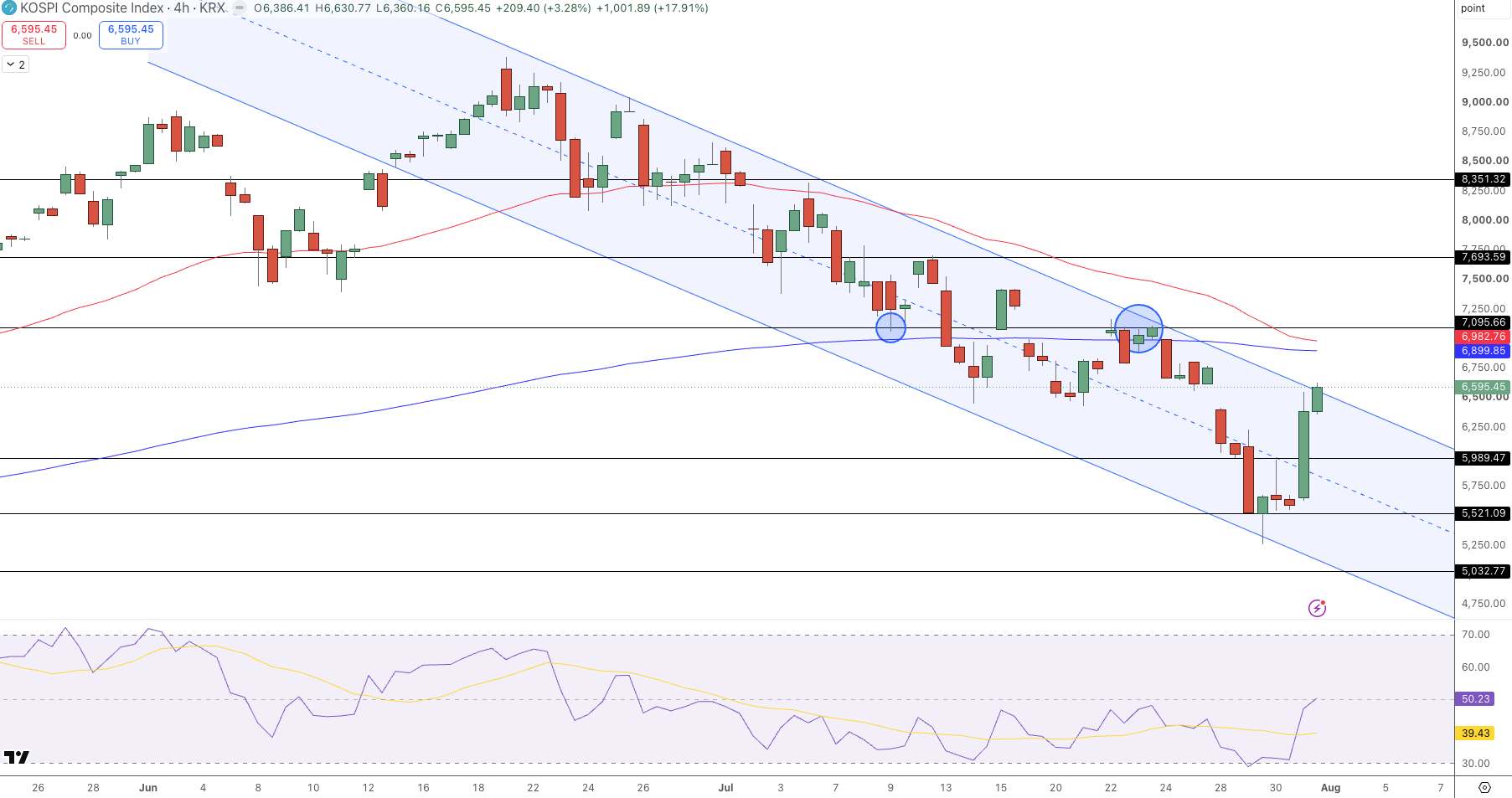
TradingKey - On Friday, July 31, South Korea's KOSPI index reached a record closing height of 6595.45, showing an increase of 1001.89 (17.91%). This increase surpassed the KOSPI’s previous most historic one-day record increase in October 2008 by the Global Financial Crisis. Samsung Electronics shares increased by almost 27%, and SK Hynix shares increased by the daily price limit (30%). Both companies had released strong quarterly results, showing a strong demand for AI memory, which is expected to remain supply constrained until 2027 and beyond. The sudden increase in the KOSPI index reversed three consecutive trading days, in which the KOSPI decreased more than 17%. It also mitigated the KOSPI’s decline in July, which was approximately 22.4%. This was the second most historic decline of the KOSPI, following the October 1997 decline of 27.2%. The KOSPI at 6595 is nearing the resistance of 6983, the 50 day EMA.
What Caused July to be the Second Most Historic Bear Market for the KOSPI?
The KOSPI decreased almost 30% after a 30 day period ending July at 9385, and reaching 5520, the KOSPI entered a bear market. There was a large number of simultaneous selloff triggers. CXMT’s $8.6 billion Shanghai IPO increased by an astonishing 466%, postulating a fear for competition in DRAM in China; Apple was reported to have asked for exemptions to buy Chinese memory; Nvidia droped 5% on concerns of circular financing, and poor post earnings guidance for Alphabet and Meta caused a reshuffle in AI capex.
Most importantly, South Korea's semiconductor fundamentals stayed strong. Samsung reported record Q2 operating income, while SK Hynix expected shortages in memory through 2027. June saw the first positive increase in annual exports in a year, hitting a record $102.25 billion with a 199.5% annual increase in semiconductor exports to $44.8 billion. The historic 17.91% increase in the KOSDAQ on Thursday showed the greater weakness in sentiment and concepts for July, rather than the fundamentals.
Catalysts for the July 31 Spike
First, there was the 37% growth of AWS in Amazon's Q2 2026 results, and 2026 demand combined with Amazon's annual capex of $220 billion was the first indicator of a strong case against the fear of peak AI spending. Second, there was the earlier guidance on results of Samsung and SK Hynix, which gained market relevance after the demand indication from Amazon. Third, foreign investors broke the selling trend for July with net purchases of over 7 trillion won, catching up to the KOSDAQ gain of 17.91%.
The Semiconductor Foundation Beneath the Volatility
As of 2026, Samsung Electronics and SK Hynix combined represent over 50% of KOSPI and more than 60% of the operating and net income of listed companies. For international investors, this concentration offers the opportunity for greater exposure to the global AI memory trade than the SOX semiconductor ETF, greater liquidity than individual stocks, and exposure to memory cycle volatility.
Enduring supply limitations fortify this structural component. High-bandwidth memory and advanced server DRAM have long lead times, and greenfield DRAM fabs take three to five years from breaking ground to volume production. This gives competitors like CXMT little opportunity to disrupt technology leads of Samsung and SK Hynix. Government capacity initiatives create a policy floor; the historically observed "Korea Discount" governance compression phenomenon results in KOSPI forward P/E ratios being lower than global peers, despite robust growth in earnings.
KOSPI Technical Setup After the Historic Move
Closing on the chart at 6,595.45, the KOSPI rebounded from the lower channel at 5,520. Surging 17.91%, this movement is much larger than the noted 3% on the chart. The index broke the 5,989 support and the lower channel. The 50 and 100 EMAs at 6,983 and 6,900 represent the immediate resistance.
KOSPI Price Chart - Source: Tradingview
To confirm the shift of the KOSPI to a positive trend, the 50 and 100 EMAs would need to be aligned along horizontal resistance, along the upper boundary of the descending channel at 7,100. KOSPI would then be expected to hit 7,694 and 8,351.
The RSI has risen sharply from the oversold zone to above the neutral 50 level. The next support level above 5,989 is at 5,521. The next support level below that is 5,033.
Key Levels
- July 31: 6,595.45 (Record Single Day KOSPI Increase 17.91%, +1,001.89 points)
- July Context: Down 22.4% (2nd Largest Monthly Decline) From Highest 9,385 to Lowest 5,520 (-41%)
- Samsung: +27%, Record Q2 Operational Profit July 31
- SK Hynix: +30% (Daily Limit) Strong profit growth YoY, and Multi-Year Supply Agreements
- June: South Korean Exports Up 70.9% YoY to $102.25B, with Semiconductors Up 199.5% YoY to $44.8B
- Foreign Flow: KOSPI estimated 7 trillion+ won net buys (one of the largest single day buys)
- Resistance: 6,983 (50 EMA), 7,100 (Trigger), 7,694, 8,351
- Support: 5,989, 5,521, 5,033
Why Did the KOSPI Fall 30% From Its Peak Before Rebounding?
The KOSPI fell roughly 30% (June peak 9,385 to July bottom 5,520) due to four overlapping factors: long-term KOSPI concerns due to Chinese DRAM competition with CXMT that just opened in Shanghai, demand-side concerns with Apple showing interest in Chinese memory suppliers, NVIDIA financing circular selling with global AI infrastructure undermining confidence, and a carry trade with lowered tech premiums after a capex repricing post-earnings for Alphabet and Meta. As Samsung and SK Hynix both had strong earnings results, this correction was not due to a lack of fundamentals but was due to sentiment and positioning.
What Does the KOSPI's Move Tell Us About AI Memory Demand?
A 17.91% oneday recovery indicates the AI memory market's supply and demand were misjudged by the market. Amazon's CEO confirmed that AWS cannot accommodate the demand for 2026 even with a capital expenditure of 220 billion and good visibility for 2028. This supports the South Korean producers' earnings, and the South Korean semiconductor exports in June were 44.8 billion dollars, a 199.5% annual increase. The KOSPI, at 6,595, and still 30% below the peak in June, is due to concerns about Chinese competition and the sustainability of the capital expenditure. The concerns are well founded but the demand for AI memory is still there.
Bottom Line
In a historic day for the KOSPI, with the Samsung stock up 27%, and the SK Hynix stock hitting the upper 30% daily limit, the KOSPI closed at 6,595.45 (+17.91%) after Amazon clarified that the demand for AI infrastructure is undersupplied and will remain so through 2027 and beyond.
The KOSPI, in July, had a 22.4% decline, the second largest monthly decline, due to the CXMT IPO, a declining interest in Apple using Chinese suppliers, and a decline of AI capital expenditure, not due to a decline in the South Korean semiconductor earnings which have increased to a record high of 44.8 billion due to a 199.5% growth in June.
The 50 EMA at 6,983 and the 7,100 resistance will determine if the historic move is a beginning of a recovery and not just a relief rally during a structural correction, from 6,595 which has been a certified supportive zone. Foreign traders were net buyers at 7 trillion won on the previous day.
Recommended Articles


