


SK Hynix Hits Daily Limit, Samsung Rises Over 26%; Have South Korean Stocks Really Recovered Lost Ground?
TradingKey - In the Asia-Pacific session on July 31, South Korea's KOSPI Index closed up 17.91% at 6,595.45 points, marking its largest single-day gain in history. SK Hynix closed up 29.95% at 1.718 million Korean won (approximately $1,240), hitting its daily limit; Samsung Electronics rose 26.81% to close at 262,500 Korean won.
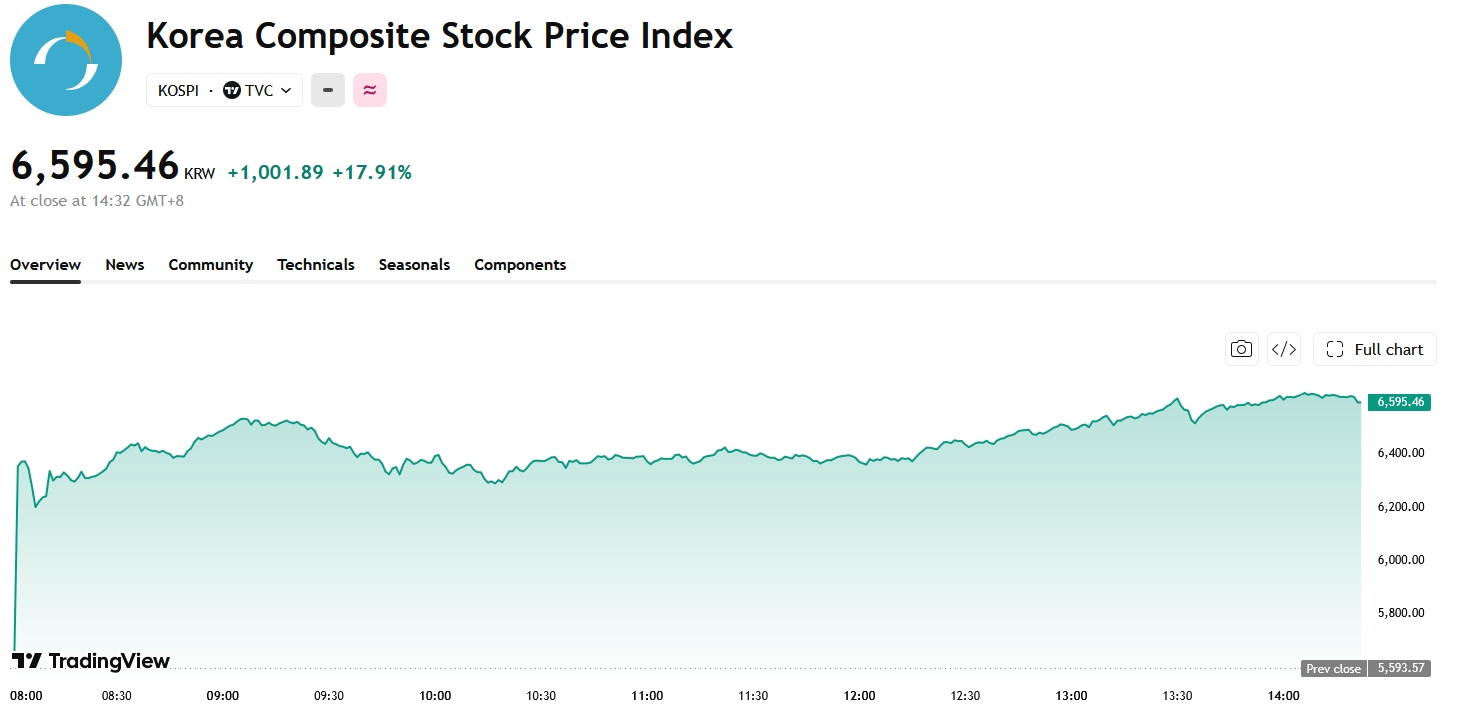
[Source: TradingView]
And just three days ago, this market was still in a downward spiral. From July 28 to 30, the KOSPI Index shed 17% in three days, falling from above 6,700 points to around the 5,500-point level.
The direct impetus for this rebound came from overnight US stocks. Microsoft ( MSFT )'s earnings beat expectations, reigniting market confidence in the long-term investment prospects of AI. The memory chip sector erupted across the board, with SanDisk ( SNDK) rising about 26% and Micron ( MU) gaining over 18%.
Another signal came from South Korea itself. SK Group Chairman Chey Tae-won bought 3,620 shares of SK Hynix under his own name for the first time on July 30, spending approximately 4.79 billion Korean won (equivalent to about $3.3463 million). The market generally interpreted this as a strong endorsement of the company's long-term value by its leader.
Why Is South Korea’s Stock Market So Volatile?
The core reason lies in the leverage structure of retail investors. CSC Financial summarized this as a "triple nesting": off-exchange credit loans entering the market, on-exchange broker margin financing adding leverage, and concentrated buying of 2x or 3x leveraged long ETFs. With these three layers superimposed, passive selling pressure is transmitted layer by layer when stock prices fall.
The 16 leveraged ETFs launched at the end of May this year had an initial scale of only 5 trillion won on their first day, ballooning to 16 trillion won by the end of June. Their trading volume once accounted for over 70% of the total turnover of South Korean equities, with holdings highly concentrated in Samsung and SK Hynix.
As July began and stock prices fell continuously, the combined positions of four major leveraged ETFs swung from a profit of 2 trillion won to a net loss of 6 trillion won during the first 15 days of the month. Amid the plunge toward the end of July, more than 1.2 million leveraged accounts hit margin call thresholds, and approximately 320,000 to 460,000 accounts were forced into liquidation.
The daily rebalancing mechanism of leveraged ETFs acts as an amplifier: buying during uptrends and selling during downtrends, executed mechanically. According to Bloomberg estimates, on July 13 when SK Hynix plummeted 15%, related leveraged ETFs were forced to dump about $5 billion, accounting for 18% of the stock's turnover that day.
The surge on July 31 was a reverse replay of the same mechanism. Overnight, US AI hardware stocks staged a broad rally, forcing short sellers of South Korean tech stocks to cover their positions. The buying pushed stock prices higher, in turn forcing more shorts to cover, triggering a short squeeze.
Thus, over the four trading days from July 28 to 31, the role of leverage in amplifying both gains and losses was vividly demonstrated in the sharp drops and surges of these four trading days.
South Korean regulators have taken action on multiple fronts targeting leverage structures. According to a Bloomberg report on July 30, authorities are weighing more aggressive market-stabilization plans, including activating the national market-stabilization fund, implementing a short-selling ban, and restricting leveraged ETFs. South Korea's Ministry of Economy and Finance has convened an emergency meeting, announcing it will maintain the highest market alert level and launch 24-hour interagency monitoring.
Have South Korean Stocks Recovered Lost Ground After Massive Rebound?
Looking back at this round of volatility, the KOSPI Index was still above 6,700 points at the close on July 27. After a consecutive three-day sell-off, it closed at 5,593 points on July 30. On July 31, it rebounded to 6,595 points, but still failed to recoup its losses, leaving a gap of about 100 points from the start of the week, and remaining far below its all-time high of 9,385 points.
The same is true at the individual stock level. Even though SK Hynix hit its daily limit-up, its stock price remains below last week's high, and is still about 42% away from its 52-week high of 2.987 million won. Although paper losses have narrowed significantly, there is still a clear distance to go before breaking even.
On the surface, the direction of the South Korean stock market depends on foreign capital and exchange rates, but fundamentally, it is determined by two more core variables.
The first variable is the strength of AI sentiment in US stocks. If US stocks experience a correction tonight, sentiment in the Asia-Pacific markets next week is highly likely to cool down rapidly. South Korean tech stocks are essentially a strong reflection of the US AI theme; capital expenditure guidance from giants like Microsoft, Google ( GOOGL ), Amazon ( AMZN) and other giants has an influence on the KOSPI Index that is even greater than that of South Korea's domestic policies.
The second variable is the sustainability of profitability for Samsung Electronics and SK Hynix. While their second-quarter earnings reports were impressive enough, the market's true focus has shifted to guidance for the third and fourth quarters.
Under this expectation, institutions have begun to reassess valuations. Daiwa Securities recently lowered its target price for SK Hynix from 3.6 million won to 3 million won; although this has not changed its core bullish thesis, it has lowered the valuation anchor.
Meanwhile, Goldman Sachs ( GS) estimates that DRAM prices will maintain double-digit growth this year, and that HBM still has significant room for price increases next year; however, if these expectations fail to materialize, the semiconductor sector's valuation will face further contraction.
Foreign capital is the key link connecting these two variables. Over the past three weeks, foreign capital has seen continuous net selling in the South Korean stock market, with its heaviest holdings coincidentally concentrated in Samsung and SK Hynix. Whether the sharp rebound on July 31 can attract foreign capital inflows ultimately depends on whether the US stock AI theme can persist, and whether the performance of South Korean semiconductor leaders can continue to beat expectations.
A rebound is not equal to a trend reversal. To what extent leverage has been cleared still lacks a precise quantitative measure. How much of the capital that chased the rally on July 31 was re-leveraged? If the leverage ratio rebounds quickly, then when the next round of volatility arrives, this mechanism is highly likely to be triggered again. The next few trading days will provide the basis for judgment on whether this is the starting point of a reversal or just a recovery after a sharp drop.
Recommended Articles


