


Kioxia Quarterly Profit Surges Even as Revenue Misses Estimates; Memory Chips to Support Second-Quarter Growth
TradingKey - Japanese NAND flash memory manufacturer Kioxia announced its first-quarter fiscal 2026 financial results on Friday. Driven by demand from AI data centers, the company's profit grew significantly, though it fell slightly short of the market expectation of 1.37 trillion yen. Additionally, its second-quarter profit guidance projects an operating profit of 1.89 trillion yen, below the Bloomberg consensus estimate of 1.95 trillion yen. However, the company expects NAND flash prices to continue rising in the second fiscal quarter, indicating that the memory industry's upcycle is expected to extend into the third quarter.
According to the earnings report, for the first fiscal quarter ended late June, Kioxia generated revenue of 1.77 trillion yen (approximately $11.06 billion), representing a year-on-year increase of more than fourfold, though slightly below the market expectation of about 1.84 trillion yen. Operating profit reached 1.27 trillion yen, up significantly from the same period last year, while net profit rose to 842.2 billion yen. The earnings performance far exceeded that of the same period last year, reflecting that rising NAND prices and the continuous release of AI server demand have provided clear support for the company's financial results.
For the next quarter, Kioxia expects revenue to further increase to 2.39 trillion yen, with operating profit reaching 1.89 trillion yen. Although this profit guidance is slightly below market expectations, the company expects the average selling price of NAND flash to continue rising in the second fiscal quarter. It also pointed out that major cloud computing providers continue to expand AI data centers and that demand for enterprise SSDs remains strong, which will continue to improve its product mix and profitability.
Kioxia stated that the global NAND market remains in a tight supply-demand state. On one hand, demand for high-capacity enterprise SSDs for AI training and inference continues to grow. On the other hand, major memory manufacturers have continued to control capital expenditures over the past two years, leading to a limited release of new capacity and keeping industry inventories at low levels. The company expects that, against the backdrop of expanding AI server demand and disciplined supply growth, NAND prices are poised to continue rising in the second fiscal quarter, providing support for third-quarter performance.
Institutions remain optimistic about Kioxia's outlook. Nomura previously raised the company's target price to 126,000 yen and maintained its "Buy" rating, believing that AI-driven enterprise storage demand remains in a rapid growth phase and that NAND price increases are expected to continue exceeding previous expectations. The market also generally believes that if global cloud service providers continue to expand their AI capital expenditures, the memory chip industry's upcycle is expected to extend into the second half of 2026.
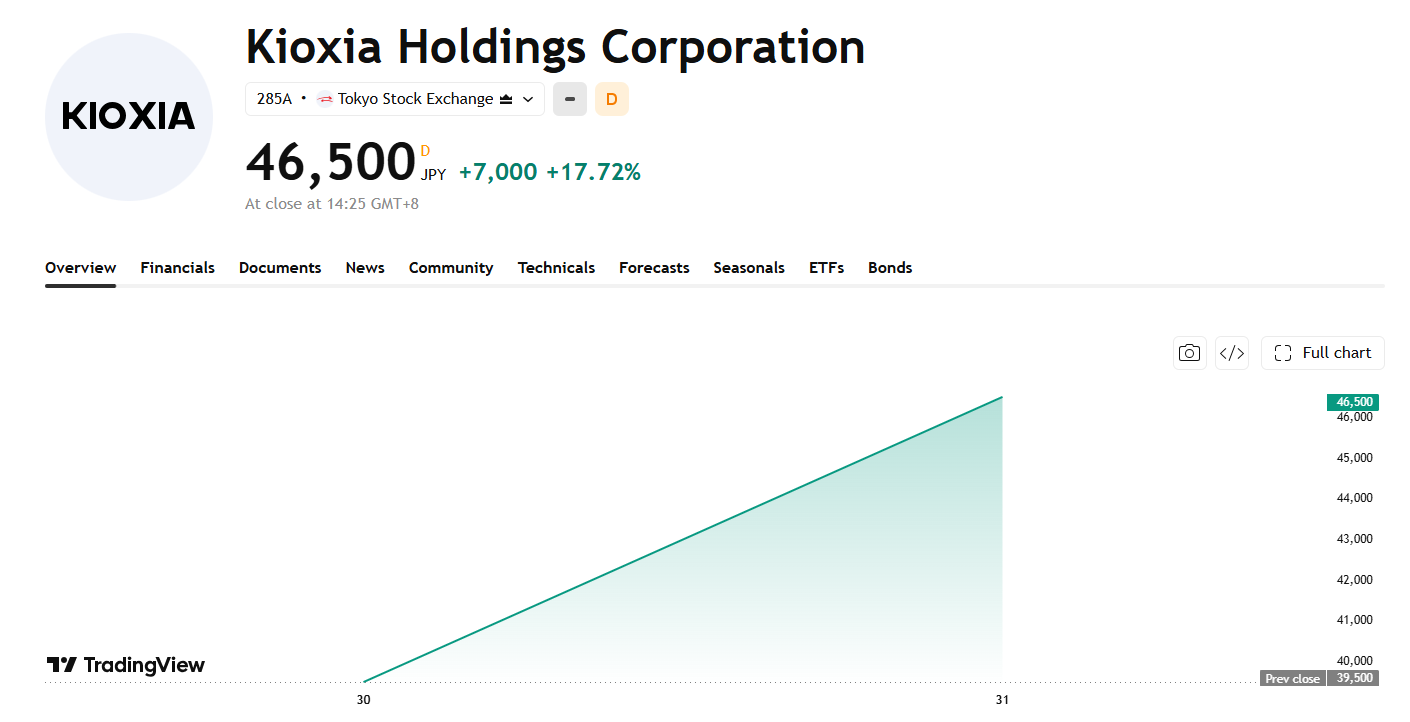
Kioxia stock price chart, Source: TradingView
In terms of share price, Kioxia's stock price had already been driven by the rally in the global memory chip sector prior to the earnings release. It hit the daily limit during intraday trading on July 31 and eventually closed up 17.72% at 46,500 yen. Analysts believe that if NAND prices continue to rise and deliver on the company's earnings guidance, Kioxia's share price is expected to receive further support.
Recommended Articles


