


Samsung Electronics Q2 Profit Surges 18-Fold as Shares Jump Over 7% Amid 2027 Supply Warning
TradingKey - During the Asia-Pacific session on July 30, Samsung Electronics disclosed its Q2 2026 earnings report and held an earnings conference call. Operating profit for the quarter reached 89.49 trillion won (approximately $62 billion), up 1,813.8% year-over-year, breaking records for the third consecutive quarter, and placing Samsung first among global semiconductor manufacturers in terms of quarterly profitability.
Boosted by the earnings results, Samsung Electronics shares jumped over 7% at one point. As of press time, the stock was trading at 216,500 won, up 3.72%.
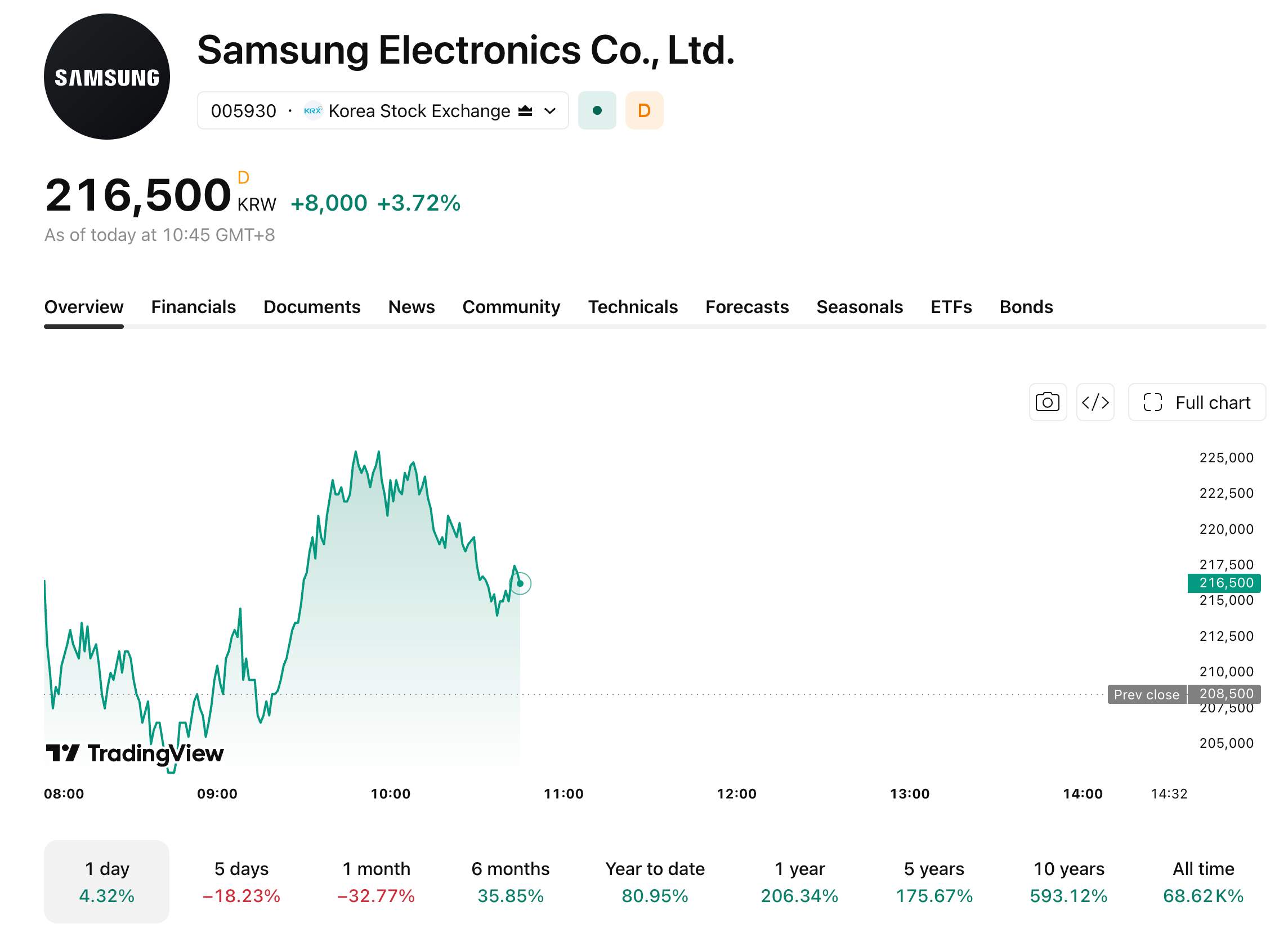
[Source: TradingView]
Beyond the profit figures, the market is focusing more on several key assessments made by management during the conference call regarding the supply-demand outlook.
In the HBM field, Samsung demonstrated key progress in technological generational transitions. On May 29, Samsung delivered samples of the industry's first 12-layer HBM4E chip to major global customers. The product adopts Samsung's sixth-generation 10nm-class DRAM process (1c) paired with its own 4nm logic base die, featuring a pin transfer speed of up to 16Gbps, a performance boost of over 20% compared to HBM4, a single-stack bandwidth of 3.6TB/s, and a capacity increase to 48GB.
Meanwhile, Samsung took the lead in achieving mass production and commercial shipment of HBM4 in February 2026. During the latest earnings call, Samsung projected that Q3 revenue for HBM4 would increase more than threefold quarter-on-quarter, and that HBM4 would account for 60% of total HBM revenue in the second half of the year.
Previously, in the HBM3E generation, Samsung fell behind SK Hynix ( SKHY) after failing to pass Nvidia's quality validation, missing out on the early dividends of top-tier AI clients. This time, the combination of leading the mass production of HBM4 and being the first to sample HBM4E reflects that Samsung's competitiveness in the HBM space is returning.
On the supply and demand front, Samsung expects server demand in its memory business to accelerate this year. Judging solely from the orders already received for 2027, the supply-demand gap will widen further compared to 2026. Q2 DRAM shipment volume grew by a low-double-digit percentage compared to Q1, while Q3 DRAM bit growth is projected to reach a mid-single-digit level.
In terms of capital expenditure, the semiconductor division spent 15.4 trillion won during the quarter, continuing to grow year-over-year. This trend aligns with industry analyses pointing toward an intensifying supply shortage in 2027.
For the foundry business, Samsung provided clear guidance: double-digit revenue growth for the full year and a significant improvement in profitability. The company has secured a 2nm high-performance computing order from a major US client (supply chain sources point to Tesla ( TSLA )'s AI5 chip), and expects to mass-produce second-generation 2nm mobile chips in the second half of 2026. The landing of these orders signifies that the foundry business is starting to make material revenue contributions.
In addition, regarding on-device AI, Samsung estimates that the popularization of "agentic AI" in PCs and smartphones in the second half of the year will drive demand for high-end memory products.
The rising stock price indicates that the market has responded positively to the progress of HBM4 and the foundry orders. However, whether the incremental costs of HBM4 can be absorbed through pricing and whether large-scale capacity expansion will depress prices after 2028 remain key variables in determining the cyclical turning point.
Recommended Articles


