


Why SK Hynix Shares Tumbled 11% After Q2 Profit Surged 557% to Record High
TradingKey - Despite delivering its most profitable quarter in history, SK Hynix ( SKHY) still failed to meet the capital market's increasingly high expectations.
On July 29, SK Hynix announced its second-quarter results for 2026. Driven by the continuous growth in demand for AI servers, the company's revenue reached 79.32 trillion Korean won (approximately $54.65 billion), representing a year-on-year increase of 257%, while its operating profit surged 557% year-on-year to 60.54 trillion Korean won, with both metrics setting new historical records.
However, this report card was still slightly below market expectations; analysts on average had previously estimated the company's revenue to be around 84 trillion Korean won and operating profit to be around 64 trillion Korean won.
Following the earnings release, SK Hynix's ADRs fell as much as 9% in after-hours trading. Although its domestic shares in South Korea opened about 3% higher, the gains quickly narrowed, and they briefly fell over 11% at one point during intraday trading. Since hitting a period high in June, the company's stock price has retreated more than 46% cumulatively, with over $500 billion in market value evaporated.
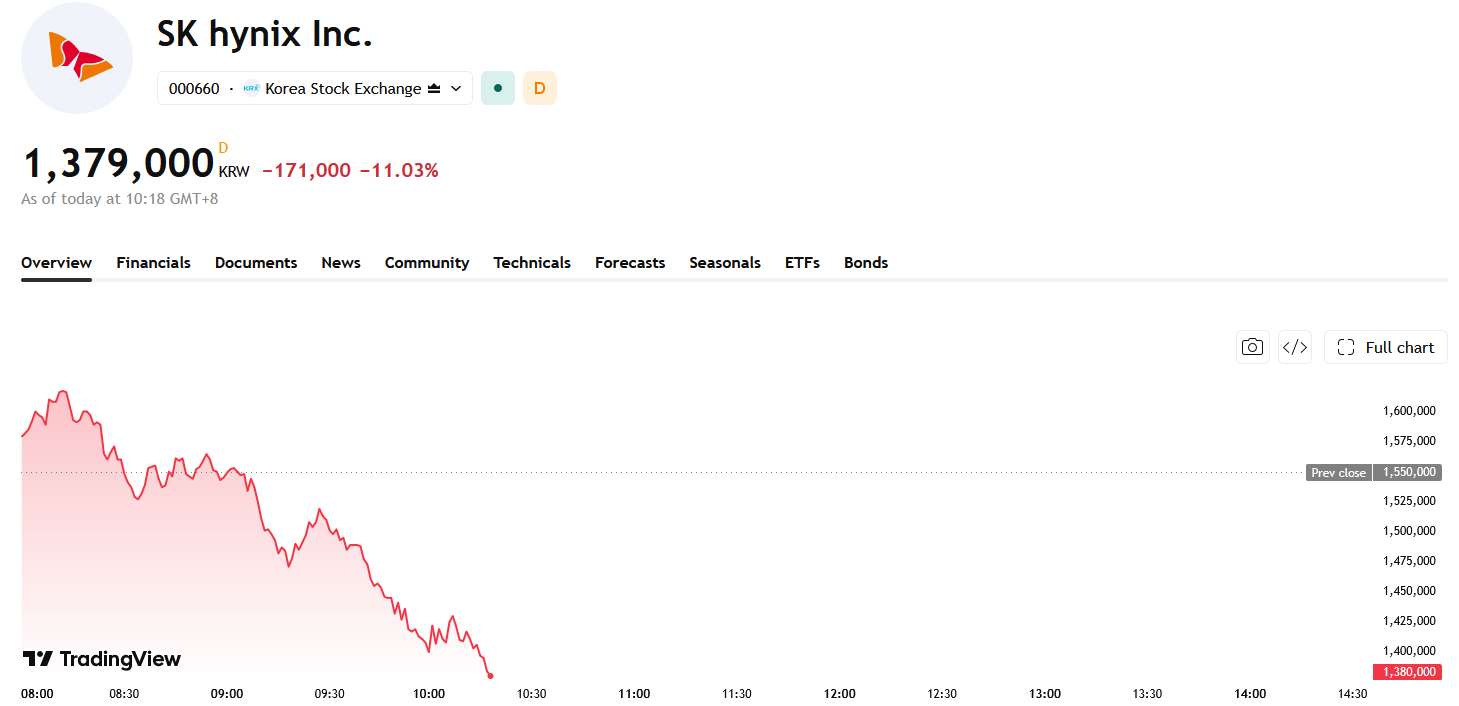
Source: TradingView
SK Hynix Hits Record Profit: Why Is the Market Hard to Satisfy?
In terms of operating performance, SK Hynix remains in a high-prosperity phase of the current AI memory cycle.
In the second quarter, the company's operating margin reached 76.3%, a further increase from the previous quarter, while its gross margin also rose to approximately 83%, both sitting at historical highs. Continued robust demand for HBM, high-performance DRAM, and enterprise SSDs from AI servers pushed product prices to remain high, driving the company's profitability far beyond that of traditional memory cycles.
Net profit reached 93.92 trillion won, representing a year-on-year increase of over 12 times. However, this figure included a one-time investment gain from the sale of a partial stake in Japanese memory maker Kioxia, making its sustainability relatively limited compared to operating profit.
What truly disappointed the market was not the financial results themselves, but the fact that the growth rate has begun to show signs of slowing.
On one hand, HBM accounts for a relatively high proportion of SK Hynix's product mix, while the rapid increase in profits during this round benefited more from the price rise of traditional DRAM. Since long-term orders account for a high proportion of HBM sales, its price adjustment pace has been relatively stable, meaning the company failed to fully capture the gains from the rapid rise in spot market prices like some of its peers.
On the other hand, although memory prices continued to rise, the rate of increase has slowed down significantly. The company disclosed that the average selling price (ASP) of DRAM rose by approximately 30% quarter-on-quarter in the second quarter, while NAND prices rose by about 50% to 55%, both lower than the roughly 60% and 70% increases in the first quarter. This indicates that this round of price hikes is gradually returning to a normal pace.
Furthermore, long-term supply agreements (LTAs) have also limited profit elasticity. According to the company, it has signed long-term supply agreements with approximately 10 major customers, and the industry expects that such long-term orders account for about half of its total sales. While long-term agreements improve revenue predictability, they also mean that the company cannot fully capture the excess profits generated by rapidly rising spot prices.
HBM4 Enters Mass Production Phase
Although its near-term performance was slightly below market expectations, SK Hynix remains optimistic about AI memory demand.
The company stated that HBM4 products started mass production shipments in the second quarter, and the supply scale will be further expanded in the second half of the year. Meanwhile, samples of the next-generation HBM4E have also been delivered to major customers, and it will enter the market in the future using a process that balances technological maturity and mass production stability.
As Nvidia's next-generation AI platform gradually enters the mass production phase, the market generally expects HBM4 demand to rise significantly in the second half of the year. As one of Nvidia's most important HBM suppliers, whether SK Hynix can sustain its leading delivery capability will directly affect its future market share and earnings performance.
In addition to HBM, the company's NAND business is also upgrading simultaneously. SK Hynix stated that 321-layer NAND has now become its highest-volume product, with plans for it to account for about half of its domestic capacity in South Korea by the end of this year. Meanwhile, demand for enterprise SSDs continues to benefit from AI data center construction, further improving the NAND product mix.
Compared to the past, when demand was primarily driven by smartphone and PC replacement cycles, this upswing in the memory industry is driven more by AI server construction. HBM, server DRAM, and enterprise SSDs are all benefiting from the expansion of AI infrastructure, making this round of supply-demand dynamics more structural in nature than in the past.
Cash Flow Is Plentiful, But Capital Expenditures Will Continue to Rise
Record profits also further improved SK Hynix's financial position. As of the end of the second quarter, the company's cash and cash equivalents reached 88 trillion KRW, an increase of 33.6 trillion KRW from the previous quarter; while total debt decreased to 18.6 trillion KRW, expanding its net cash position to 69.4 trillion KRW, with financial flexibility significantly enhanced.
However, the sustained strong demand for AI also means the company still needs to invest more capital to expand production capacity.
Management expects that capital expenditures this year will be at the high end of the 40 trillion KRW range, close to 50 trillion KRW, exceeding the previous year's level. The company is advancing mass production at the M15X factory and plans to start the Phase 1 cleanroom of the Yongin Semiconductor Cluster in early 2027, while continuing to construct projects such as the P&T7 advanced packaging facility and the M17 NAND production base, positioning itself in advance for HBM and advanced memory demand over the next few years.
For the market, this also means a new test is approaching. If AI demand continues to maintain high growth, large-scale capacity expansion is expected to further consolidate its industry-leading position. However, if industry supply grows faster than demand in the future, high capital expenditures and new depreciation could also put pressure on profit margins.
Recommended Articles


