


Solana Processes Record 169.9 Million Transactions in a Single Day
Solana processed 169.9 million non-vote transactions on a single day this week on August 4 according to data from Blockworks. This is the most number of transactions on a single day the network has ever seen. Non-vote transactions filter out the messages validators send each other to agree on blocks, hence this number shows actual user and application activity rather than consensus overhead.
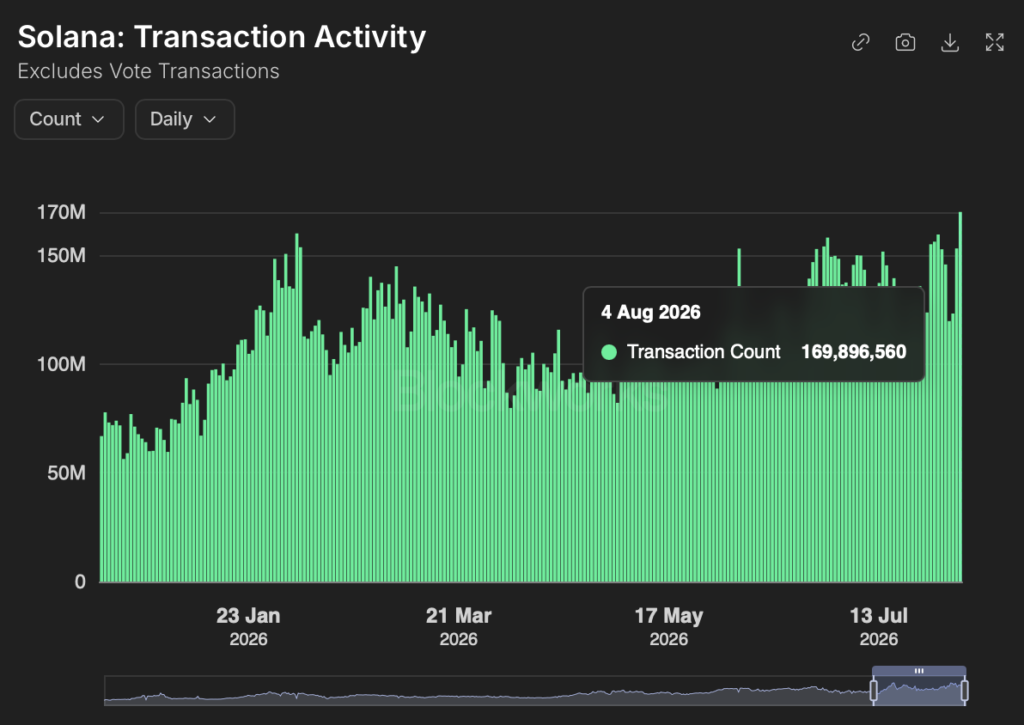
Source: Blockworks
From a weekly timeframe, transaction count has surpassed the highs set in early February and up around 55% since the lows of this year in April.
A 66% Capacity Increase That Filled in Six Days
On July 29, Solana activated a network upgrade called SIMD-0286 at the start of a new epoch, the roughly two-day cycle Solana uses to rotate validator duties. The upgrade increased the maximum compute limit in a block from 60 million to 100 million compute units or a 66% increase. Compute units essentially measure processing work, so a higher limit can accommodate more transactions per block.
Written by Jito Labs engineer Lucas Bruder, this upgrade is the largest expansion in throughput that Solana has shipped since its inception. Block times remained at 400 milliseconds and speed wasn’t compromised with this upgrade, which was only possible after XDP kernel-bypass networking, a method that lets validators move data faster by skipping parts of the operating system, cleared 70% of staked SOL.
The 60 Million Cap Was Being Tested by Real Traffic
Data from the Solana Foundation shows that 11.2% of blocks were hitting 56 million compute units or higher under the previous 60 million limit. The limit was put to the test during volatile periods, exactly when traders need their orders to land. In this sense, the blockspace was not sitting empty waiting for users to arrive. Demand was getting squeezed out.
Most of the New Flow Is Trading Machinery
Market makers running proprietary AMMs update their quotes onchain constantly, and Blockworks Research put that flow at roughly 20% of all Solana transactions as of late 2025. Arbitrage and order-book maintenance sit on top of it. This kind of traffic expands to fill whatever blockspace exists, because that is how liquidity provision works on a venue with 400ms blocks and sub-cent fees. It is also the traffic that keeps spreads tight for everyone else.
The payments side showed up the same day. Western Union’s Stablecard went live August 4 on Solana rails through Rain, covering 37 markets and running on the USDPT stablecoin. Circulation is still near 7.4 million tokens, small enough that it is not moving the transaction count yet. But the reason Western Union picked Solana is the same reason the record was possible, and the headroom now exists for that flow to land at scale.
Record Throughput, Weakest Fees Since 2023
The caveat sits in the revenue line. Q2 network fees came in at $51 million, Solana’s weakest quarter since Q3 2023, and DEX volumes are at their lowest since September 2024. Transaction counts are printing records while the money attached to them shrinks.
The mix has changed. Memecoin speculation paid well on a per-transaction basis. Market-maker requoting and stablecoin payments do not. That is healthier as infrastructure and thinner as a business, and it is a genuine tension rather than a footnote.
Alpenglow and 200 millisecond slots come next. Solana is building for throughput it has not hit yet.
Don’t just read crypto news. Understand it. Subscribe to our newsletter. It's free.
Recommended Articles


