


US presses Mexico for tighter AI server sourcing rules under USMCA
As per a Wall Street Journal report, Washington is pushing Mexico for stricter rules of origin for AI servers and related equipment. The proposition would restrict materials coming from outside of North America for AI hardware produced in Mexico.
USTR has confirmed that talks are underway over broader issues of rules of origin and economic security without particularly mentioning AI servers in its reports.
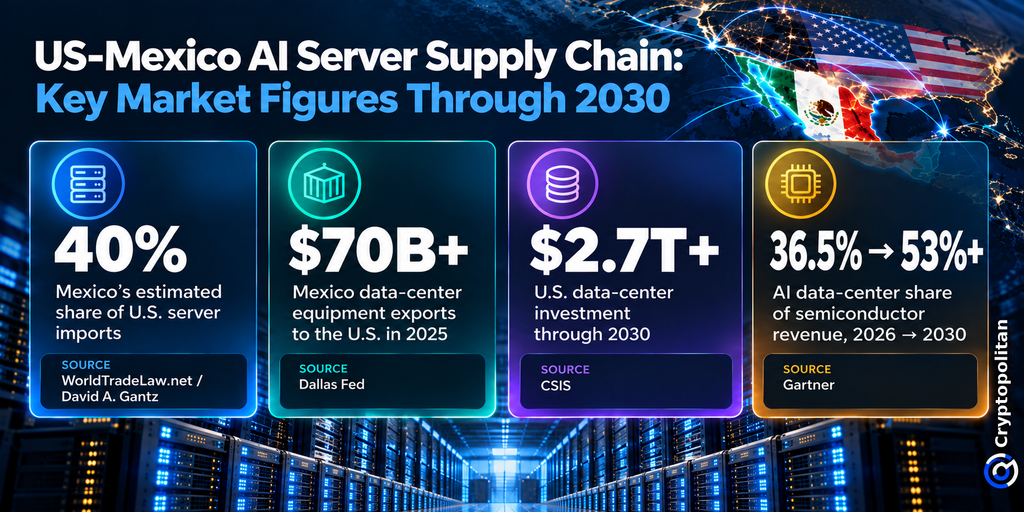
Mexico has turned into a major supplier of servers. According to trade attorney David A. Gantz, Mexico supplies 40% of American server imports that is the second-largest volume of servers after Taiwan. Implementing the new sourcing rules may drastically change prices and supplier strategies far beyond the border.
Where the rules-of-origin fight fits in the USMCA talks
American and Mexican officials have gathered in Mexico City in July for a third round of talks pertaining to the assessment of the United States-Mexico-Canada Agreement (USMCA), including economic security and trade matters. Furthermore, USTR indicated that Mexico has revised its dual-use export controls to be more compliant with the regulations in the US.
At the core of Washington’s stance is the belief that the advantages stemming from the USMCA should exclusively apply to the goods made in North America. U.S. Trade Representative Jamieson Greer expressed the assessment’s purpose in the following way:
“closes any loopholes that would allow free-riding by non-Parties.” — U.S. Trade Representative Jamieson Greer
This issue directly relates to the reported AI-server proposal. By insisting on a bigger share of regional content, it would mean that devices manufactured in Mexico predominantly from non-North American parts would find it more difficult to be designated for the same trade benefits, although these devices do not currently have specific regional value content requirements under the agreements made in the USMCA, Gantz says.
Why Ciudad Juárez became the choke point
Due to Taiwanese manufacturers, northern Mexico has turned into a key base for AI servers. Foxconn and other suppliers expanded as US tech companies urged them to produce more nearer to home. Pegatron reportedly has five assembly plants in Ciudad Juárez.
Mexico’s exports of data-center equipment to the US, a significant portion produced by Taiwan-based firms, exceeded $70 billion in 2025, according to the Dallas Fed. Exports of automatic data processing hardware were more than $85 billion, including servers, motherboards, and other data-center components.
It is because of that remarkable growth that Dallas Fed economist Brendan Kelly refers to the shift as more than a relocation of the assembly line but rather:
An initial success case of nearshoring a critical supply chain back to North America.
— Dallas Fed economist Brendan Kelly
However, nearshoring is not entirely done as most high-value content still comes from abroad. In its report, the OECD notes that the semiconductor industry in Mexico is mainly focused on design as well as back-end activities such as assembly, testing and packaging instead of front-end fabrication.
The cost problem tighter sourcing could create
More regional sourcing options may give a boost to North American development, but a rapid transition could cause an increase in costs until local production catches up.
CSIS estimates the investments in new data centers in the U.S. will reach $2.7 trillion until 2030, semiconductors alone will utilize approximately 54 cents of each dollar. The most radical model predicts that 100% tariffs imposed on all semiconductors and products based on semiconductors could contribute an increase of nearly $1.4 trillion.
Gartner said global semiconductor revenues will account for $1.56 trillion in 2026 and that data centers will rise from 36.5% of total revenue in the current year to more than 53% by 2030. Ben Lee, the analyst from Gartner, directly tied the surge in AI data centers with the way spending is financed across the semiconductor industry, saying:
As AI infrastructure scales, it is … reshaping investment across the semiconductor ecosystem.
— Gartner analyst Ben Lee
This is what makes the changes in the supply chain very important: new sourcing regulations appear along with growing demand for semiconductors due to growth in AI demand.
The rival-ecosystem risk Washington keeps courting
According to CSIS, the chip restrictions imposed by the US and its allies since 2022 have sped up Chinese localization efforts in chip production. Likewise, Brookings has also stated that the limitation of access to US chips may motivate countries to develop computing systems not based on US technology.
This, however, does not mean that stricter USMCA content rules will have similar impacts. However, this illustrates the trade-off involved: on the one hand, stricter regional sourcing could lead to improved supply-chain security and, on the other, overly strict requirements could lead to higher expenses and alternative supply chains.
From chip exports to the routes around them
The proposal also fits a wider U.S. effort to close indirect routes to restricted AI computing. BIS guidance issued in May clarified that licensing rules can follow certain restricted entities even when they operate outside designated countries.
Cryptopolitan reported in August that BIS is also drafting a rule that could stop Chinese firms from renting U.S. AI chips through foreign data centers, a channel current controls do not cover. Rules of origin for AI servers would add another lever aimed at the supply chain itself. The next question is whether Washington and Mexico can set thresholds that strengthen North American production without disrupting the AI-server boom.
Don’t just read crypto news. Understand it. Subscribe to our newsletter. It's free.
บทความแนะนำ


