

Gold hits six-week high on risk-off mood and Fed rate cut bets
- Gold climbs to a six-week high as risk-off sentiment boosts safe-haven demand.
- US Dollar weakens toward two-week lows, offering additional support to XAU/USD.
- Technical setup stays bullish after breakout above the symmetrical triangle pattern.
Gold (XAU/USD) kicks off the new month on a firm footing, climbing to its highest level since October 21 on Monday, as risk-off sentiment underpins safe-haven demand, while traders gear up for another interest rate cut by the Federal Reserve (Fed) at its December 9-10 monetary policy meeting.
At the time of writing, XAU/USD is trading around $4,250, putting the metal on track for its best annual performance since 1979. Prices are up nearly 60% so far this year, supported by strong central bank demand, robust ETF inflows, persistent geopolitical tensions and the prospect of lower interest rates in the United States (US).
Investors now turn their attention to key US economic data releases this week, which could influence interest rate cut expectations. Markets are already pricing in around an 87% probability of a 25-basis-point (bps) reduction at next week’s meeting, following dovish-leaning remarks from several policymakers and softer US data last week.
Market movers: Risk-off mood, Fed outlook steer markets
- A dovish Fed outlook continues to weigh on the US Dollar (USD), offering further upside for Gold by making the metal more affordable for overseas buyers. The US Dollar Index (DXY), which measures the Greenback’s value against a basket of six major currencies, is trading around 99.26, hovering near two-week lows.
- Global equities came under pressure on Monday as risk aversion gripped markets at the start of December. In the US, investors turned cautious ahead of key economic data and the December 9-10 Fed meeting. Asian markets, particularly Japan, were weighed down by hawkish comments from the Bank of Japan (BoJ) Governor Kazuo Ueda. In China, the RatingDog General Manufacturing Purchasing Managers Index (PMI) fell to 49.9 in November, its lowest level since July, adding to the cautious tone. Meanwhile, a selloff in cryptocurrencies also contributed to the broader risk-off environment.
- Markets are also watching a possible Fed leadership change after US President Donald Trump said on Sunday, “I know who I am going to pick, yeah. We’ll be announcing it.” Reports indicate Kevin Hassett is the leading candidate to replace Jerome Powell, fuelling expectations of a more dovish policy path given his prior advocacy for interest-rate cuts.
- On the geopolitical front, attention is on Russia-Ukraine peace talks after four-hour negotiations concluded in Florida over the weekend. US and Ukrainian officials described the session as “difficult but productive.” The US negotiator, Steve Witkoff, is expected to travel to Moscow today for follow-up talks and could meet President Vladimir Putin on Tuesday.
- The US economic calendar features the ISM Manufacturing PMI later on Monday, with consensus expecting the index to hold in contraction territory at 48.6 compared with 48.7 in October. In the week ahead, the spotlight shifts to the Personal Consumption Expenditures (PCE) report due on Friday.
Technical analysis: XAU/USD maintains bullish bias after triangle breakout
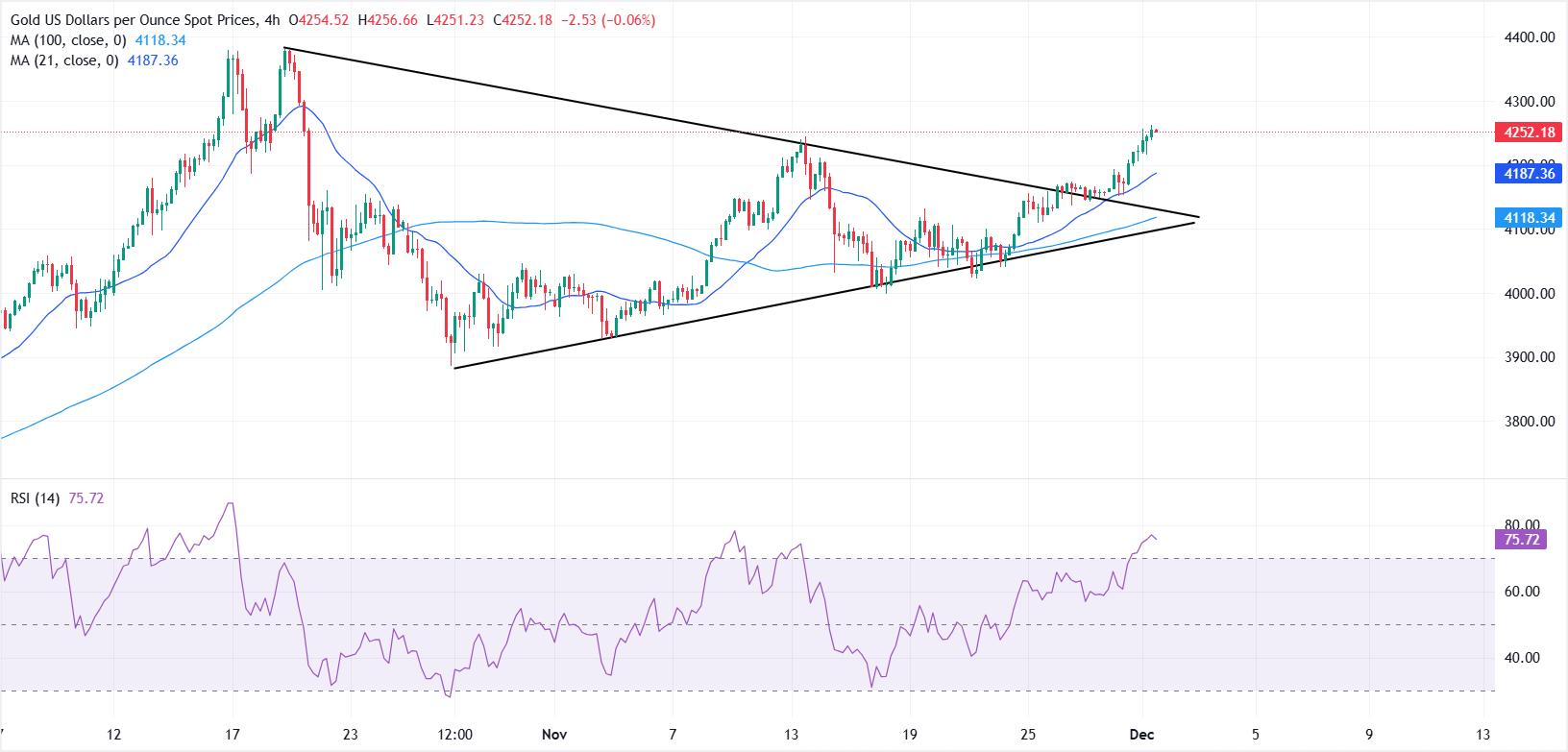
On the 4-hour chart, Gold has confirmed a successful breakout above a well-defined symmetrical triangle pattern, signalling a bullish continuation structure. The breakout shows improving momentum, although follow-through buying remains limited for now as the Relative Strength Index (RSI) holds in overbought territory near 77.
This is keeping prices somewhat capped, with XAU/USD oscillating inside the previous supply zone between $4,250 and $4,270. A clean move above this zone would strengthen bullish conviction and open the door for a retest of the all-time high near $4,381.
On the downside, initial support is aligned at the 21-period Simple Moving Average (SMA) near $4,187, followed by the upper boundary of the broken triangle pattern.
Fed FAQs
Monetary policy in the US is shaped by the Federal Reserve (Fed). The Fed has two mandates: to achieve price stability and foster full employment. Its primary tool to achieve these goals is by adjusting interest rates. When prices are rising too quickly and inflation is above the Fed’s 2% target, it raises interest rates, increasing borrowing costs throughout the economy. This results in a stronger US Dollar (USD) as it makes the US a more attractive place for international investors to park their money. When inflation falls below 2% or the Unemployment Rate is too high, the Fed may lower interest rates to encourage borrowing, which weighs on the Greenback.
The Federal Reserve (Fed) holds eight policy meetings a year, where the Federal Open Market Committee (FOMC) assesses economic conditions and makes monetary policy decisions. The FOMC is attended by twelve Fed officials – the seven members of the Board of Governors, the president of the Federal Reserve Bank of New York, and four of the remaining eleven regional Reserve Bank presidents, who serve one-year terms on a rotating basis.
In extreme situations, the Federal Reserve may resort to a policy named Quantitative Easing (QE). QE is the process by which the Fed substantially increases the flow of credit in a stuck financial system. It is a non-standard policy measure used during crises or when inflation is extremely low. It was the Fed’s weapon of choice during the Great Financial Crisis in 2008. It involves the Fed printing more Dollars and using them to buy high grade bonds from financial institutions. QE usually weakens the US Dollar.
Quantitative tightening (QT) is the reverse process of QE, whereby the Federal Reserve stops buying bonds from financial institutions and does not reinvest the principal from the bonds it holds maturing, to purchase new bonds. It is usually positive for the value of the US Dollar.
추천 기사


