




Mexican Peso rallies as Trump softens tariffs threats
- Mexican Peso gains 0.35%, recovering after Trump's threat of a 25% tariff rattles markets.
- Trump is expected to delay tariffs implementation to March 1, hints at potential exemptions for certain imports.
- Mixed US economic indicators and Fed commentary maintain cautious market sentiment.
The Mexican Peso (MXN) recovered some ground against the US Dollar (USD), rising 0.35% on Friday after posting losses of more than 1% on Thursday on United States (US) President Donald Trump's tariffs rhetoric. At the time of writing, the USD/MXN trades at 20.60 after hitting a daily high of 20.74.
Lately, the main driver of the USD/MXN pair has been US President Trump. On Thursday, he said that 25% tariffs imposed on Mexico would commence on February 1, adding that his decision is justified by the Mexican government's failure to fight drug cartels fentanyl traffic to the US and that his country subsidizes Mexico as the trade deficit grows.
After those remarks, the USD/MXN jumped from around 20.49 to a two-day peak of 20.79 as the market digested Trump's comments. However, Reuters revealed on Friday that Trump has backpedaled as sources said the US would apply new tariffs on Mexico and Canada on March 1. According to Reuters, the White House will announce a process for countries to seek exemptions for certain imports.
Aside from this, the latest US inflation report and the Federal Reserve’s (Fed) preferred inflation gauge, the Core Personal Consumption Expenditures (PCE) Price Index, increased in December as expected, exceeding November’s reading. In the twelve months to December, Core PCE remained unchanged compared to the latest figures.
The data comes after the US GDP report for the last quarter was weaker than expected and following the Fed’s last monetary policy meeting.
Of note, the Fed parade has begun, as Governor Michelle Bowman and Chicago’s Fed President Austan Goolsbee crossed the newswires.
Daily digest market movers: Mexican Peso boosted by Reuters sources article on US tariffs on Mexico
- A Reuters exclusive report revealed that US President Trump is expected to announce new tariffs against Canada and Mexico that will begin March 1.
- “The sources, who asked not to be named because they are not authorized to speak publicly on the matter, said they did not have details on a final tariff rate, but noted Trump has consistently said that he plans to impose a 25% tariff on imports from the two countries on Saturday,” said the Reuters report.
- JP Morgan revealed via Reuters that the Mexican Peso could depreciate 11.8% if the US imposes 25% tariffs on Saturday. The US bank said that the “base case” is for tariffs to be postponed.
- The US Core PCE rose by 2.8% YoY in December as expected. Monthly, the underlying inflation rose 0.2%, up from 0.1%
- Fed Governor Michelle Bowman remained hawkish and supported the US Dollar after saying that inflation risks are tilted to the upside. Although she doesn’t disregard rate cuts, they would be data-dependent and might be gradual.
- Chicago’s Fed President Austan Goolsbee added that he liked December’s inflation report and is comfortable that inflation is on the path to the 2% target.
- Money market futures expect the Fed to cut interest rates by 50 bps in 2025, with traders expecting the first move in June.
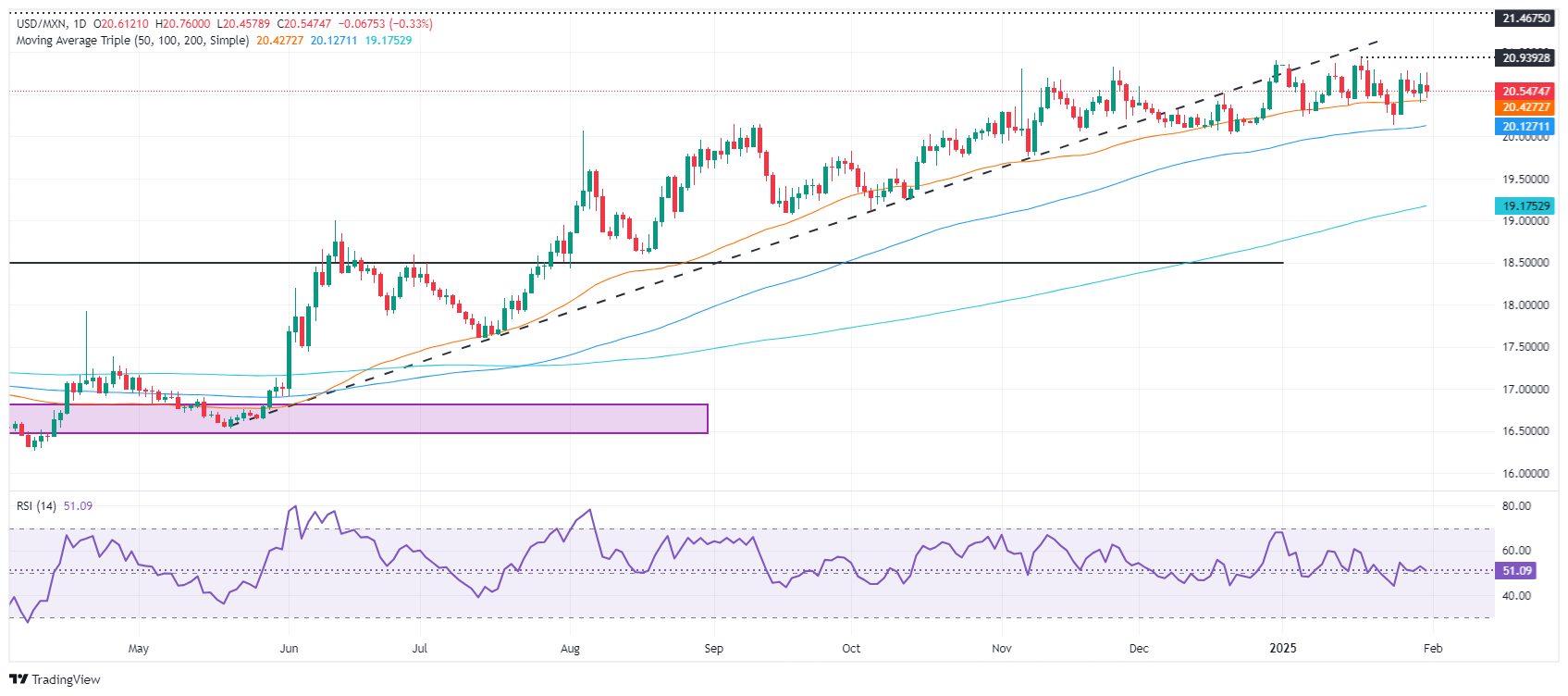
Technical outlook: Mexican Peso appreciates but clashes with support at 20.50
USD/MXN uptrend is intact despite the ongoing pullback following Reuters source's tariffs news on Mexico. The exotic pair dupped to 20.45 shy of challenging the 50-day Simple Moving Average (SMA) of 20.40 but jumped a sign that sellers were outnumbered by buyers, opening the door to reclaim 20.50.
On further strength, the USD/MXN's next resistance would be the January 28 swing high of 20.77. If that level is taken out, the next resistance would be 21.00, followed by the March 8, 2022, high at 21.46. Conversely, if the exotic pair tumbles below the 50-day SMA, further downside is seen at the 100-day SMA at 20.08, before the 20.00 figure.
Mexican Peso FAQs
The Mexican Peso (MXN) is the most traded currency among its Latin American peers. Its value is broadly determined by the performance of the Mexican economy, the country’s central bank’s policy, the amount of foreign investment in the country and even the levels of remittances sent by Mexicans who live abroad, particularly in the United States. Geopolitical trends can also move MXN: for example, the process of nearshoring – or the decision by some firms to relocate manufacturing capacity and supply chains closer to their home countries – is also seen as a catalyst for the Mexican currency as the country is considered a key manufacturing hub in the American continent. Another catalyst for MXN is Oil prices as Mexico is a key exporter of the commodity.
The main objective of Mexico’s central bank, also known as Banxico, is to maintain inflation at low and stable levels (at or close to its target of 3%, the midpoint in a tolerance band of between 2% and 4%). To this end, the bank sets an appropriate level of interest rates. When inflation is too high, Banxico will attempt to tame it by raising interest rates, making it more expensive for households and businesses to borrow money, thus cooling demand and the overall economy. Higher interest rates are generally positive for the Mexican Peso (MXN) as they lead to higher yields, making the country a more attractive place for investors. On the contrary, lower interest rates tend to weaken MXN.
Macroeconomic data releases are key to assess the state of the economy and can have an impact on the Mexican Peso (MXN) valuation. A strong Mexican economy, based on high economic growth, low unemployment and high confidence is good for MXN. Not only does it attract more foreign investment but it may encourage the Bank of Mexico (Banxico) to increase interest rates, particularly if this strength comes together with elevated inflation. However, if economic data is weak, MXN is likely to depreciate.
As an emerging-market currency, the Mexican Peso (MXN) tends to strive during risk-on periods, or when investors perceive that broader market risks are low and thus are eager to engage with investments that carry a higher risk. Conversely, MXN tends to weaken at times of market turbulence or economic uncertainty as investors tend to sell higher-risk assets and flee to the more-stable safe havens.
추천 기사


