South Korea’s KOSPI Tumbles Nearly 4% as Tax Hike Plans and US Tariffs Loom

Mitrade
Trending Articles
coverImg
Source: DepositPhotos

TradingKey - South Korea's KOSPI index dropped over 3% at Friday's opening, marking the biggest decline since early April. This fall is attributed to the South Korean government unveiling a tax reform proposal on Thursday to increase corporate tax rates and securities transaction taxes, compounded by the impact of impending reciprocal US tariffs.

The proposal aims to adjust the corporate tax structure from the current four-tier system of 9% to 24% to a new range of 10% to 25%. Additionally, the securities transaction tax will be raised from 0.15% to 0.2%, and the threshold for capital gains tax on stocks will decrease from 5 billion won to 1 billion won.

This move is part of the government's efforts to counteract declining national revenues amid an economic slowdown. The government anticipates that this reform will increase the annual tax burden on households and businesses by 8.2 trillion won over the next five years, marking the largest hike in recent years.

However, many industry experts have voiced objections. Park Hun, a tax professor at Seoul National University, cautioned that hiking corporate taxes would only exacerbate the burden on Korean businesses, which are already under pressure from trade tariffs.

Economists warn that the proposed tax increases could negatively affect the Korean stock market, potentially hindering President Lee Jae-myung's promise of reaching the 5,000-point benchmark.

Namho Kim, general manager of Seoul's Timefolio Asset Management, explained that lowering the threshold will significantly increase the number of taxable investors, raising concerns of a surge in sell-offs. Additionally, major shareholders may dump shares at year-end to avoid taxes, potentially triggering a market shock and leading to undervaluation of stocks for an extended period.

Inha University economics professor Shin Il-soon highlighted further risks, noting that individual investors are more vulnerable to market instability than major shareholders. It is estimated that 14.1 million retail investors could exit the market. According to 2024 data from the Korea Securities Depository, the government collects approximately 6.6 trillion won annually in securities transaction taxes, with 75% coming from retail investors. The exit of small investors could therefore reduce the tax base.

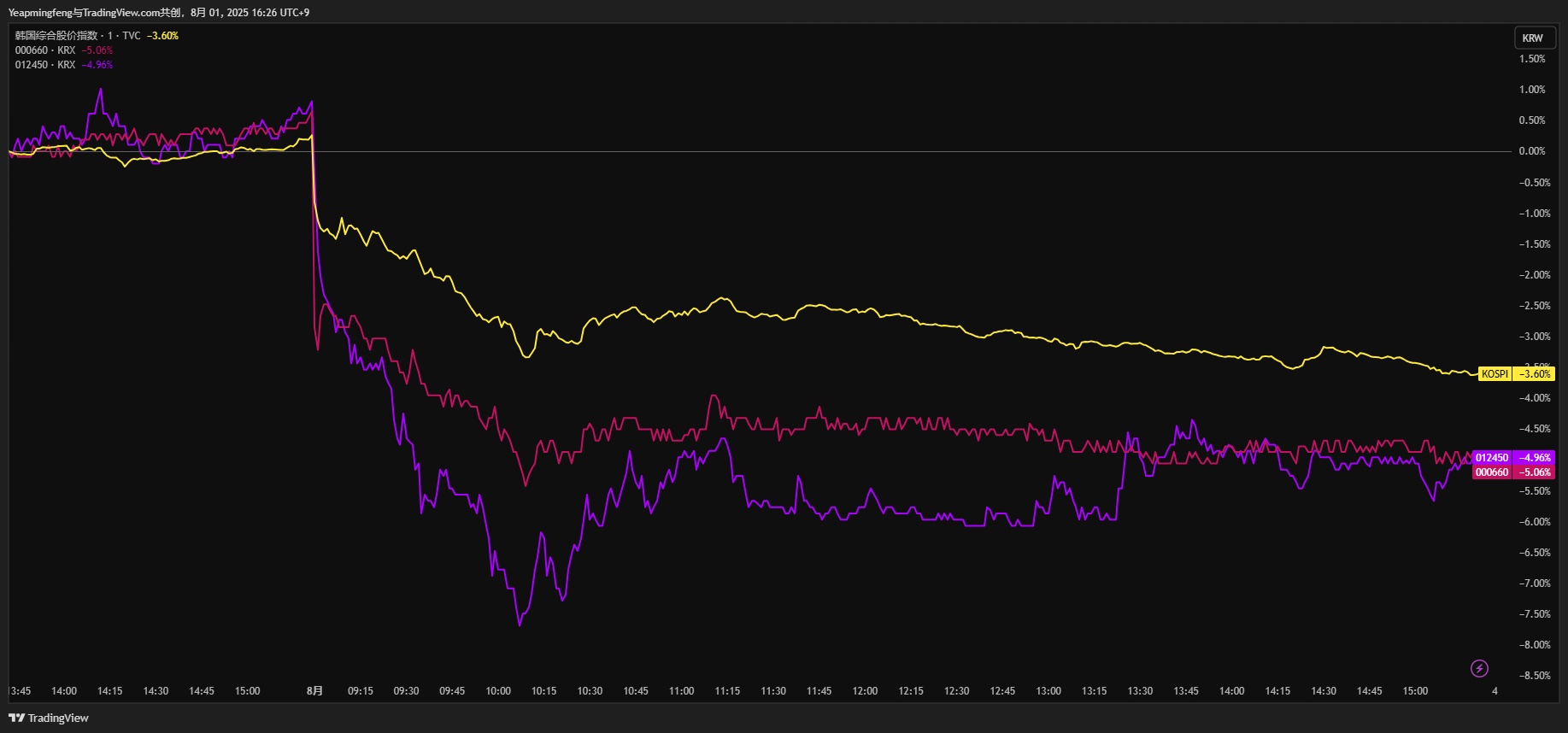
The market reacted pessimistically to the proposal's announcement, with widespread declines in Korean stocks. By the close, SK Hynix fell 5.67% and Hanwha Aerospace dropped 5.72%, both exerting significant downward pressure on the KOSPI index, which ended 3.88% lower.
altText

Korean stock market, source: TradingView

Given the ruling party's majority in parliament, the proposal is expected to pass smoothly, potentially deepening the pessimism among Korean stock investors.

Read more

  • Fed Chair Candidate: What Would a Hassett Nomination Mean for U.S. Stocks?
  • * The content presented above, whether from a third party or not, is considered as general advice only.  This article should not be construed as containing investment advice, investment recommendations, an offer of or solicitation for any transactions in financial instruments.

    goTop
    quote
    Related Articles
    placeholder
    2025 Black Friday is coming! Which stocks may see volatility?Coming on the day right after Thanksgiving in the United States, Back Friday marks the start of the holiday shopping season. Sales data from this shopping frenzy day reflects investor confidence and consumer trends. The National Retail Federation (NRF) predicts that holiday season (Nov and Dec) retail sales in 2025 will likely exceed $1 trillion for the very first time, which represents a year-over-year increase of 3.7 to 4.2 percent. Historic data from the past decade show that the retail sector has generally outperformed the S&P 500 during the weeks before and after Black Friday. The following retailing companies are expected to be big winners:
    Author  Insights
    Nov 24, Mon
    Coming on the day right after Thanksgiving in the United States, Back Friday marks the start of the holiday shopping season. Sales data from this shopping frenzy day reflects investor confidence and consumer trends. The National Retail Federation (NRF) predicts that holiday season (Nov and Dec) retail sales in 2025 will likely exceed $1 trillion for the very first time, which represents a year-over-year increase of 3.7 to 4.2 percent. Historic data from the past decade show that the retail sector has generally outperformed the S&P 500 during the weeks before and after Black Friday. The following retailing companies are expected to be big winners:
    placeholder
    Nvidia Q3 Earnings Explode: $57B Smashes Wall Street, After-Hours Rally of 6% Slaps Down the "AI Bubble" Narrative! Short-term Volatility, Long-term Optimism At the latest GTC conference, Jensen Huang revealed that for the five quarters ending in 2026, the order backlog for Blackwell + Rubin has reached $500 billio
    Author  TradingKey
    Nov 20, Thu
    Short-term Volatility, Long-term Optimism At the latest GTC conference, Jensen Huang revealed that for the five quarters ending in 2026, the order backlog for Blackwell + Rubin has reached $500 billio
    placeholder
    The Ultimate Test for the Market: What Nvidia's Earnings Mean for U.S. StocksTradingKey - Nvidia (NVDA), the leader in the AI chip market, is set to release its fiscal year 2026 Q3 earnings report after the close of US markets on Wednesday. As US investors engage in a frantic
    Author  TradingKey
    Nov 19, Wed
    TradingKey - Nvidia (NVDA), the leader in the AI chip market, is set to release its fiscal year 2026 Q3 earnings report after the close of US markets on Wednesday. As US investors engage in a frantic
    placeholder
    What's Really Inside the AI Bubble? Decoding the Core Controversies Over Scale, Reliance and Valuation As ChatGPT nears its three-year anniversary, the AI boom has fueled a three-year U.S. equity rally. However, growing AI bubble concerns and investor fatigue now threaten to derail market
    Author  TradingKey
    Nov 14, Fri
    As ChatGPT nears its three-year anniversary, the AI boom has fueled a three-year U.S. equity rally. However, growing AI bubble concerns and investor fatigue now threaten to derail market
    placeholder
    As Rotation from Tech to Value Gains Steam, Is It Time to Buy the Dow Jones by End-2025?The Dow Jones Industrial Average has reached successive record highs, and its outperformance against the Nasdaq over the past two days reached the highest level in nine months, signaling
    Author  TradingKey
    Nov 13, Thu
    The Dow Jones Industrial Average has reached successive record highs, and its outperformance against the Nasdaq over the past two days reached the highest level in nine months, signaling

    Stocks Related Articles

    • Amazon Stock Analysis: How to Invest in Amazon Stock?
    • Best 15 ASX Lithium Stocks To Watch in 2024-2025 | Industry Overview & Stock List
    • GOOG vs GOOGL: What's the Difference? Which One Should You Buy?
    • What Is A Stock Dividend? Top 20 High-Dividend Stocks List For 2024
    • How To Buy Nvidia Stocks (NASDAQ: NVDA)? Are Nvidia Stocks Worth Investing In During 2024?
    • How to Invest in Stock Market for Beginners

    Click to view more