


Bitcoin Could Reach $50 Million by 2041 as Global Collateral, Says EMJ Capital’s Jackson

 Trending Articles
- Trump National Address ‘About-Face,’ Bitcoin Slumps Back to $66,000
- Gold under pressure as fears mount, $4,600 support at risk
- Gold Second-Quarter Outlook: Safe-Haven Failure or Pricing Logic Reshaping? Can Gold Enter a Major Rally?
- WTI edges higher above $110 as Trump intensifies Iran's infrastructure threats
- Trump Openly Seizes Oil, Threatening to “Control Iran Overnight.” WTI Crude Has Doubled to $115 This Year; Will Oil Prices Face More Variables?
- WTI eases below $103.50 as US, Iran reportedly seeking 45-day ceasefire

Sovereign Collateral Thesis: Jackson argues Bitcoin will displace the Eurodollar system to become the neutral "plumbing" for global central banks.
The "Hundred-Bagger" Model: The forecast applies the same contrarian framework Jackson used to identify value in distressed assets like Carvana.
Supply Crunch: A $50 million target is described as a mathematical necessity if the massive sovereign debt market re-prices against capped Bitcoin supply.
While most of Wall Street debates whether Bitcoin can reclaim six figures, EMJ Capital founder Eric Jackson has anchored his thesis to a far more aggressive horizon: $50 million per coin by 2041.
In a recent interview, Jackson outlined a "Vision 2041" scenario that moves beyond the typical "digital gold" narrative. Instead, he posits that Bitcoin will evolve into the primary global collateral layer, effectively replacing the Eurodollar system and sovereign bonds as the neutral asset underpinning world finance.
The "Plumbing" of Global Finance Jackson’s thesis rests on a structural overhaul of financial "plumbing." Currently, the global system relies on sovereign debt (like U.S. Treasuries) and the Eurodollar network to facilitate borrowing and daily operations. Jackson argues this system is fraught with political risk and dependent on the whims of treasury officials.
"Vision 2041" sees Bitcoin—an apolitical, digital bearer asset with a fixed supply—displacing government debt as the preferred collateral for central banks and sovereigns.
If this shift occurs, Jackson contends the valuation is simply an accounting output, not a speculative guess. Given the sheer scale of global government liabilities, backing that debt with a scarce asset capped at 21 million units would mathematically force the price per coin into the "tens of millions."
The "Hundred-Bagger" Framework Jackson draws a direct parallel to his distressed equity strategy, specifically his bet on Carvana in 2022. When Carvana shares cratered from roughly $400 to $3.50, market sentiment had collapsed, dismissing the company as broken.
Jackson, however, looked past the chart to the underlying business logic. He noted that customers still valued the platform, and once management addressed the debt load, the fundamentals remained intact. He views Bitcoin through the same lens: investors are fixated on the volatile daily ticker, missing the structural role the asset is poised to play over the next 15 years.
Mathematical Necessity, Not Moonshot The $50 million figure is derived from the collision of infinite sovereign debt issuance against finite Bitcoin scarcity. Jackson admits the thesis relies on a long chain of assumptions—primarily that sovereigns will accept a neutral digital asset as reserves. However, he insists that if the premise holds, the resulting valuation is a logical necessity to support the world’s balance sheets.
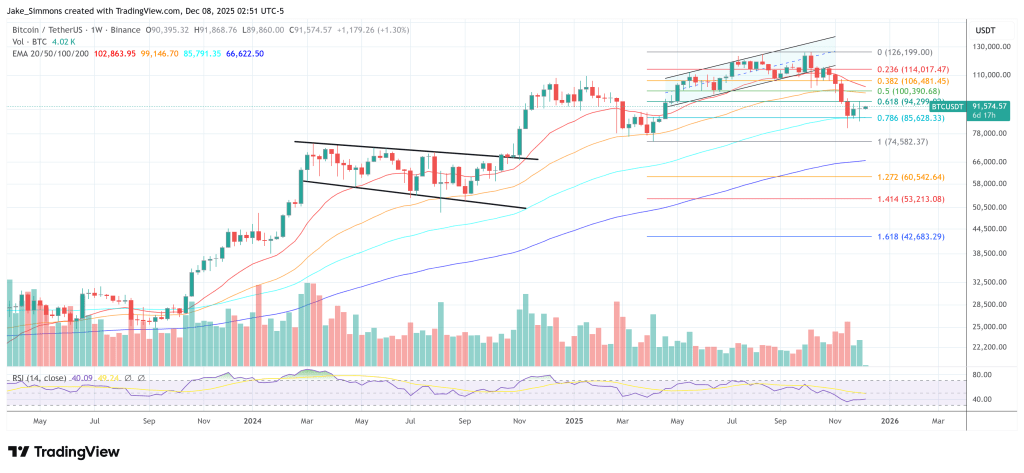
At press time, Bitcoin was trading around $91,574, a figure that reflects current retail sentiment rather than the institutional restructuring Jackson predicts.
Read more
The above content was completed with the assistance of AI and has been reviewed by an editor.


