


Prediction: This Artificial Intelligence (AI) Stock Will Outperform Nvidia by 2030
Key Points
Nvidia can credit the rise in its stock to relentless demand for its chipsets over the last few years.
Rising spending on servers, networking equipment, and data centers suggests that infrastructure could be the next big theme in the AI story.
While rising infrastructure spending bodes well for Nvidia, foundry specialist Taiwan Semiconductor Manufacturing may be even better positioned.
- 10 stocks we like better than Taiwan Semiconductor Manufacturing ›
When ChatGPT was released to the broader public on Nov. 30, 2022, Nvidia had a market capitalization of just $345 billion. As of the closing bell on July 25, 2025, its market cap had eclipsed $4.2 trillion, making it the most valuable company in the world -- by a pretty wide margin, too.
Given these historic gains, it's not entirely surprising that for many growth investors, the artificial intelligence (AI) movement revolves around Nvidia. At this point, the company is basically seen as a barometer measuring the overall health of the entire AI sector.
Where to invest $1,000 right now? Our analyst team just revealed what they believe are the 10 best stocks to buy right now. Learn More »
It's hard to bet against Nvidia, but I do see another stock in the semiconductor realm that appears better positioned for long-terms gains.
Let's explore what makes Taiwan Semiconductor Manufacturing (NYSE: TSM) such a compelling opportunity in the chip space right now, and the catalysts at play that could fuel returns superior to Nvidia's over the next several years.
The AI infrastructure wave is just starting
I like to think of the AI narrative as a story. For the last few years, the biggest chapter revolved around advanced chipsets called graphics processing units (GPUs), which are used across a variety of generative AI applications. These include building large language models (LLMs), machine learning, robotics, self-driving cars, and more.
These various applications are only now beginning to come into focus. The next big chapter in the AI storyline is how infrastructure is going to play a role in actually developing and scaling up these more advanced technologies.
Global management consulting firm McKinsey & Company estimates that investments in AI infrastructure could reach $6.7 trillion over the next five years, with a good portion of that allocated toward hardware for data centers.
Piggybacking off of this idea, consider that cloud hyperscalers Amazon, Microsoft, and Alphabet, along with their "Magnificent Seven" peer Meta Platforms, are expected to devote north of $330 billion on capital expenditures (capex) just this year. Much of this is going toward additional servers, chips, and networking equipment for accelerated AI data center expansion.
To me, the aggressive spending on capex from the world's largest businesses is a strong signal that the infrastructure wave in AI is beginning to take shape.
Image Source: Getty Images.
This is great for Nvidia and even better for TSMC
Rising AI infrastructure investment is a great tailwind for Nvidia but also a source of growth for Advanced Micro Devices, Broadcom, and many others.
Unlike AMD or Nvidia, though, growth for Taiwan Semiconductor (TSMC for short) doesn't really hinge on the success of a particular product line. In other words, Nvidia and AMD are competing fiercely against one another to win AI workloads, which boils down to which of them can design the most powerful, energy efficient chips at an affordable price.
The investment case around TSMC is that it could be seen as more of an agnostic player in the AI chip market because its foundry and fabrication services stand to benefit from broader, more secular tailwinds fueling AI infrastructure -- regardless of whose chips create the most demand.
Think of TSMC as the company actually making the picks and shovels that Nvidia, AMD, and other chip companies need to go out and sell while competing among one another.
TSMC's "Nvidia moment" may be here
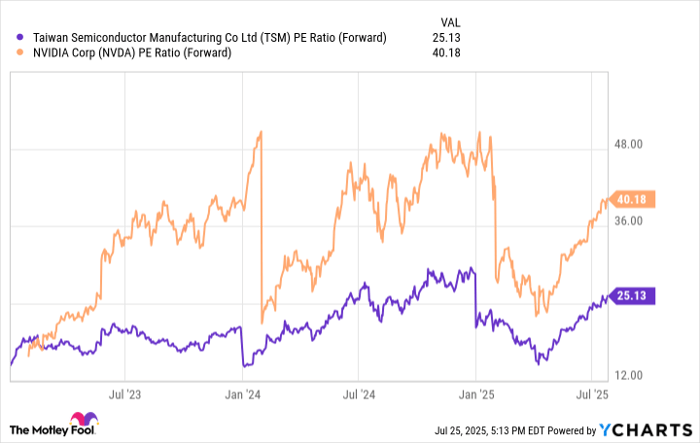
The valuation disparity between Nvidia and TSMC says a couple of things about how the latter is viewed in the broader chip landscape.
TSM PE Ratio (Forward) data by YCharts; PE = price to earnings.
Companies such as Nvidia and AMD rely heavily on TSMC's foundry and fabrication services, which are essentially the backbone of the chip industry. While some on Wall Street would argue that Nvidia has a technological moat thanks to its one-two punch of chips and software, I think that TSMC has an underappreciated moat that provides the company with broader exposure to the chip industry compared to its peers.
Over the next five years, I think use cases of AI development increase as businesses seek to expand beyond their current markets in cloud computing, cybersecurity, enterprise software, among others.
Emerging applications such as autonomous driving and quantum computing will drive demand for GPUs and data center capacity even further. For this reason, TSMC may be on the verge of an "Nvidia moment" featuring prolonged, explosive growth.
TSMC's modest forward price-to-earnings multiple (P/E) of 25 puts it in a unique position compared to Nvidia (with its forward P/E of 40) for considerable expansion as the infrastructure chapter of AI continues to be written.
I think Taiwan Semiconductor Manufacturing's valuation will increasingly become more congruent with the company's growth over the next several years, and so I predict that the stock will outperform Nvidia by 2030.
Should you invest $1,000 in Taiwan Semiconductor Manufacturing right now?
Before you buy stock in Taiwan Semiconductor Manufacturing, consider this:
The Motley Fool Stock Advisor analyst team just identified what they believe are the 10 best stocks for investors to buy now… and Taiwan Semiconductor Manufacturing wasn’t one of them. The 10 stocks that made the cut could produce monster returns in the coming years.
Consider when Netflix made this list on December 17, 2004... if you invested $1,000 at the time of our recommendation, you’d have $630,291!* Or when Nvidia made this list on April 15, 2005... if you invested $1,000 at the time of our recommendation, you’d have $1,075,791!*
Now, it’s worth noting Stock Advisor’s total average return is 1,039% — a market-crushing outperformance compared to 182% for the S&P 500. Don’t miss out on the latest top 10 list, available when you join Stock Advisor.
See the 10 stocks »
*Stock Advisor returns as of July 29, 2025
Adam Spatacco has positions in Alphabet, Amazon, Meta Platforms, Microsoft, and Nvidia. The Motley Fool has positions in and recommends Advanced Micro Devices, Alphabet, Amazon, Meta Platforms, Microsoft, Nvidia, and Taiwan Semiconductor Manufacturing. The Motley Fool recommends Broadcom and recommends the following options: long January 2026 $395 calls on Microsoft and short January 2026 $405 calls on Microsoft. The Motley Fool has a disclosure policy.
Recommended Articles


