


History Says the Smartest Investing Move Is Also the Easiest. Here's Why.
Key Points
New investors don't have to employ sophisticated algorithms to make money in the market.
It's better to hold onto your investments for the long term than to try timing the market.
The simplest investment -- such as an S&P 500 index fund -- can often be the best.
- 10 stocks we like better than S&P 500 Index ›
Learning about stocks and starting to invest can seem daunting to new investors, but you might be surprised to learn that the smartest strategy is actually the easiest. You might see professionals using sophisticated algorithms and derivatives to make money in the stock market
But you don't have to do that to be successful; in fact, all you have to do is keep investing. Here's the proof.
Missed AI’s "Act 1"? Act 2 Could Be 15x Bigger. Most investors think they missed the AI boat because they didn't buy Nvidia in 2005. But according to our analysts, we’re only at the end of "Act 1"—the R&D phase. "Act 2" is the global rollout. Continue »
Time in beats timing
Time in the market beats timing the market, as the saying goes, and several studies have shown this to be true.
Charles Schwab, for example, studied five different investing personalities who invested $2,000 annually for 20 years. While the perfect timer did score the best, coming out with $187,000, the consistent investor came in close, with $171,000. Since the perfect timer doesn't exist, consistent investing is an excellent alternative. In fact, all of the investors did OK in the study, even the one who picked the worst time of the year to invest.

Image source: Getty Images.
This pattern remained consistent in 70 of the 80 rolling 20-year time periods the study back-tested for over the past 100 years, and nearly all 30-, 40-, and 50-year time periods.
If you try to time the market, you might sell before a stock reaches its peak, missing out on significant gains, or buy right before a stock tanks. Since it isn't possible to predict the future, you could end up underperforming the consistent investor. That doesn't mean you should invest blindly; you should certainly try to find bargains, and if a stock is too expensive, you should wait for the price to go down. But in the meantime, invest in something else.
Staying in for the long haul
Simply investing, even in a fund that tracks the S&P 500 (SNPINDEX:^GSPC) and nothing else, can lead to fabulous wealth creation over time. On average, the S&P 500 has gained more than 10% annually for the past 20 years, and it has always bounced back from crashes and corrections.
If you had invested $10,000 in an exchange-traded fund (ETF) that tracks the S&P 500, like the Vanguard S&P 500 ETF (NYSEMKT:VOO) or the State Street SPDR S&P 500 ETF Trust (NYSEMKT:SPY), and done nothing else, your investment would have gone through two market crashes where the index lost more than 30% of its value and plenty of dips and corrections. If you'd let it sit and not tried to do any fancy footwork, your $10,000 investment would now be worth more than $87,000.
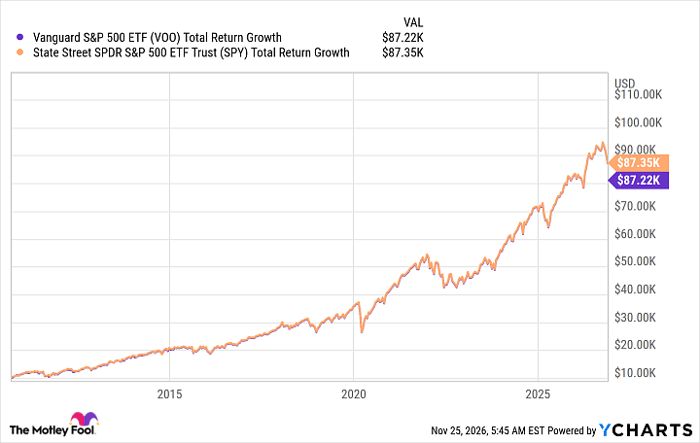
VOO Total Return Level data by YCharts
And that's just an index fund. If you curate a diversified portfolio of 50 stocks, keep investing in them, and hold on, you even have a chance to beat the market.
Should you buy stock in S&P 500 Index right now?
Before you buy stock in S&P 500 Index, consider this:
The Motley Fool Stock Advisor analyst team just identified what they believe are the 10 best stocks for investors to buy now… and S&P 500 Index wasn’t one of them. The 10 stocks that made the cut could produce monster returns in the coming years.
Consider when Netflix made this list on December 17, 2004... if you invested $1,000 at the time of our recommendation, you’d have $328,591!* Or when Nvidia made this list on April 15, 2005... if you invested $1,000 at the time of our recommendation, you’d have $924,693!*
Now, it’s worth noting Stock Advisor’s total average return is 791% — a market-crushing outperformance compared to 201% for the S&P 500. Don't miss the latest top 10 list, available with Stock Advisor, and join an investing community built by individual investors for individual investors.
See the 10 stocks »
*Stock Advisor returns as of November 28, 2026.
Charles Schwab is an advertising partner of Motley Fool Money. Jennifer Saibil has positions in Vanguard S&P 500 ETF. The Motley Fool has positions in and recommends Vanguard S&P 500 ETF. The Motley Fool recommends Charles Schwab and recommends the following options: short September 2026 $95 calls on Charles Schwab. The Motley Fool has a disclosure policy.
Recommended Articles


