


Ripple Price Forecast: XRP rises 14% from November lows, approaching $1.00
- XRP gains momentum, up 14% from lows of $0.86 in November as bulls tighten their grip.
- The XRP derivatives market faces rising short position liquidations as selling pressure eases.
- The path of least resistance turns upward, supported by improvements in key momentum indicators.
Ripple (XRP) trades largely in bullish hands on Friday, with price at $0.98. The token is up a notable 14% from its November low of $0.86, indicating that risk-on sentiment is improving and raising recovery odds.
A daily close above $1.00 could prompt investors to take on more risk. However, traders should temper expectations as XRP sits below key technical indicators, which could cap short-term gains.
XRP recovers as short liquidation surge
The XRP derivatives market is gradually turning the tables, with short traders feeling the pinch as liquidations increase. CoinGlass data shows total 24-hour liquidations of $3.2 million, with $2.1 million in short positions.
Approximately $1.1 million in long positions has been liquidated. The largest single liquidation amounted to $369,000. A sustained increase in short-position liquidations acts as an involuntary buying force that tends to accelerate upward price volatility, as the order book compresses and liquidity positioning resets.
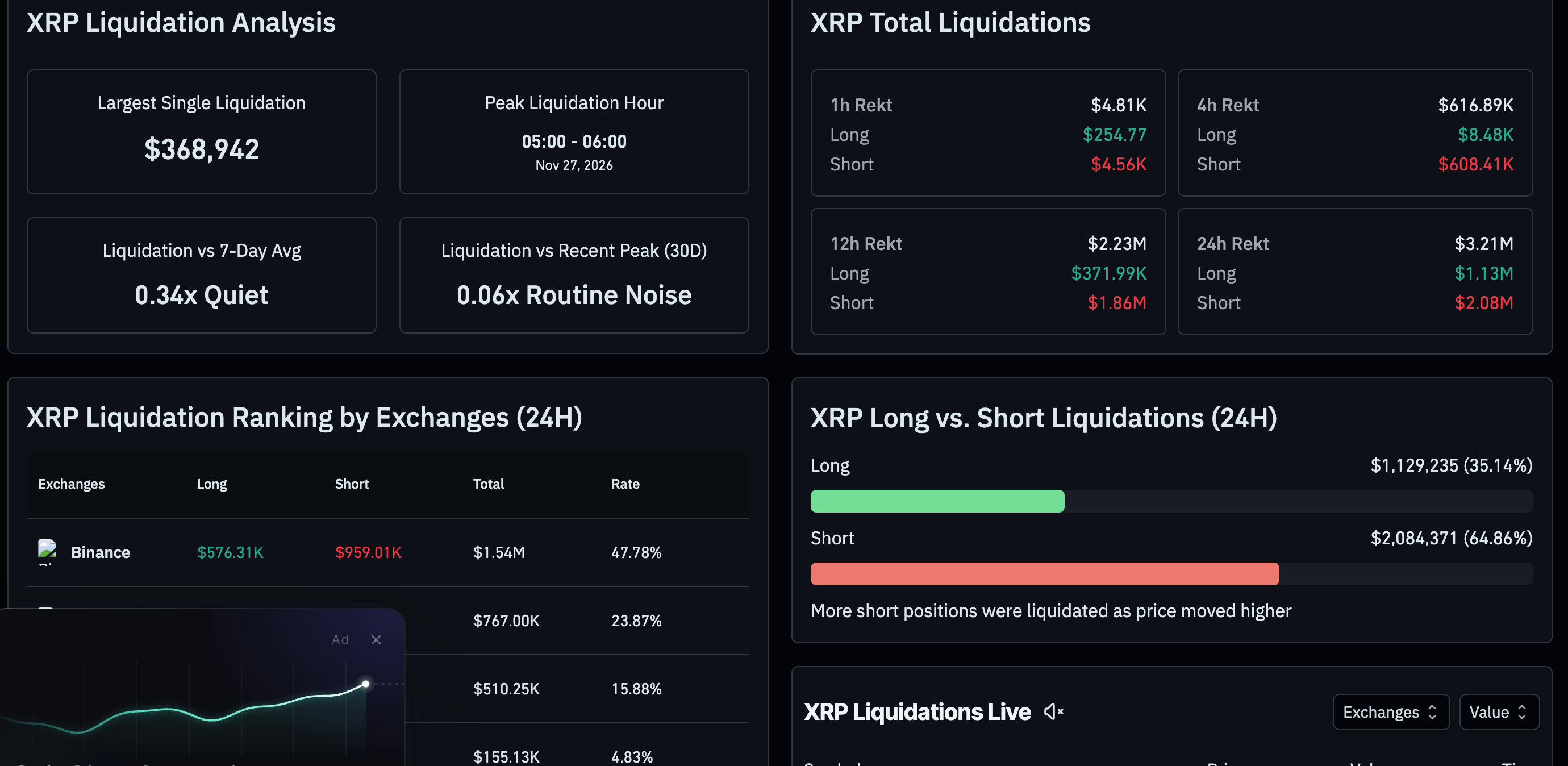
Still, price increases driven largely by short liquidations could be unsustainable because forced market buys close existing positions rather than bringing in fresh long-term capital. Buying pressure diminishes as the cluster of short positions is wiped out. Hence, fresh spot trading is required to absorb potential profit-taking and cushion XRP against short-term headwinds.
Moreover, the Fear & Greed Index at 12 in the Extreme Fear territory on Friday suggests a minor improvement in market sentiment. However, appetite remains largely subdued, as market sentiment holds well below 51 in Neutral territory last month.
Technical analysis: XRP nurtures early-stage recovery
XRP trades at $0.98, up nearly 3% on the day despite sustaining a bearish near-term bias as price holds below the SuperTrend at $1.09 and a full stack of Exponential Moving Averages (EMAs), with the 50-day EMA at $1.13, the 100-day EMA at $1.20 and the 200-day EMA at $1.30 all acting as overhead supply.
The reclaimed positive reading in the Moving Average Convergence Divergence (MACD) and the Relative Strength Index (RSI) at 41 hint at improving but still fragile momentum, suggesting any recovery attempts are likely to struggle while spot remains capped under the descending trendline resistance around $1.17.
Initial resistance lies at the SuperTrend barrier near $1.09, followed by the 50-day EMA at $1.13, with the broken downward trendline at $1.17 reinforcing a broader ceiling ahead of the 100-day EMA at $1.20. A stronger bullish reversal would require a daily close above the 200-day EMA at $1.30, while on the downside, the lack of nearby mapped support leaves the pair vulnerable to further slippage, with traders likely to look to previous swing lows for the next potential demand zones.
(The technical analysis of this story was written with the help of an AI tool. Know more.)
Crypto ETF FAQs
An Exchange-Traded Fund (ETF) is an investment vehicle or an index that tracks the price of an underlying asset. ETFs can not only track a single asset, but a group of assets and sectors. For example, a Bitcoin ETF tracks Bitcoin’s price. ETF is a tool used by investors to gain exposure to a certain asset.
Yes. The first Bitcoin futures ETF in the US was approved by the US Securities & Exchange Commission in October 2021. A total of seven Bitcoin futures ETFs have been approved, with more than 20 still waiting for the regulator’s permission. The SEC says that the cryptocurrency industry is new and subject to manipulation, which is why it has been delaying crypto-related futures ETFs for the last few years.
Yes. The SEC approved in January 2024 the listing and trading of several Bitcoin spot Exchange-Traded Funds, opening the door to institutional capital and mainstream investors to trade the main crypto currency. The decision was hailed by the industry as a game changer.
The main advantage of crypto ETFs is the possibility of gaining exposure to a cryptocurrency without ownership, reducing the risk and cost of holding the asset. Other pros are a lower learning curve and higher security for investors since ETFs take charge of securing the underlying asset holdings. As for the main drawbacks, the main one is that as an investor you can’t have direct ownership of the asset, or, as they say in crypto, “not your keys, not your coins.” Other disadvantages are higher costs associated with holding crypto since ETFs charge fees for active management. Finally, even though investing in ETFs reduces the risk of holding an asset, price swings in the underlying cryptocurrency are likely to be reflected in the investment vehicle too.
Recommended Articles


