


Warren Buffett Said Stocks Are Better Than Bonds for Long-Term Investors. History Shows He Was Right.
Key Points
During a 10-year $1 million bet to prove that professional money managers couldn’t beat the S&P 500, Warren Buffett accidentally realized that his zero-coupon U.S. Treasury bonds were a bad investment.
By moving money from low-yield Treasury bonds into faster-growing Berkshire Hathaway stock, Buffett and his partner in “the bet” delivered more than $2 million to an Omaha charity, instead of only $1 million.
In 2018, Warren Buffett warned investors that bonds can be risky in failing to deliver future investment growth and failing to keep up with inflation -- and that stocks ultimately become less risky with a longer investment time horizon.
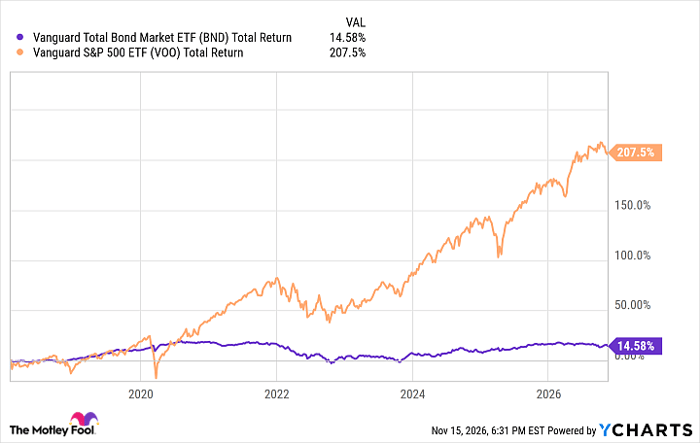
The Vanguard S&P 500 ETF has strongly outperformed the total return of the Vanguard Total Bond Market ETF in the past eight years.
- Motley Fool Issues Rare "Total Conviction" Buy Alert ›
Warren Buffett became a legendary investor by investing in stocks, not bonds. But he had some strong opinions about bonds that other investors should consider.
Many people think of bonds as being "less risky" than stocks, and that can be true. But understanding the "risk" of bonds vs. stocks depends on your time horizon and investment goals.
Missed AI’s "Act 1"? Act 2 Could Be 15x Bigger. Most investors think they missed the AI boat because they didn't buy Nvidia in 2005. But according to our analysts, we’re only at the end of "Act 1"—the R&D phase. "Act 2" is the global rollout. Continue »
In his 2017 shareholder letter to Berkshire Hathaway shareholders, Warren Buffett shared an interesting story about his experience with the true risks of bonds. This experience reminded him why he prefers buying stocks.
Let's look at why Buffett said that stocks are a better buy than bonds for most long-term investors.
Image source: Getty Images.
Warren Buffett's bet: Wall Street pros failed to beat the S&P 500 index
In 2017, Buffett was reaching the end of a unique, public 10-year-long wager. He had made a friendly bet with an investment advisory firm, Protégé Partners, to see if professional hedge fund managers could outperform the S&P 500 (SNPINDEX:^GSPC) for the next 10 years, starting in 2008.
Buffett bet that they couldn't. He believed that most professional money managers would fail to beat the S&P 500 for that long.
Buffett was right. All five of the professional hedge fund managers chosen by Protégé failed to beat the S&P 500.
The bet involved $1 million, with Buffett and Protégé each pledging $500,000 toward that total. No matter who won the bet, the $1 million proceeds would go to a Nebraska charity, Girls Inc. of Omaha.
To fund the bet, Buffett and Protégé each bought a package of zero-coupon U.S. Treasury bonds worth $318,250 when purchased at the start of the bet (about 64% of face value) and would be worth $500,000 after 10 years (for a total of $1 million at the end of the bet).
But midway through the bet, in 2012, Buffett realized that due to recent changes in the bond market, their zero-coupon Treasury bonds had become a terrible investment. The bonds had started out yielding about 4.56% annually, but by 2012, with five years left until maturity, they were yielding only about 0.88% annually.
Warren Buffett can't abide a bad deal on an investment. He and Protégé quickly agreed to sell their Treasury bonds and put the proceeds into Berkshire Hathaway (NYSE:BRKB) Class B shares. He was confident that Berkshire Hathaway stock would deliver a much better average annual return for the next five years than 0.88%.
Once again, he was right. As a result, as Buffett wrote: "Girls Inc. of Omaha found itself receiving $2,222,279 last month rather than the $1 million it had originally hoped for."
Three reasons why bonds are risky
Buffett's experience with Treasury bonds taught a few important lessons about the real risks of bond investing. Here are a few reasons, according to Buffett, why bonds can be riskier than stocks:
1. Bonds might not grow your money enough in the long run
Buffett wrote that investing is about giving up consumption today so you can have more money to spend later. But bonds can fail to achieve this goal if they don't make your money grow in the long run.
As he wrote, "By that standard, purportedly 'risk-free' long-term bonds in 2012 were a far riskier investment than a long-term investment in common stocks."
2. Bonds can lose value to inflation
If inflation is 3% per year and bonds deliver 4% yields, they're barely staying ahead of inflation. Buffett bought those zero-coupon Treasury bonds at a time of lower inflation and lower interest rates than we have today. But from 2012 to 2017, his bonds were on track to yield only 0.88% per year.
Buffett noted this inflation risk of bonds when he wrote: "At that time, even a 1% annual rate of inflation between 2012 and 2017 would have decreased the purchasing-power of the government bond that Protégé and I sold."
3. Stocks become less risky in the long run
The S&P 500 can crash on any given day, but it tends to go up in the long run. That means the longer your time horizon, the longer you can hold your stocks, and the more likely they’ll deliver a positive return. Bonds can be safer than stocks in the short run, but over time, stocks gradually become a better bet.
As Buffett wrote: "...in any upcoming day, week, or even year, stocks will be riskier -- far riskier -- than short-term U.S. bonds. As an investor's investment horizon lengthens, however, a diversified portfolio of U.S. equities becomes progressively less risky than bonds, assuming that the stocks are purchased at a sensible multiple of earnings relative to then-prevailing interest rates."
Buffett followed up on these ideas in his shareholder letter in a February 2018 interview with CNBC, where he said he believed long-term investors should buy stocks rather than bonds. He said, "If you had to choose between buying long-term bonds or equities, I would choose equities in a minute...If I were going to own a 30-year government bond or own equities for 30 years, I think equities will considerably outperform that 30-year bond."
History shows that Warren Buffett was right. In the eight years since Buffett's shareholder letter and CNBC interview in Feb. 2018, the Vanguard S&P 500 ETF (NYSEMKT:VOO) has strongly outperformed the Vanguard Total Bond Market ETF (NASDAQ:BND).
BND Total Return Level data by YCharts
This doesn't mean you shouldn't buy any bonds. Bond ETFs can be appropriate as part of a diversified portfolio. Today's bonds offer higher yields than they did when Buffett was buying Treasury bonds in 2008, which could make them a better deal for investors than they used to be. I own shares of the Vanguard Total Bond Market ETF, even though my time horizon for investing is still decades long.
But if you want maximum growth of your money and can hold for the long term through short-term stock market booms and busts, buying stocks should be the foundation of your investment strategy.
Should you buy stock in Vanguard Total Bond Market ETF right now?
Before you buy stock in Vanguard Total Bond Market ETF, consider this:
The Motley Fool Stock Advisor analyst team just identified what they believe are the 10 best stocks for investors to buy now… and Vanguard Total Bond Market ETF wasn’t one of them. The 10 stocks that made the cut could produce monster returns in the coming years.
Consider when Netflix made this list on December 17, 2004... if you invested $1,000 at the time of our recommendation, you’d have $305,941!* Or when Nvidia made this list on April 15, 2005... if you invested $1,000 at the time of our recommendation, you’d have $771,325!*
Now, it’s worth noting Stock Advisor’s total average return is 719% — a market-crushing outperformance compared to 192% for the S&P 500. Don't miss the latest top 10 list, available with Stock Advisor, and join an investing community built by individual investors for individual investors.
See the 10 stocks »
*Stock Advisor returns as of November 21, 2026.
Ben Gran has positions in Vanguard Total Bond Market ETF. The Motley Fool has positions in and recommends Berkshire Hathaway, Vanguard S&P 500 ETF, and Vanguard Total Bond Market ETF. The Motley Fool has a disclosure policy.
Recommended Articles


