


Nvidia Q3 Revenue Surges 103%, Next-Quarter Revenue Guidance Reaches $130 Billion, Shares Briefly Rise Over 4% After Hours
TradingKey - After the bell on November 17 ET, Nvidia (NVDA) reported its third-quarter results for fiscal 2027 ended October 25. Both revenue and adjusted earnings per share exceeded expectations, with data center revenue topping $100 billion. The company expects fourth-quarter revenue to continue growing, while gross margin is projected to decline from about 75% this quarter to between 71% and 72%. This marks the first earnings report following the resignation of Jensen Huang.
Third-quarter revenue was $115.844 billion, up 103% year-over-year and 20% quarter-over-quarter, 6.18% above the pre-earnings estimate of $109.1 billion. Adjusted diluted earnings per share were $2.68, up 111% year-over-year and 8.50% higher than the expected $2.47. GAAP diluted earnings per share were $2.70, up 108% year-over-year.
Following the earnings release, Nvidia shares rose as much as 4% at one point; as of press time, the gain narrowed to about 3%, trading at $159.92.
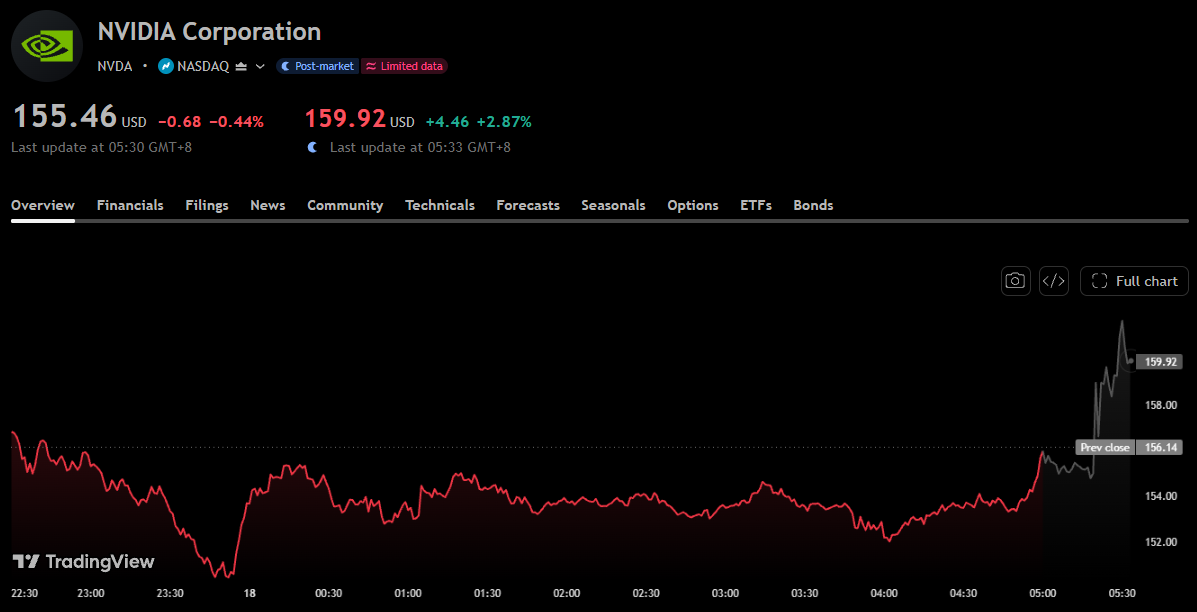
[Nvidia Stock Price Chart, Source: TradingView]
Nvidia Data Center Revenue Tops $100 Billion as Rubin Ramps Up
Data center revenue reached $107.6 billion, up 110% year over year and 21% sequentially. Hyperscale customer revenue accounted for $60.1 billion of that total, up approximately 71% year over year. Revenue from AI cloud, industrial, and enterprise customers totaled $47.5 billion, up approximately 195% year over year, driving the larger year-over-year increase between the two customer segments. Edge computing revenue came in at $8.2 billion, up 42% year over year.
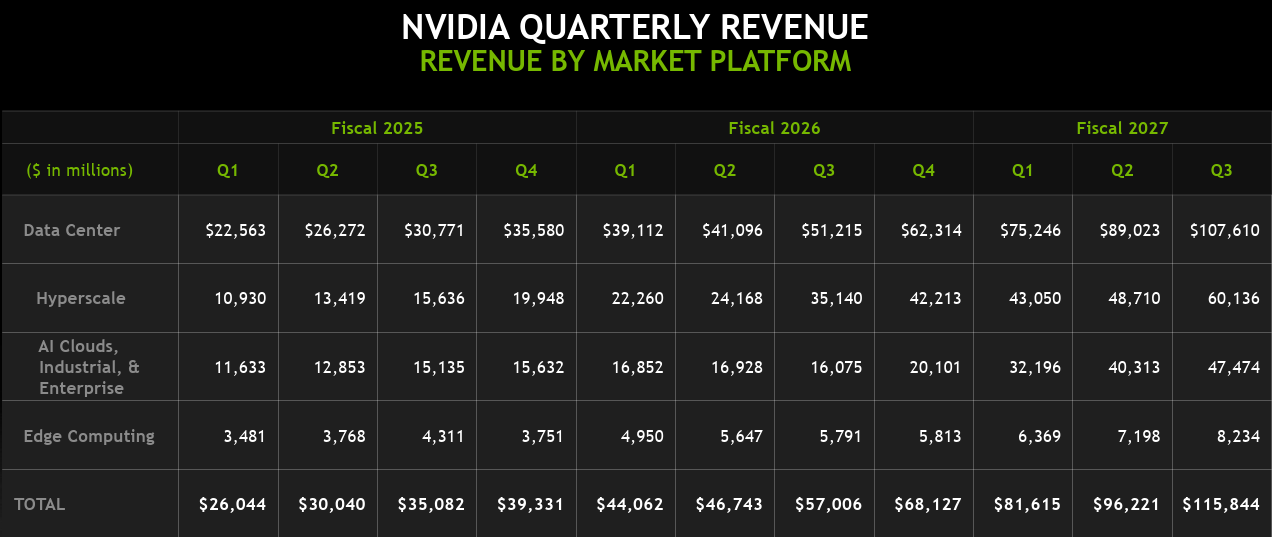
[Nvidia Segment Results, Source: Nvidia Fiscal 2027 Third Quarter Financial Results]
Nvidia said Blackwell demand remains strong, with revenue from its next-generation Vera Rubin platform increasing by nearly $20 billion from the previous quarter, driven by contributions from both hyperscale customers as well as AI cloud, industrial, and enterprise clients. Interim Chief Executive Officer and Chief Financial Officer Colette Kress stated that Vera Rubin shipments got off to a strong start and the product roadmap is progressing as planned.
Next-Quarter Revenue Guidance Midpoint Hits $130 Billion, Gross Margin Expected to Fall Back to 71%-72%
GAAP and adjusted gross margins were 74.8% and 74.9%, respectively, both up 1.4 percentage points year-over-year, which the company attributed to an improved product mix driven by Blackwell Ultra. GAAP operating income was $77.520 billion, up 115% year-over-year, and net income was $65.287 billion, up 105% year-over-year. Adjusted operating income was $77.883 billion, up 116% year-over-year, and adjusted net income was $64.870 billion, up 109% year-over-year.
GAAP net income was higher than adjusted net income, primarily because GAAP results included a $1.767 billion gain from equity securities. This gain exceeded the combined impact of $255 million in acquisition-related and other costs, $108 million in legal settlement costs, $523 million in other adjustments, and $464 million in related tax effects. Other adjustments involved equity derivatives, equity method investments, convertible debt, dividend income, and interest related to acquisition consideration payable.
Operating cash flow for the quarter was $48.253 billion. After deducting $4.422 billion in payments for purchases of property, equipment, and intangible assets and $54 million in related principal payments, free cash flow was $43.777 billion, nearly doubling from $22.089 billion in the prior-year period.
Nvidia expects fourth fiscal quarter revenue of $126.1 billion to $133.9 billion, with a midpoint of $130.0 billion, up approximately 12% from the third fiscal quarter. The fourth fiscal quarter has an additional week, and the guidance does not include data center compute revenue from China. Both GAAP and adjusted gross margins are expected to be 71% to 72%; at the midpoint, the adjusted gross margin is 3.4 percentage points lower than the current quarter. GAAP and adjusted operating expenses are expected to be approximately $11.0 billion and $10.7 billion, respectively.
Recommended Articles


