


Not Nvidia. Not Broadcom. This Is the AI Chip Stock I’d Buy Before the Year Ends.
Key Points
Nvidia's and Broadcom's chips are vital parts of data centers and other AI infrastructure.
But TSMC has a virtual monopoly on manufacturing Nvidia's and Broadcom's AI chips.
TSMC has used increased demand to flex its pricing power and expand its margins.
- Motley Fool Issues Rare "Total Conviction" Buy Alert ›
It wouldn't be an exaggeration to call the current AI boom the most transformative tech shift since the internet. It has forced countless businesses to pivot, sparked a race for computing power, and sent megacap tech and AI stocks to unprecedented valuations.
Two of the biggest beneficiaries of the AI boom are Nvidia (NASDAQ:NVDA) and Broadcom (NASDAQ:AVGO), worth $3.9 trillion and $1.7 trillion, respectively, as of market close on Nov. 13. Although both companies have continued to grow, this year has been underwhelming for their stocks. Nvidia is down over 12%, and Broadcom is essentially flat.
Missed AI’s "Act 1"? Act 2 Could Be 15x Bigger. Most investors think they missed the AI boat because they didn't buy Nvidia in 2005. But according to our analysts, we’re only at the end of "Act 1"—the R&D phase. "Act 2" is the global rollout. Continue »
Both companies are good long-term plays, but if I had to choose an AI chip stock to invest in before the new year, it wouldn't be either of them; it would be Taiwan Semiconductor Manufacturing (NYSE:TSM) (or TSMC). It's not your typical AI stock, but it's as important to the ecosystem as any company.

Image source: Getty Images.
AI chip giants
Nvidia became the AI sweetheart because of its graphics processing units (GPUs), chips originally used for video games. However, they turned out to be great for training AI. As generative AI became mainstream, the demand for Nvidia's chips skyrocketed. Now, it has a full AI ecosystem that has become the gold standard.
In its most recent quarter, Nvidia made $96.2 billion in revenue. Just three years ago, in the same quarter, it made only $13.5 billion.
Broadcom is also a chip company, but it focuses more on AI accelerators and networking chips. Those chips were typically used for telecom infrastructure, but now, they're important parts of data centers.
As with Nvidia, the AI boom has supercharged Broadcom's finances. It made $29.6 billion in its most recent quarter, up from $8.9 billion three years ago.
It all starts with TSMC
The beauty of TSMC's business is that no matter the chip -- whether it's GPUs, AI accelerators, or networking -- TSMC is likely the one actually making it. Companies like Nvidia and Broadcom design their chips, but they don't actually manufacture them because of the specialized plants and the cost it would take to do so effectively.
Instead of spending tens of billions on factories, it's much easier to let TSMC handle it. It has solidified its position as the world's top chip manufacturer, with a 73% market share in the semiconductor (chip) foundry market and a virtual monopoly on advanced AI chips.
While companies battle it out in the AI race, TSMC gets to profit regardless. It's the backbone of the AI pipeline.
TSMC has impressive growth
TSMC has been on a roll since the current AI boom began, consistently putting up impressive growth. It expects fourth-quarter revenue between $52.3 billion and $54.3 billion, up 55% to 61% from the $33.7 billion it made in last year's fourth quarter.
Here are TSMC's year-over-year revenue and net income growth over the past four quarters:
| Quarter | Year-Over-Year Revenue Growth | Year-Over-Year Net Income Growth |
|---|---|---|
| Q3 2026 | 41.2% | 68.7% |
| Q2 2026 | 33.7% | 77.4% |
| Q1 2026 | 40.6% | 58.3% |
| Q4 2025 | 25.5% | 35.0% |
Source: TSMC quarterly reports. Net income growth is in [] currency.
As essentially the only game in town for manufacturing advanced AI chips, TSMC has been able to flex its pricing power. Having 66.4% gross margins and 58.7% operating margins is virtually unheard of for a capital-intensive manufacturer like TSMC. Three years ago, they were 54.3% and 41.7%, respectively.
Take advantage of the pullback
TSMC's stock is up 31% this year, but has dropped by over 7% in the past month (as of Nov. 13), as overall sentiment around semiconductor stocks and big-spending AI companies has cooled off.
In many cases, investor skepticism around huge spending is warranted. In TSMC's case, demand justifies its spending. Its capital expenditures this year could reach $64 billion, up about $23 billion from last year.
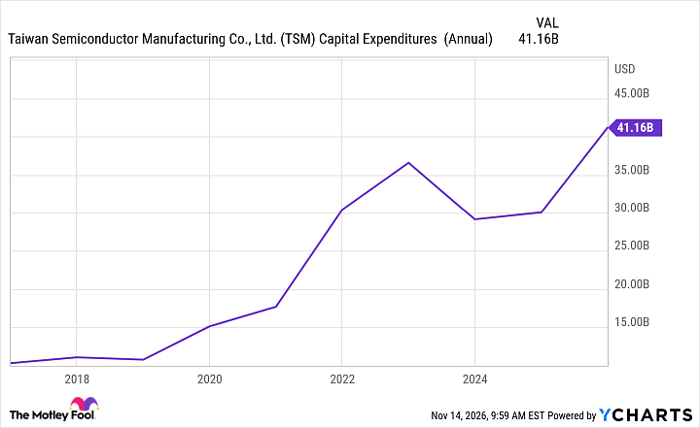
TSM Capital Expenditures (Annual) data by YCharts
With demand booming and outpacing supply, spending to expand capacity makes sense. TSMC noted it has "robust multiyear demand" that justifies the investment.
Few companies have a stronghold in their specific industry like TSMC. Current AI boom aside, it's the go-to chip manufacturer for everything from smartphones to TVs to car infotainment systems and more. Its current dominance, growth opportunities, and rock-solid financials make it a no-brainer buy heading into 2027.
Should you buy stock in Taiwan Semiconductor Manufacturing right now?
Before you buy stock in Taiwan Semiconductor Manufacturing, consider this:
The Motley Fool Stock Advisor analyst team just identified what they believe are the 10 best stocks for investors to buy now… and Taiwan Semiconductor Manufacturing wasn’t one of them. The 10 stocks that made the cut could produce monster returns in the coming years.
Consider when Netflix made this list on December 17, 2004... if you invested $1,000 at the time of our recommendation, you’d have $327,620!* Or when Nvidia made this list on April 15, 2005... if you invested $1,000 at the time of our recommendation, you’d have $959,410!*
Now, it’s worth noting Stock Advisor’s total average return is 802% — a market-crushing outperformance compared to 205% for the S&P 500. Don't miss the latest top 10 list, available with Stock Advisor, and join an investing community built by individual investors for individual investors.
See the 10 stocks »
*Stock Advisor returns as of November 17, 2026.
Stefon Walters has positions in Taiwan Semiconductor Manufacturing. The Motley Fool has positions in and recommends Broadcom, Nvidia, and Taiwan Semiconductor Manufacturing. The Motley Fool has a disclosure policy.
Recommended Articles


