


Dow Drops Over 700 Points With Tech as Main Drag, Nvidia Extends Slide by 4%
TradingKey - On November 16, Eastern Time, U.S. stocks moved lower on Monday, with tech stocks being the primary drag. Nvidia extended its decline as investors continued to monitor the company's CEO succession plan and the impact of tightened U.S. restrictions on overseas access to AI computing power.
At the close, the Dow Jones Industrial Average fell 1.41% to 51,608.17; the Nasdaq Composite Index fell 2.49% to 24,509.76; and the S&P 500 Index fell 1.92% to 7,416.59.
Tech Stock Performance
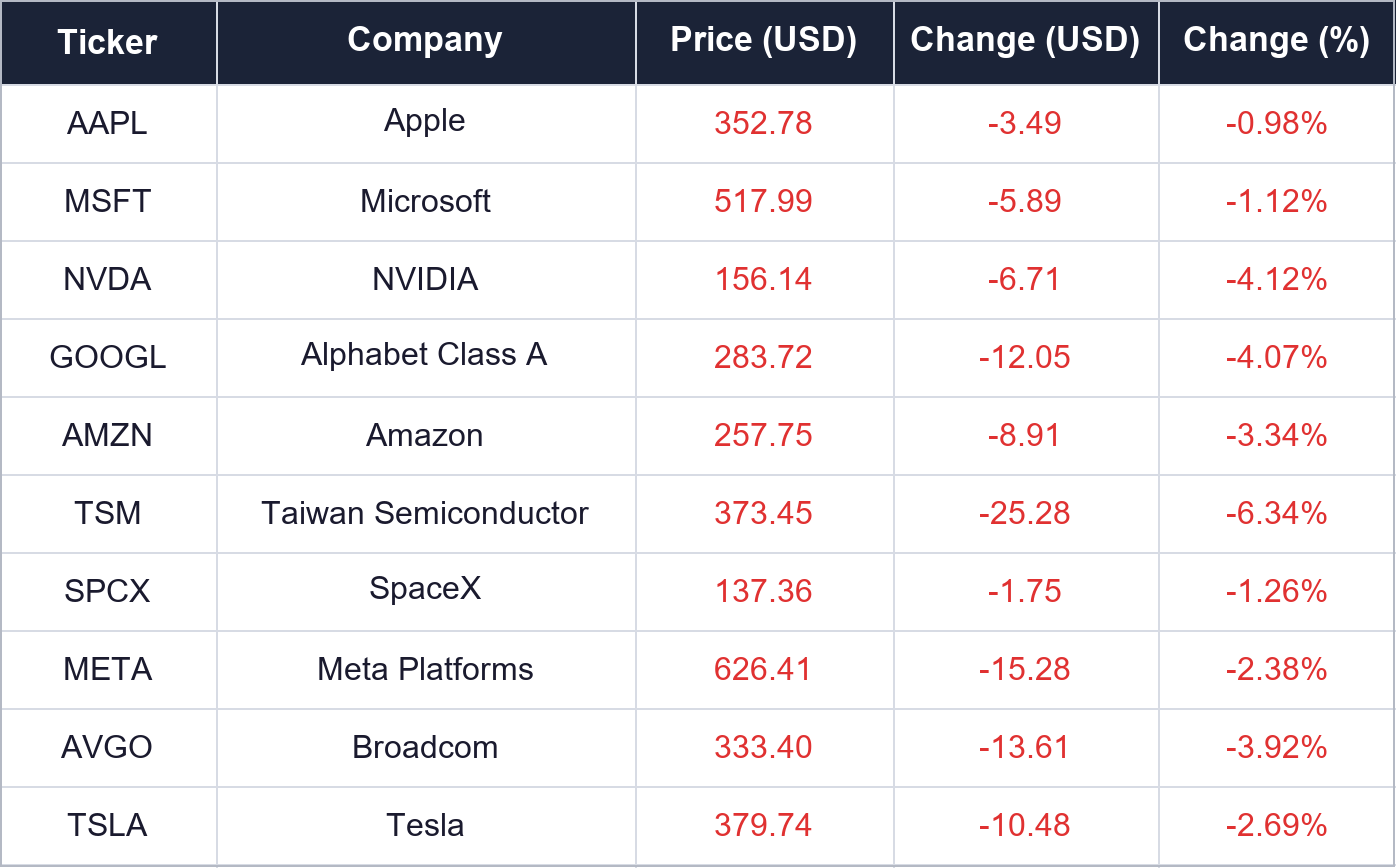
Nvidia (NVDA) fell more than 4%. According to CNBC, the company's board is not currently discussing reinstating Jensen Huang as CEO. Meanwhile, tighter U.S. regulations on remote computing power access via third-country data centers have further fueled market concerns over Nvidia's overseas business.
The performance of mega-cap tech stocks today is shown in the chart below:
The Philadelphia Semiconductor Index fell 5.28% to 9,610.65 points. All 30 constituent stocks fell across the board. Micron Technology (MU) fell 7.62%, Intel (INTC) fell 7.07%, Lam Research (LRCX) fell 6.68%, ASML (ASML) fell 5.91%, AMD (AMD) fell 5.58%, Applied Materials (AMAT) fell 5.47%, and Texas Instruments (TXN) fell 3.09%.
Company News
Nvidia Board Reportedly Has Not Discussed Reinstating Jensen Huang, Moves Ahead with Investigation and CEO Search
According to CNBC, citing people familiar with the matter, Nvidia's board of directors is not currently considering reinstating Jensen Huang as CEO and is focused on investigating whether his personal conduct compromised national security or company trade secrets. The company has retained law firm Wachtell Lipton to lead the probe, and the board previously stated that it is selecting an executive search firm for a new CEO.
Microsoft Discloses Cause of Global Outage: Latent Flaw and Traffic Shift Triggered Cascading Failure
In a preliminary post-incident review, Microsoft disclosed that last week's global Microsoft 365 outage stemmed from a software defect introduced in July of this year. Approximately 15 hours before the outage, Teams traffic was shifted to a network gateway shared with Exchange Online; meanwhile, about 14% of the relevant server capacity was offline due to a separate issue. The combination of increased traffic and reduced available capacity triggered the flaw, causing server resources to be exhausted and servers to stop responding. Automated traffic routing subsequently redirected requests to other servers, causing the outage to cascade further. Microsoft stated that internal testing failed to replicate the real-world traffic combinations and hardware conditions in the production environment, noting that newer servers with higher processor core counts were actually more susceptible to triggering the issue. The company has fixed the affected code and reinforced safeguards for capacity, monitoring, and traffic routing.
SK Hynix Reportedly Moves Ahead with HBM4 Expansion, with Equipment Installation Slated for First Half of 2027
According to South Korea's Electronic Times (ETNews), citing semiconductor equipment industry sources, SK Hynix is moving forward with additional investments in HBM4 production equipment, focusing on packaging and testing stages such as bonding, dicing, and inspection, with the goal of completing equipment move-in and installation in the first half of 2027. The additional equipment is expected to be deployed at the P&T6 plant in Cheongju, utilizing existing idle space to expand HBM4 capacity. Industry sources estimate that once the plant is fully operational, the newly added HBM capacity could exceed 20,000 wafers per month on a wafer-equivalent basis.
Industry & Macro News
US Tightens Controls on Overseas Access to AI Computing Power, Closing Third-Country Data Center Leasing Route
The U.S. Commerce Department's Bureau of Industry and Security (BIS) issued an interim final rule designed to prevent companies from circumventing existing advanced chip export restrictions through remote computing arrangements at third-country data centers. The new rule targets remote access to advanced AI chips and servers, closing the regulatory gap between physical chip export controls and overseas computing power leasing.
SemiAnalysis Lowers AI Accelerator Spending Forecasts, Cutting 2028 Projection by 28% from Previous Estimate
According to media reports, SemiAnalysis, in its latest model update, lowered its forecasts for global AI accelerator capital expenditures in 2028 and 2030 by 28% and 40%, respectively, and cut its cumulative forecast for accelerator logic silicon shipment area from 2026 to 2030 by 17%. In addition, the 2028 HBM demand forecast was revised down by 30%, and the 2030 power consumption demand forecast was reduced by 34%.
Nvidia accounted for 66% of the reduction in silicon shipment area forecasts in this round. Measured by compute revenue corresponding to shipments, SemiAnalysis lowered its 2030 forecast for Nvidia by 66%, with adjustments reflecting changes to both shipment volume and average selling price assumptions. The firm cited slowing revenue growth among AI companies, tightening financing conditions, and data center construction delays as the primary reasons for the adjustments.
Warsh on AI's Economic Impact: Fed Assesses Productivity Gains, Job Losses, and Return-on-Investment Risks
Federal Reserve Chair Kevin Warsh said Monday at a Productivity and Employment Task Force meeting in San Francisco that Fed staff have begun modeling the various economic outcomes that widespread AI adoption could bring, focusing on assessing its impact on productivity, economic growth, and the labor market.
Warsh outlined three scenarios: AI boosts productivity, with workers and capital owners sharing the gains of growth; AI drives economic expansion, but automation displaces certain jobs, leading to higher unemployment; or returns on AI investments fall short of expectations, triggering a pullback in stock valuations, an economic slowdown, and rising unemployment, ultimately failing to deliver the anticipated productivity gains.
Recommended Articles


