


Anthropic's IPO Takes Place on November 19. Investors Will Learn These 3 Key Details.
Key Points
Investors will get more insight into the economics of selling AI to determine if AI spending is actually sustainable.
SpaceX showed that the market's appetite for AI-sector IPOs was strong, and Anthropic's oversubscription suggests that it still is.
- 10 stocks we like better than Space Exploration Technologies ›
Anthropic will take center stage on Nov. 19 when it holds its initial public offering (IPO). It will be a critical day for the artificial intelligence (AI) trade, as how the stock is received could indicate whether the party is truly over or if it's full speed ahead.
While investors will be keeping an eye on a number of details connected to Anthropic, these are three of the most important details to monitor.
Missed AI’s "Act 1"? Act 2 Could Be 15x Bigger. Most investors think they missed the AI boat because they didn't buy Nvidia in 2005. But according to our analysts, we’re only at the end of "Act 1"—the R&D phase. "Act 2" is the global rollout. Continue »
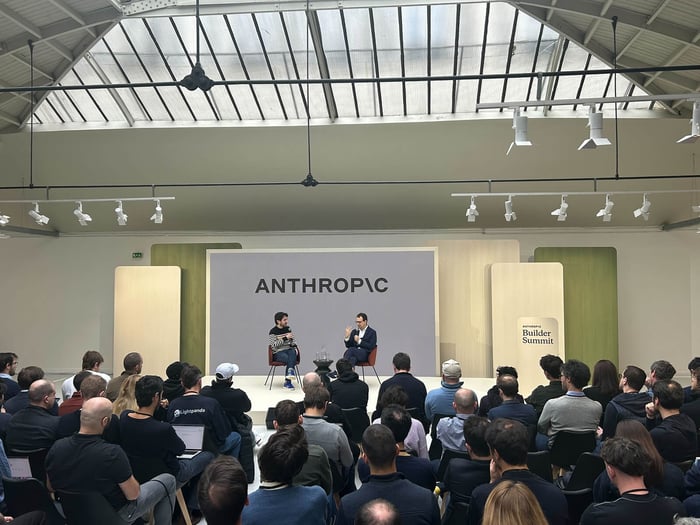
Image source: Anthropic.
The economics of selling AI
Companies like Nvidia (NASDAQ:NVDA) and Micron (NASDAQ:MU) have achieved excellent financial growth due to soaring hardware sales. The economics of selling semiconductors have been well established.
However, investors do not yet know as much about the economics of selling AI services. While companies like Alphabet (NASDAQ:GOOG) (NASDAQ:GOOGL) and Microsoft (NASDAQ:MSFT) have offered hints about their AI service revenues, these corporations were established long before AI became mainstream.
Anthropic will be the true test since its entire business revolves around AI services like Claude. The demand case for Claude is undeniable, but the big question is whether Anthropic can actually turn a profit with its services.
"We finally get to see what the other side of the equation looks like. What do the economics of selling AI look like? That's a great valuation marker. It's a great referendum," Direxion Head of Capital Markets Jake Behan said at Direxion's "Ahead of the Cycle" live briefing at the New York Stock Exchange.
The revenue growth is certainly there, and that has been the case for a while. Anthropic reported $17 billion in Q3 revenue. That was a 1,127% year-over-year jump, but a 47% sequential increase, which indicates that its growth rate is moderating.
The main concern is that Anthropic booked a $23.3 billion net loss in the third quarter. However, its operating loss of $567 million was more palatable. Investors should get more clarity about how Anthropic’s financial state is being viewed after the IPO, and later when the company reports its Q4 earnings.
IPO appetite
The second key insight will be the level of appetite for the newly debuted stock. Anthropic’s IPO will essentially be a measure of whether investors are still willing to take risks as the AI trade continues its prolonged downturn.
Early signs look good. The IPO is about six times oversubscribed. Both institutional and retail investors want to load up on the stock.
That level of demand implies that investors are still eager to get more exposure to the AI trade, despite the current broadly negative sentiment. The amount of capital destined to flow into Anthropic may partially explain why AI stocks have been down in recent weeks. Anthropic is targeting a $1.4 trillion valuation, and all of that money has to come from somewhere.
Anthropic's IPO is generating plenty of buzz, and the oversubscription suggests that an early boom such as the one investors saw with SpaceX (NASDAQ:SPCX) is possible. The challenge will be whether Anthropic holds on to any early gains or deflates like a balloon.
How public markets value service-based AI revenue
Investors use metrics like the price-to-earnings ratio, price/earnings-to-growth (PEG) ratio, and price-to-sales ratio to value companies. While the last metric has its flaws, it’s the only one of those that can be applied here since Anthropic is still unprofitable.
While it's easy to weigh the values of chipmakers against each other with those metrics, Anthropic doesn't have publicly traded peers to measure its valuation against — and won’t until OpenAI's IPO, which most expect to happen next year.
Some investors can forgive a young company high net losses if its revenue growth is surging and it’s making progress toward consistent profitability. That generosity will be tested in the days and weeks after Anthropic's IPO.
This year’s previous blockbuster IPO, SpaceX, has been quite the roller coaster ride for shareholders. However, investors were quite happy with its Q3 earnings report, which came out on Oct. 20, and featured 161% year-over-year revenue growth and $4.4 billion in net income.
SpaceX owns the Grok large language model, so it may be a good gauge of how investors approach Anthropic. If Anthropic’s operating losses get more manageable or it transitions to delivering positive net income, that may be enough to offset any concerns that come up.
How Anthropic fares in the weeks following its IPO won't just matter for the company. It will be a vital indicator of the state of the entire AI trade.
Should you buy stock in Space Exploration Technologies right now?
Before you buy stock in Space Exploration Technologies, consider this:
The Motley Fool Stock Advisor analyst team just identified what they believe are the 10 best stocks for investors to buy now… and Space Exploration Technologies wasn’t one of them. The 10 stocks that made the cut could produce monster returns in the coming years.
Consider when Netflix made this list on December 17, 2004... if you invested $1,000 at the time of our recommendation, you’d have $335,171!* Or when Nvidia made this list on April 15, 2005... if you invested $1,000 at the time of our recommendation, you’d have $1,000,640!*
Now, it’s worth noting Stock Advisor’s total average return is 823% — a market-crushing outperformance compared to 208% for the S&P 500. Don't miss the latest top 10 list, available with Stock Advisor, and join an investing community built by individual investors for individual investors.
See the 10 stocks »
*Stock Advisor returns as of November 16, 2026.
Marc Guberti has no position in any of the stocks mentioned. The Motley Fool has positions in and recommends Alphabet, Micron Technology, Microsoft, Nvidia, and Space Exploration Technologies. The Motley Fool has a disclosure policy.
Recommended Articles


