


The Evidence Is Piling Up: AMD Could Be the Best Artificial Intelligence (AI) Stock to Buy Amid the Sell-Off
Key Points
The demand for AMD's server CPUs continues to grow, as evidenced by the company's expanded agreement with Google.
AMD is forecasting a significant uptick in growth next year and expects to sustain solid growth for a long time, driven by expansion in the server CPU market.
AMD's earnings growth potential and valuation point to a nice surge in its stock price through the end of the decade.
- 10 stocks we like better than Advanced Micro Devices ›
The past few months haven't been pretty for semiconductor stocks, as evidenced by the 12% decline in the PHLX Semiconductor Sector index over the past three months. Even Advanced Micro Devices (NASDAQ:AMD) has been caught up in this vortex, experiencing significant volatility amid concerns about the sustainability of artificial intelligence (AI) infrastructure spending, which has been key to the growth of the semiconductor sector.
However, the recent weakness in the semiconductor sector has opened up a great opportunity for investors to buy a top stock at an attractive valuation. AMD is emerging as one of the most important players in the AI chip ecosystem, and I won't be surprised to see it embark on a stunning long-term rally.
Missed AI’s "Act 1"? Act 2 Could Be 15x Bigger. Most investors think they missed the AI boat because they didn't buy Nvidia in 2005. But according to our analysts, we’re only at the end of "Act 1"—the R&D phase. "Act 2" is the global rollout. Continue »
Let's see why I think that AMD could be one of the best AI stocks you can buy right now.

Image source: Getty Images.
Google has just given AMD a big boost
AMD's Epyc server central processing units (CPUs) are in tremendous demand from hyperscalers and AI companies. As a result, the company's data center revenue jumped by 97% year over year in Q3 to $8.5 billion. The good news for AMD investors is that its data center segment has incredible room for growth.
Alphabet's (NASDAQ:GOOG) (NASDAQ:GOOGL) Google Cloud division has expanded its partnership with AMD to deploy the latter's 5th-generation Epyc server CPUs, security fabric, and x86 software to power its cloud Tensor Processing Unit (TPU) systems. AMD Epyc will serve as the foundation for Google's TPUs, allowing users to run inference applications.
The good news for AMD investors is that Alphabet is poised to spend aggressively on its cloud computing infrastructure. After all, the Google Cloud business reported a backlog of a whopping $561 billion at the end of the third quarter. The tech giant expects to recognize half of that backlog in the next two years, which explains why its capital expenditure is ballooning.
AMD, therefore, is going to be a direct beneficiary of Alphabet's enormous spending. Not surprisingly, the company expects its growth to accelerate at a solid clip. AMD expects revenue to increase by more than 80% in 2027, fueled by healthy growth in the data center business, where it sees the server CPU total addressable market (TAM) jump to $220 billion by 2030.
Importantly, AMD is well-positioned to capitalize on this massive opportunity. It has partnerships with major hyperscalers and AI companies, including OpenAI, Anthropic, Meta Platforms, Microsoft, and others, in the data center segment. These customers should ensure solid long-term revenue growth for AMD, which is precisely what analysts are expecting.
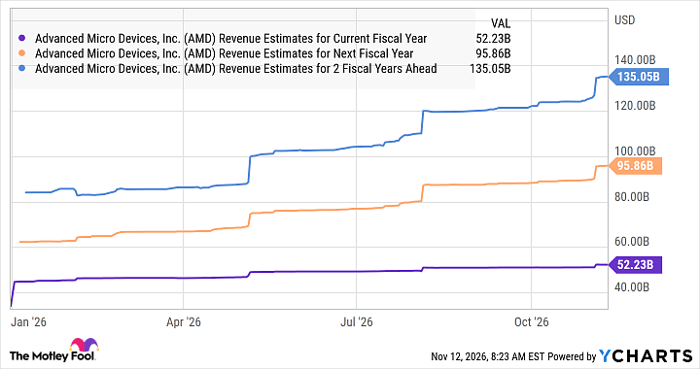
AMD Revenue Estimates for Current Fiscal Year data by YCharts
The $52.2 billion revenue estimate for 2026 points to a 51% jump over last year. The forecast for 2027 and 2028 is also quite solid, indicating that AMD is on track to become a significantly larger company. The good news for investors is that AMD's revenue growth will filter down to the bottom line as well.
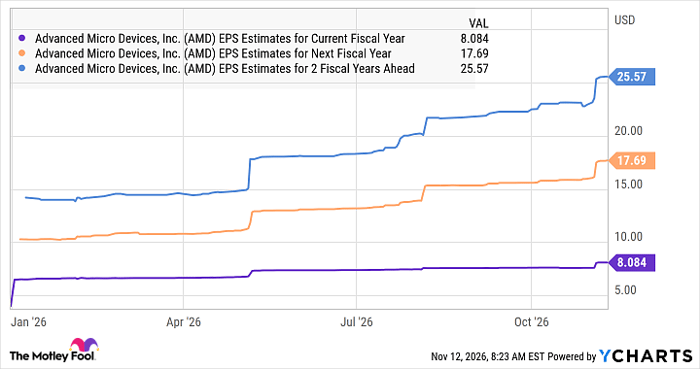
AMD EPS Estimates for Current Fiscal Year data by YCharts
Finally, when we consider the company's long-term earnings growth potential and valuation, it becomes clear why buying this semiconductor stock amid the recent sell-off could be a smart move.
The stock seems primed for a big jump
AMD trades at 33 times forward earnings, making it quite attractive given the impressive pace of earnings per share (EPS) growth. It is also worth noting that analysts expect its EPS to grow by nearly 70% annually over the long run.
Assuming AMD clocks even 50% earnings growth in 2029 and 2030, its EPS could reach $57.53 by the end of the decade (using 2028's projected EPS of $25.57 as the base). A price-to-earnings (P/E) ratio of 20 at that time, which is in line with the tech-focused Nasdaq-100 index's forward P/E, would send AMD's shares to $1,150 in just over four years.
That's twice AMD's current price, which is why opportunistic investors should capitalize on the recent weakness in the semiconductor sector and buy this stock for long-term gains.
Should you buy stock in Advanced Micro Devices right now?
Before you buy stock in Advanced Micro Devices, consider this:
The Motley Fool Stock Advisor analyst team just identified what they believe are the 10 best stocks for investors to buy now… and Advanced Micro Devices wasn’t one of them. The 10 stocks that made the cut could produce monster returns in the coming years.
Consider when Netflix made this list on December 17, 2004... if you invested $1,000 at the time of our recommendation, you’d have $335,171!* Or when Nvidia made this list on April 15, 2005... if you invested $1,000 at the time of our recommendation, you’d have $1,000,640!*
Now, it’s worth noting Stock Advisor’s total average return is 823% — a market-crushing outperformance compared to 208% for the S&P 500. Don't miss the latest top 10 list, available with Stock Advisor, and join an investing community built by individual investors for individual investors.
See the 10 stocks »
*Stock Advisor returns as of November 15, 2026.
Harsh Chauhan has no position in any of the stocks mentioned. The Motley Fool has positions in and recommends Advanced Micro Devices, Alphabet, Meta Platforms, and Microsoft. The Motley Fool has a disclosure policy.
Recommended Articles


