


Coinbase Global vs. Mastercard: Which Financial Stock Is a Better Buy for 2027?
Key Points
Coinbase Global has expanded beyond trading into international derivatives and stablecoin infrastructure.
Mastercard maintains top-tier profitability while processing transactions across more than 220 countries and territories.
Which financial innovator offers the better risk-adjusted opportunity for your portfolio in 2027?
- Motley Fool Issues Rare "Total Conviction" Buy Alert ›
As digital assets and traditional payments converge, investors often weigh the high-growth potential of Coinbase Global (NASDAQ:COIN) against the steady, massive cash flows of Mastercard (NYSE:MA) to determine the better long-term buy.
While both companies operate in the broad payments landscape, they serve very different niches. Coinbase provides the infrastructure for the burgeoning crypto economy, whereas Mastercard manages a massive global network for fiat transactions. Comparing them helps clarify whether you prefer the volatility of emerging tech or the stability of a dominant financial incumbent.
The case for Coinbase Global
Coinbase Global generates revenue primarily from transaction fees on its platform and a growing subscription and services segment. The company serves individual consumers, large institutions through Coinbase Prime, and developers building on decentralized networks. It has recently expanded its reach through the acquisition of Deribit, enabling it to offer international cryptocurrency products such as options and perpetual swaps. Coinbase maintains a significant partnership with Circle (NYSE:CRCL) regarding USDC (CRYPTO:USDC), which supports its stablecoin services. Revenue concentration remains a factor, as a meaningful portion of net revenue is tied to transactions involving Bitcoin (CRYPTO:BTC) and Ethereum (CRYPTO:ETH), as well as stablecoin revenue.
In fiscal 2025, revenue reached nearly $7.2 billion, representing growth of approximately 9.4% over the previous year. The company reported net income of close to $1.3 billion, yielding a net margin of roughly 17.6%. This performance reflects a shift toward more diversified revenue streams as the company matures within the fintech stocks landscape. While trading volumes fluctuate based on market sentiment, the services segment provides a more predictable revenue floor than the transaction-heavy model of previous cycles.
As of Coinbase's December 2025 balance sheet, the debt-to-equity ratio was approximately 0.5, suggesting a moderate level of total debt relative to shareholder equity. The current ratio, which measures the ability to cover short-term liabilities with short-term assets, stood at a healthy 2.3. Free cash flow for fiscal 2025 was nearly $2.4 billion, calculated as cash from operations minus capital expenditures. Note that stock-based compensation accounted for roughly 34.6% of operating cash flow, inflating reported cash generation, as this is a non-cash expense added back in the cash flow statement.
The case for Mastercard
Mastercard functions as a global payments technology provider, connecting financial institutions, merchants, and consumers via its proprietary network. It does not issue cards or extend credit directly, which insulates it from the credit-default risk faced by traditional lenders. In 2026, the company acquired BVNK to enhance its regulated stablecoin payment and settlement capabilities, signaling an evolution in its digital strategy. It also maintains a strategic partnership with SoFi Technologies (NASDAQ:SOFI) to enable stablecoin settlement for card programs. The business relies on a diverse range of brands, including Maestro and Cirrus, to facilitate transactions in more than 150 currencies.
In fiscal 2025, revenue reached roughly $32.8 billion, a 16.4% increase over the prior year. The company achieved net income of approximately $15.0 billion, resulting in an exceptionally high net margin of 45.6%. This high level of profitability is a hallmark of the company's scalable network model, in which additional transaction volume incurs relatively little incremental cost. Revenue growth was driven by a combination of domestic spending and a continued recovery in cross-border travel and related transaction fees.
As of Mastercard's December 2025 balance sheet, the debt-to-equity ratio was roughly 2.5. The current ratio was approximately 1, indicating that short-term assets roughly equaled short-term liabilities. Free cash flow for fiscal 2025 reached close to $16.4 billion. Because stock-based compensation was only about 3.4% of operating cash flow, the company's cash generation is considered high quality and is not significantly inflated by non-cash pay. This robust cash flow allows for consistent capital returns to shareholders and strategic investments in new technology.
Risk profile comparison
Coinbase Global faces significant operating results dependence on the volatility of crypto asset prices and overall trading volumes. Regulatory and litigation exposure remains a primary concern, as the company faces scrutiny from authorities like the New York Attorney General regarding marketing practices. It also continues to defend against class action lawsuits concerning the alleged sale of unregistered securities. Additionally, the company must manage security risks related to cyberattacks and the protection of private keys, alongside revenue concentration in a few major digital assets.
Mastercard faces intense competition from other global networks like Visa (NYSE:V) and American Express (NYSE:AXP), as well as rising fintech alternatives and government-backed digital infrastructure. The company is a defendant in ongoing antitrust litigation related to merchant transaction fees and interchange rates, which could impact future pricing power. Geopolitical trends, including sanctions and data localization requirements, can also disrupt cross-border volumes. Furthermore, Mastercard must navigate rapid technological shifts, such as AI integration, while protecting its network from large-scale cybersecurity incidents and fraud.
Valuation comparison
Mastercard carries a higher valuation based on trailing sales, while Coinbase Global is currently priced at a higher multiple of its future earnings estimates.
| Metric | Coinbase Global | Mastercard |
|---|---|---|
| Forward P/E | 57.1 | 30.9 |
| P/S ratio | 7.1 | 15.4 |
Valuation metrics include sourcing from Financial Modeling Prep (FMP) and may differ from other data providers.
Which stock would I buy in 2027?
Coinbase Global starts at a disadvantage here because I am a crypto skeptic (and a Mastercard shareholder). Crypto has no inherent value -- it doesn't produce earnings or cash flow and has no real-world utility. Buying cryptocurrency as an investment is entirely a bet that someone will later buy it from you at a higher price.
Furthermore, Coinbase Global's fortunes are inextricably linked to those of crypto:
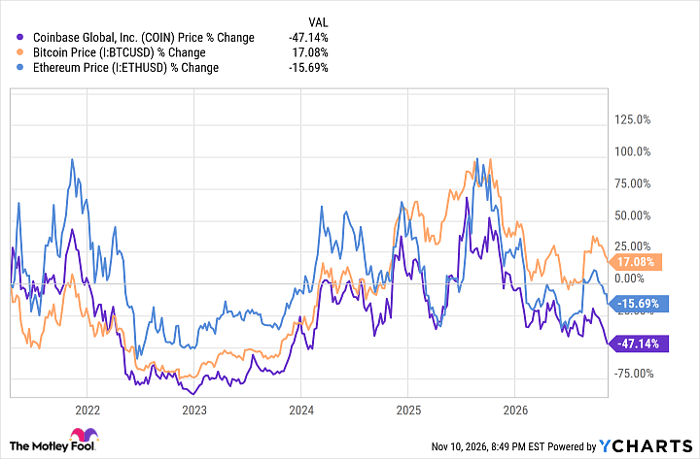
COIN data by YCharts
Observe how closely Coinbase's stock mimics the price movements of Bitcoin and Ethereum (except worse). To me, Coinbase seems like a second-order play on crypto, and not a very good one, to boot.
I've owned shares of Mastercard for about eight years, and I don't intend to sell anytime soon. It pays a modest dividend, has a high net margin, and doesn't have the level of crypto exposure that Coinbase can't escape. I just wouldn't hitch my wagon to cryptocurrency. Perhaps that makes me a boring investor, but Mastercard looks like a more attractive investment to me.
Should you buy stock in Coinbase Global right now?
Before you buy stock in Coinbase Global, consider this:
The Motley Fool Stock Advisor analyst team just identified what they believe are the 10 best stocks for investors to buy now… and Coinbase Global wasn’t one of them. The 10 stocks that made the cut could produce monster returns in the coming years.
Consider when Netflix made this list on December 17, 2004... if you invested $1,000 at the time of our recommendation, you’d have $348,060!* Or when Nvidia made this list on April 15, 2005... if you invested $1,000 at the time of our recommendation, you’d have $1,067,492!*
Now, it’s worth noting Stock Advisor’s total average return is 849% — a market-crushing outperformance compared to 210% for the S&P 500. Don't miss the latest top 10 list, available with Stock Advisor, and join an investing community built by individual investors for individual investors.
See the 10 stocks »
*Stock Advisor returns as of November 13, 2026.
American Express is an advertising partner of Motley Fool Money. Erin Kennedy has positions in Mastercard and Visa. The Motley Fool has positions in and recommends American Express, Bitcoin, Ethereum, Mastercard, and Visa. The Motley Fool recommends Coinbase Global. The Motley Fool has a disclosure policy.
Recommended Articles


