

Apple Shares Hit Fresh Record High: The AI Safe-Haven Premium Logic Behind 37x P/E

Source Tradingkey

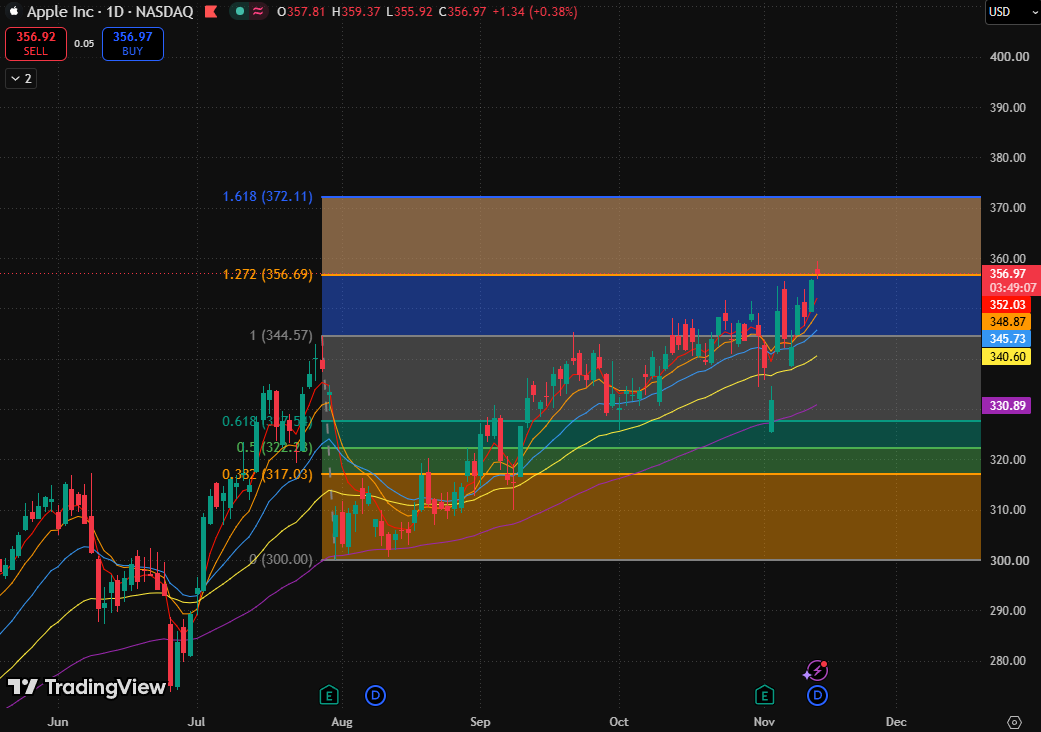
TradingKey - On November 12, Eastern Time, Apple (AAPL) shares rose to $359.3, hitting another record high. Amid a sell-off in AI concept stocks, lower capital expenditures, steady cash flow, and continuous share repurchases have made Apple a choice for capital seeking defensive tech allocations. Bernstein believes the market is pricing Apple like a high-quality consumer company.
6-0e48c02783574193a742ba82fbd6e692

Apple stock price chart, Source: TradingView

Apple’s Cash Flow Advantage in Focus Amid Lighter AI Capex Burden

Bernstein noted that Apple's capital expenditures account for approximately 2% of revenue. By partnering with Google (GOOGL) and running certain AI models on-device, the company has reduced its reliance on expensive AI servers.

This leaves Apple less exposed to the cash flow squeeze from massive data center construction. When investors begin to worry about returns on AI investments, financing costs, and the sustainability of equipment procurement, Apple's appeal stems from a different logic: participating in AI applications while retaining more capital for shareholder returns.

In fiscal 2026, Apple returned approximately $102 billion to shareholders through buybacks and dividends. Bernstein expects the company will still have the capacity to repurchase shares equivalent to approximately 3.0% and 3.3% of its market capitalization in fiscal 2027 and 2028, respectively. Sustained buybacks reduce share count, helping support earnings per share while bolstering investor confidence in its earnings stability.

Apple's P/E Hits Record 37x: Why Is the Market Willing to Pay a Premium?

Apple currently trades at roughly 37 times expected calendar year 2027 earnings per share, with its relative forward P/E reaching twice that of the S&P 500, leaving both metrics at historical highs.

This premium does not stem from industry-leading growth. Bernstein noted that while Apple's growth does not stand out among megacap tech companies, its revenue streams are more predictable: roughly 1.4 billion active iPhone users generate continuous upgrade demand, and the services business contributes about 40% of gross profit, further strengthening earnings durability.

Customer loyalty and pricing power also support this view. Citing surveys, Bernstein noted that iPhone brand retention is around 90%, with price sensitivity lower than that of other mainstream smartphones. This means the company is better positioned to defend its customer base and product margins.

The firm therefore believes Apple is better compared with high-quality consumer companies such as Costco (COST) and Walmart (WMT). With the two trading at forward P/E ratios of roughly 46 times and 39 times, respectively, Apple's 37-times valuation does not stand out in this group.

The stock reaching a new high reflects the market's willingness to pay a premium for cash flow and earnings visibility. However, record-high valuations also mean that Apple must continue to deliver on upgrade demand, services growth, and share repurchases going forward so that EPS growth keeps pace with the stock price, rather than relying on safe-haven inflows to continuously lift multiples.

Disclaimer: For information purposes only. Past performance is not indicative of future results.
placeholder
Gold Price Analysis Today | Forex Gold Analysis | XAU/USD Analysis - November 11, 2026Get the latest gold price analysis, forex gold insights, and XAU/USD analysis for November 11, 2026. Read on for the details.
Author  Mitrade
Nov 11, Wed
Get the latest gold price analysis, forex gold insights, and XAU/USD analysis for November 11, 2026. Read on for the details.
placeholder
Nvidia slid 7.7% after hours while AMD and Broadcom rose — the AI trade changed hands, it didn't breakNvidia closed Wednesday at 173.73, up 2.87%, then fell as much as 8.1% to 159.44 after reports that its board was preparing for a possible leadership change. The same session, the Philadelphia Semiconductor Index rose 5.7% with all 30 components higher, CoreWeave jumped 24.7% on 168% revenue growth, and Micron added 11.9%. If AI demand were being repriced, AMD and Broadcom would not be bid. This is a governance discount on one name, and 204.54 — the 200-day average — is the level that settles it.
Author  Irene Q.
Nov 12, Thu
Nvidia closed Wednesday at 173.73, up 2.87%, then fell as much as 8.1% to 159.44 after reports that its board was preparing for a possible leadership change. The same session, the Philadelphia Semiconductor Index rose 5.7% with all 30 components higher, CoreWeave jumped 24.7% on 168% revenue growth, and Micron added 11.9%. If AI demand were being repriced, AMD and Broadcom would not be bid. This is a governance discount on one name, and 204.54 — the 200-day average — is the level that settles it.
placeholder
US October PPI Preview: Fed Rate Hike Expectations Rise, PPI May Be Key Variable; How Will US Stocks, Dollar, and Gold Move?On Friday (Nov. 13) Eastern Time, the U.S. will release the October Producer Price Index (PPI). Following the October CPI once again exceeding expectations, the market will look to the PP
Author  TradingKey
Nov 12, Thu
On Friday (Nov. 13) Eastern Time, the U.S. will release the October Producer Price Index (PPI). Following the October CPI once again exceeding expectations, the market will look to the PP
placeholder
Gold hit a one-year low while central banks bought 321 tonnes — the sellers were never the ones you thinkSpot gold closed at 3,876 on Thursday, down 2.8% and its lowest close in more than a year, with an intraday low near 3,852. The dollar is at a 19-month high of 103.21 and the 10-year yield is at 5.10%, so the price move is easy to explain. What is harder to explain is who sold: central banks bought 321 tonnes in Q3, the PBoC added for a 24th straight month, ETF holdings are near a record 4,256 tonnes, and roughly 95% of the futures selling came from non-reportable and sovereign-type accounts rather than hedge funds. This piece separates the two books that have to balance.
Author  Irene Q.
Yesterday 02: 40
Spot gold closed at 3,876 on Thursday, down 2.8% and its lowest close in more than a year, with an intraday low near 3,852. The dollar is at a 19-month high of 103.21 and the 10-year yield is at 5.10%, so the price move is easy to explain. What is harder to explain is who sold: central banks bought 321 tonnes in Q3, the PBoC added for a 24th straight month, ETF holdings are near a record 4,256 tonnes, and roughly 95% of the futures selling came from non-reportable and sovereign-type accounts rather than hedge funds. This piece separates the two books that have to balance.
placeholder
Brent rose 3.3% and US crude stocks built 4.66 million barrels in the same weekBrent January settled at 95.82, up 3.3%, and WTI at 88.74, up 2.55%, after the US signalled it would not pursue a deal with Iran and attacks on Gulf shipping continued. In the same week, EIA data showed US crude inventories rising 4.657 million barrels against expectations of a 1.1 million draw, with gasoline up another 1.799 million. OPEC output also rebounded 1.96 million barrels a day to 27.16 million in October, led by Saudi Arabia at 10.56 million. This piece separates the geopolitical premium from the physical balance and lays out where each side of the trade is anchored.
Author  Irene Q.
Yesterday 03: 06
Brent January settled at 95.82, up 3.3%, and WTI at 88.74, up 2.55%, after the US signalled it would not pursue a deal with Iran and attacks on Gulf shipping continued. In the same week, EIA data showed US crude inventories rising 4.657 million barrels against expectations of a 1.1 million draw, with gasoline up another 1.799 million. OPEC output also rebounded 1.96 million barrels a day to 27.16 million in October, led by Saudi Arabia at 10.56 million. This piece separates the geopolitical premium from the physical balance and lays out where each side of the trade is anchored.
goTop
quote