


How These 5 Aerospace Stocks Earn Money Beyond New Plane Sales
Key Points
GE and RTX benefit from industry production ramps and installed engine bases.
TransDigm and Loar Holdings use acquisition-driven, niche-focused strategies.
AAR Corp is a leading independent aftermarket services company.
- 10 stocks we like better than GE Aerospace ›
The aerospace market can be broadly split into two groups: original equipment manufacturers (OEMs) and aftermarket companies. While the OEM companies are the most highly visible, the latter are often the most profitable and relatively more stable due to a stream of recurring revenue that can last decades in some cases. Here's a look at five companies with heavy aftermarket exposure, namely GE Aerospace (NYSE: GE), TransDigm Group (NYSE: TDG), Loar Holdings (NYSE: LOAR), AAR Corp (NYSE: AIR), and RTX (NYSE: RTX).
GE Aerospace and LEAP engines
GE Aerospace's joint venture with Safran, CFM International, is the dominant player in the aircraft engine market, with its LEAP engine used on both the Boeing 737 MAX (the sole option) and on the Airbus A320neo family (RTX's Pratt & Whitney also provides an engine). These two narrow-body airplanes are the workhorses of the skies. GE Aerospace also has the GEnx engine on the Boeing 787 Dreamliner and the GE9X engine on the upcoming Boeing 777X.
Missed Nvidia in 2009? This Rare Signal Is Flashing Again. In 2009, a "Double Down" signal flashed for a little-known chipmaker called Nvidia. For the first time in years, that same "Total Conviction" signal is flashing for a company 1/100th the size of Nvidia. Continue »
It's an extremely powerful position, and as Boeing and Airbus aggressively ramp production to try to deliver on their multi-year backlogs, GE/CFM will grow their installed base of engines. That's great news for long-term profitability, because although new engines are usually sold at a loss, they can generate more than 40 years of lucrative aftermarket revenue as engines come in for "shop visits" and are overhauled.
As such, investors should focus on the long term with GE Aerospace. As CEO Larry Culp noted on the last earnings call, "With the LEAP installed base expected to more than double between 2025 and 2030, our team focused on increasing capacity for the LEAP fan assembly." That increase speaks to a long road of lucrative income ahead.
TransDigm competes in niche markets
One of the characteristic features of aerospace parts is that they are strictly regulated and controlled by aviation bodies like the Federal Aviation Administration (FAA) and European Union Aviation Safety Agency (EASA). That gives companies like highly engineered aerospace components manufacturer TransDigm an opportunity to hold significant pricing power in the aftermarket.

Image source: Getty Images.
About 55% of its revenue comes from the aftermarket (commercial aerospace and defense). The company's acquisition-led strategy is to buy manufacturers of relatively small and niche proprietary parts (TransDigm has bought over 100 businesses since 1993) and then incorporate them into its overall operations.
It's a strategy that has resulted in startling profit margins for an industrial company and creates the cash flow to reinvest in acquisitions.
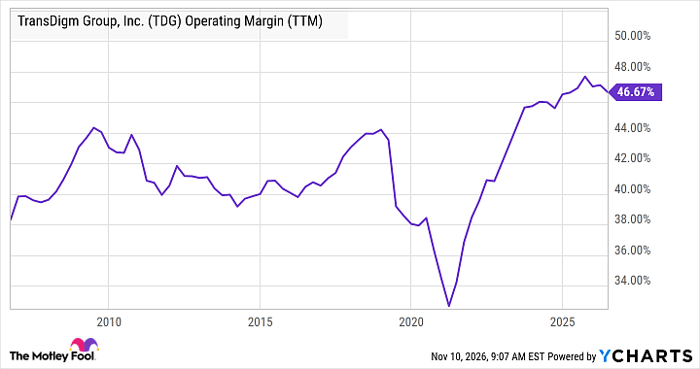
TDG Operating Margin (TTM) data by YCharts.
Loar's business model looks familiar
The TransDigm model is so successful that Loar is following a similar strategy. In fact, CEO Dirkson Charles and CFO Glenn D'Alessandro were both senior executives at McKechnie Aerospace, a company acquired by TransDigm in 2010.
Loar's playbook reads like a copy of TransDigm's, with a focus on highly engineered niche components in aerospace and defense, where management believes it holds market-leading positions. If it's half as successful as TransDigm, it would be a highly attractive option for investors.
AAR Corp
Aftermarket services company AAR Corp provides parts distribution, maintenance, repair, and overhaul (MRO) services, as well as maintenance software, to a wide range of commercial airlines, defense customers, and OEM customers (including Airbus, GE Aerospace, and RTX).
It's a direct beneficiary of the pickup in air travel since the end of the pandemic, and of the fact that older airplanes continue to be flown more as Boeing and Airbus are still ramping up production. Moreover, its acquisition of a majority stake in MRO Holdings will expand its geographic reach and service offerings to its existing customer base.

Image source: Getty Images.
RTX Corp
I've previously discussed the improving prospects for RTX's defense business, Raytheon. Now it's time to focus on its commercial aerospace aftermarket business (RTX also has an extensive OEM business), It runs across Collins Aerospace, and more importantly, Pratt & Whitney aircraft engines, where in common with GE Aerospace's CFM International joint venture, it has a long tail of aftermarket revenue from its installed base of engines in the Airbus A320 neo family of aircraft.
All told, these five companies offer investors an excellent way to profit from an investing theme likely to stay relevant for many decades to come.
Should you buy stock in GE Aerospace right now?
Before you buy stock in GE Aerospace, consider this:
The Motley Fool Stock Advisor analyst team just identified what they believe are the 10 best stocks for investors to buy now… and GE Aerospace wasn’t one of them. The 10 stocks that made the cut could produce monster returns in the coming years.
Consider when Netflix made this list on December 17, 2004... if you invested $1,000 at the time of our recommendation, you’d have $341,157!* Or when Nvidia made this list on April 15, 2005... if you invested $1,000 at the time of our recommendation, you’d have $1,037,753!*
Now, it’s worth noting Stock Advisor’s total average return is 834% — a market-crushing outperformance compared to 207% for the S&P 500. Don't miss the latest top 10 list, available with Stock Advisor, and join an investing community built by individual investors for individual investors.
See the 10 stocks »
*Stock Advisor returns as of November 11, 2026.
Lee Samaha has no position in any of the stocks mentioned. The Motley Fool has positions in and recommends Aar, Boeing, GE Aerospace, RTX, Safran, and TransDigm Group. The Motley Fool has a disclosure policy.
Recommended Articles


