


Nvidia Stock Price Forecast: Shares May Break Below Multiple $164 Support Levels as Jensen Huang Probe and Succession Concerns Add to Market Selling Pressure
TradingKey - On November 10, Eastern Time, Nvidia (NVDA) shares hit a new recent intraday low. Following market concerns over returns on AI investments and a slowdown in data center construction, an independent investigation and shareholder litigation surrounding Chief Executive Officer Jensen Huang have prompted investors to reassess the company's governance risks. Market concerns that leadership uncertainty could weaken the company's execution capabilities have led investors to lower the valuation multiples they are willing to assign.
Nvidia's board of directors announced on November 8 that it had launched an independent investigation into reports that Jensen Huang may have been targeted by foreign intelligence activities, overseen by an independent board committee and external counsel. The board also stated that there is currently no reason to believe national security or company secrets have been compromised, and that it continues to maintain confidence in Huang and the management team.
However, the matter has already entered the litigation phase. According to Reuters, shareholders filed a proposed class-action lawsuit on November 9, alleging that Nvidia and Huang concealed relevant relationships and their potential risks, misled investors, and seeking damages.
For shareholders, a greater uncertainty lies in whether leadership can remain stable. Bernstein noted that Huang sets Nvidia's long-term strategy, has approximately 60 direct reports, and the company lacks an obvious second-in-command. Such a centralized management structure means that the impact of a sudden leadership change could extend across product roadmaps, customer coordination, and strategic investments, rather than merely replacing a single position.
The Information reported that executive search firms may have already begun scouting candidates to present alternatives should Nvidia's board decide to replace Huang. Potential candidates include AMD (AMD) Chief Executive Officer Lisa Su and Arm (ARM) Chief Executive Officer Rene Haas.
Even if no personnel changes ultimately occur, the investigation could continue to consume management's attention. If a transition takes place, the market would need to reassess whether a new team could sustain Huang's role in technological decision-making and customer relations. Such uncertainty could depress valuations in advance, without waiting for changes in revenue to materialize.
From a technical perspective, Nvidia has broken below the 0.786 Fibonacci retracement level ($181.20), with the current key pivot at $164.27. Recent rebounds failed to reclaim lost ground and were followed by another lower open and pullback, indicating that short-term momentum remains weak.
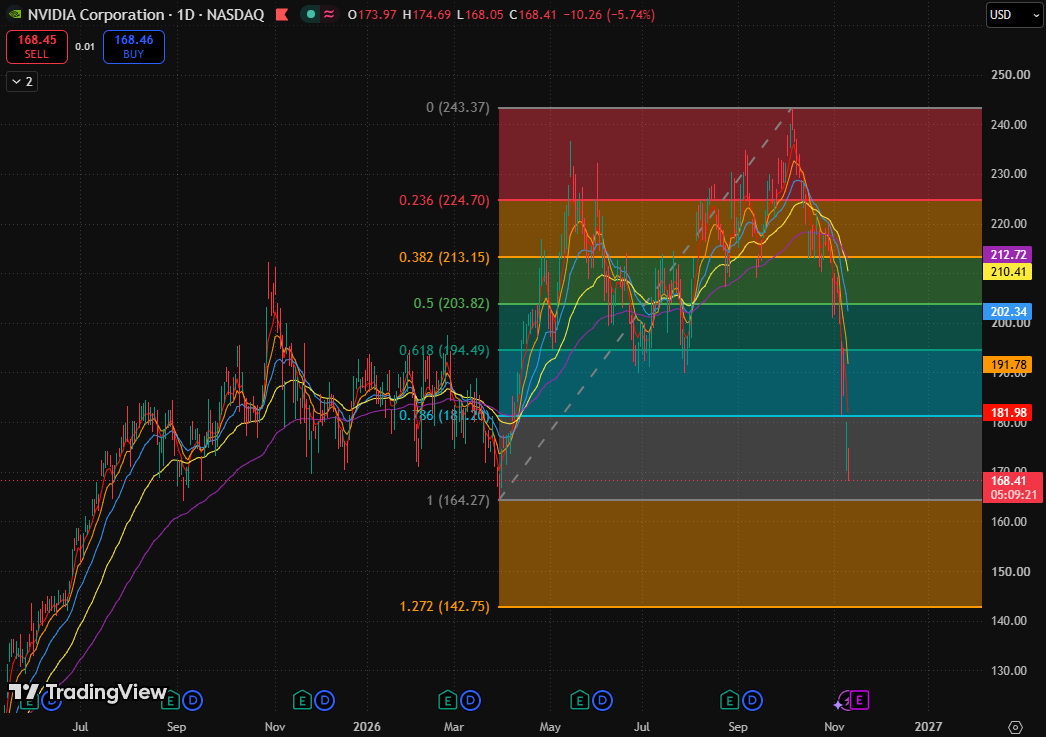
Nvidia daily stock price chart, Source: TradingView
Regarding moving averages, the 5-day exponential moving average ($181.98), 10-day exponential moving average ($191.78), and 20-day exponential moving average ($202.34) continue to exert downward pressure, with short-term moving averages fanning downward. The 80-day exponential moving average ($210.41) has fallen below the 160-day exponential moving average ($212.72), and medium-term moving averages have also shifted into a bearish sequence. The price is below all five moving averages, which have formed a complete bearish alignment, pointing to consistent weakness across both short- and medium-term horizons.
If the stock price breaks below $164.27 and a rebound fails to reclaim it, the test of previous lows will shift toward a downward extension, potentially declining further toward the 1.272 Fibonacci extension level ($142.75) to seek support.
If the stock price finds support at $164.27, it could stage a gradual recovery toward the $181.20–$181.98 zone formed by the 0.786 Fibonacci retracement level and the 5-day exponential moving average; the next resistance level above lies in the $191.78–$194.49 area formed by the 10-day exponential moving average and the 0.618 Fibonacci retracement level.
Recommended Articles


