


If I Could Buy and Hold Only 1 Artificial Intelligence (AI) Stock Through a Democratic Congress, It Would Be This One
Key Points
Democrats won control of both the House of Representatives and the Senate in the 2026 midterms.
One of the biggest talking points for Democrats on the campaign trail was heavier oversight over AI data centers.
While more regulation could impact the hyperscalers, Apple is in a unique position to benefit no matter who controls Congress.
- Motley Fool Issues Rare "Total Conviction" Buy Alert ›
The 2026 midterm elections have introduced a layer of uncertainty for artificial intelligence (AI) investors. With Democrats winning control of both chambers of Congress, lawmakers are preparing to introduce legislation addressing AI safety, electricity costs, and the expansion of data centers across the United States.
For companies such as Nvidia (NASDAQ: NVDA), Microsoft (NASDAQ: MSFT), Amazon (NASDAQ: AMZN), Alphabet (NASDAQ: GOOGL) (NASDAQ: GOOG), Meta Platforms (NASDAQ: META), Tesla (NASDAQ: TSLA), and Space Exploration Technologies (NASDAQ: SPCX), the implications could be significant.
Missed Nvidia in 2009? This Rare Signal Is Flashing Again. In 2009, a "Double Down" signal flashed for a little-known chipmaker called Nvidia. For the first time in years, that same "Total Conviction" signal is flashing for a company 1/100th the size of Nvidia. Continue »
Much of the AI revolution has been driven by investments in semiconductors, cloud computing, and data center infrastructure. There's one technology giant pursuing a different strategy. If I could buy and hold just one AI stock throughout the next two years of a divided government, I'd consider Apple (NASDAQ: AAPL). Let's dig into why.
Image source: The Motley Fool.
Apple's AI strategy is different from its competitors
Most of the largest AI developers are spending unprecedented sums of money building AI infrastructure. Nvidia supplies the graphics processing units powering these facilities, while Microsoft, Amazon, Alphabet, and Meta are investing hundreds of billions of dollars each year to expand their computing capacity. Tesla is also spending heavily on autonomous driving and robotics.
Apple is taking a different approach. Rather than competing to build data centers, Apple is focused on bringing AI capabilities directly to its existing products. This includes integrating generative AI features into the iPhone, the Mac, and Siri, while relying on partners for additional computing capabilities.
The financial implications of this strategy are compelling. During fiscal 2026, Apple's capital expenditures (capex) declined 29% to roughly $9 billion. Meanwhile, research and development (R&D) spending increased 32% to $45.8 billion, reflecting continued investment across software and AI.
The takeaway here is that Apple is investing heavily in innovation without committing nearly as much capital to physical AI infrastructure as its hyperscaler peers. That difference could become important if Congress pursues legislation that makes building new data centers more difficult.
Why Apple looks more resilient to AI regulation
Data centers consume enormous amounts of electricity and water, raising questions about utility costs, environmental impacts, and whether local communities should shoulder the financial burden of new development. Many Democratic lawmakers are indicating that they intend to pursue additional oversight when the new Congress convenes.
It's important to note that President Donald Trump retains veto authority, meaning sweeping federal restrictions are not guaranteed. Nevertheless, even the possibility of tighter regulation introduces uncertainty for big tech.
Slower data center construction could affect demand for Nvidia's chips. For cloud services providers such as Amazon, Microsoft, and Alphabet, new restrictions could hinder expansion plans and make budgeting more challenging.
By contrast, Apple already has a global installed base across billions of devices through which it can push AI-powered features. Rather than building an entirely new customer ecosystem, Apple can introduce updated capabilities to people who already own its products. This creates a unique opportunity to encourage device upgrades, strengthen customer loyalty, and potentially expand its budding services business.
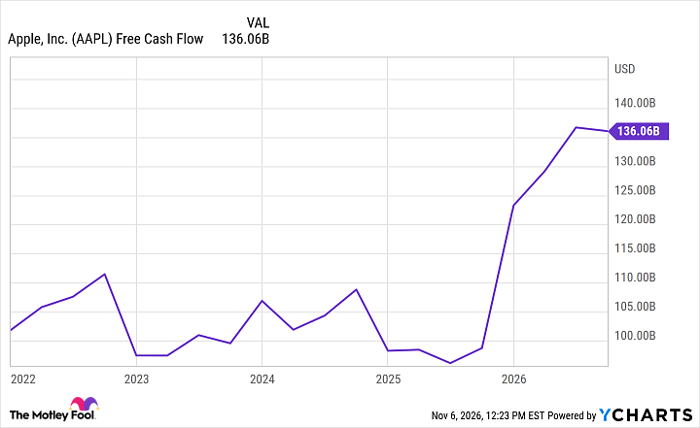
Apple's cash flow is the biggest reason to own the stock
While Apple's AI strategy is interesting, the company's underlying financial performance is what makes the investment thesis compelling. During its fiscal fourth quarter (ended Sept. 26), Apple generated $114.5 billion in revenue, representing 12% growth year over year.
iPhone revenue increased 17% to $57.6 billion, while services revenue reached $31.6 billion. These figures illustrate an important point: Apple does not need AI to become an entirely new business segment overnight.
AAPL Free Cash Flow data by YCharts
The company's existing products and services already generate meaningful revenue, providing management with the financial flexibility to invest in emerging technologies without jeopardizing the core operation. Moreover, Apple's relatively modest capex profile allows it to preserve more cash for dividends, share repurchases, and future product innovation.
While the next two years could bring changes to the regulatory environment surrounding AI, Apple stands out because the company doesn't need to win the AI infrastructure spending race to benefit from the technology. It just needs to make AI useful enough that consumers continue buying its products and paying for its services.
For investors, that flexibility is especially valuable. That's why Apple is my top buy-and-hold AI stock in the current political landscape.
Should you buy stock in Apple right now?
Before you buy stock in Apple, consider this:
The Motley Fool Stock Advisor analyst team just identified what they believe are the 10 best stocks for investors to buy now… and Apple wasn’t one of them. The 10 stocks that made the cut could produce monster returns in the coming years.
Consider when Netflix made this list on December 17, 2004... if you invested $1,000 at the time of our recommendation, you’d have $353,560!* Or when Nvidia made this list on April 15, 2005... if you invested $1,000 at the time of our recommendation, you’d have $1,115,850!*
Now, it’s worth noting Stock Advisor’s total average return is 852% — a market-crushing outperformance compared to 203% for the S&P 500. Don't miss the latest top 10 list, available with Stock Advisor, and join an investing community built by individual investors for individual investors.
See the 10 stocks »
*Stock Advisor returns as of November 6, 2026.
Adam Spatacco has positions in Alphabet, Amazon, Microsoft, Nvidia, and Tesla. The Motley Fool has positions in and recommends Alphabet, Amazon, Apple, Meta Platforms, Microsoft, Nvidia, Space Exploration Technologies, and Tesla. The Motley Fool has a disclosure policy.
Recommended Articles


