


Stock-Split Watch: Is Micron (MU) Next?
Key Points
Micron stock is currently a top-five performing stock in the S&P 500 this year.
Micron's meteoric rise stems from surging demand for artificial intelligence (AI) memory solutions.
One of Micron's peers, Sandisk, recently approved an 8-for-1 stock split.
- Motley Fool Issues Rare "Total Conviction" Buy Alert ›
In a similar fashion to the last few years, artificial intelligence (AI) stocks have brought more market-beating gains in 2026. Few have performed as well as Micron Technology (NASDAQ: MU). As of this writing (Nov. 5), Micron stock has gained 138% year to date -- making it the fifth-best-performing stock in the S&P 500 (SNPINDEX: ^GSPC).
Micron's rally has been fueled by unrelenting demand for memory chips, which have become important components of AI data centers. With Sandisk (NASDAQ: SNDK) recently announcing a stock split, investors may be wondering whether Micron could follow suit.
Missed Nvidia in 2009? This Rare Signal Is Flashing Again. In 2009, a "Double Down" signal flashed for a little-known chipmaker called Nvidia. For the first time in years, that same "Total Conviction" signal is flashing for a company 1/100th the size of Nvidia. Continue »
I think Micron's latest capital allocation decisions suggest management has other priorities.

Image source: Getty Images.
Why has Micron stock soared in 2026?
Micron's success can be traced to accelerating demand for dynamic random-access memory (DRAM). DRAM temporarily stores information that computers need to access. Unlike long-term storage, which preserves files and information even when a device is off, DRAM helps processors retrieve data while applications are running.
This is especially important for generative AI models, which need to process vast amounts of information at high speeds. Micron also manufactures high bandwidth memory (HBM), a specialized form of DRAM optimized for moving data between memory and advanced AI accelerators, including Nvidia GPUs.
As the hyperscalers build data centers, demand for both conventional DRAM and HBM has surged. However, adding additional memory isn't something suppliers can do easily. Building new manufacturing facilities and expanding production capacity require time and capital.
In addition, producing HBM consumes manufacturing resources that would otherwise be used for conventional DRAM. This has resulted in tight supply across the AI memory market, benefiting manufacturers such as Micron by allowing them to charge higher prices.
Sandisk's stock split raises an interesting question
Micron isn't the only memory company enjoying a record year. Sandisk, which specializes in NAND flash memory used for data storage, is also benefiting from demand for AI infrastructure. To date, Sandisk stock has gained 252% in 2026, making it the S&P 500's second-best performing stock.
On Oct. 29, Sandisk announced an 8-for-1 stock split, scheduled to take effect after the market closes on Nov. 19. Management explained that the split would make its shares more accessible to retail investors and employees.
It's important to understand how stock splits work. Let's say an investor owned one share of Sandisk stock worth $1,200 before the split. Once the split goes into effect, you would own eight shares worth $150 each afterward. Notice how the value of the investment doesn't change.
Given Micron's similar performance, it's understandable to wonder whether management might pursue the same strategy. After all, Micron stock surpassed $1,200 earlier this year, potentially making individual shares prohibitive for retail investors without access to fractional-share trading.
Why Micron probably won't split its stock anytime soon
Micron has already announced a significant capital allocation initiative. On Oct. 8, the company's board of directors expanded its existing share repurchase authorization to $35.16 billion. Repurchases under the program may begin on Dec. 9.
That specific date is important. Micron's CHIPS Act funding agreements impose restrictions on share repurchases during the first two years. Beginning Dec. 9, a different set of conditions applies, including limitations and uses around free cash flow.
Of course, a stock split and buyback program aren't mutually exclusive. Sandisk has pursued both. Nevertheless, Micron's upsized repurchase authorization gives investors a more direct financial development to monitor.
In addition, Micron's share price has declined considerably in recent trading sessions. Following the midterm elections, semiconductor stocks have experienced meaningful drawdowns amid concerns about the outlook for AI infrastructure spending.
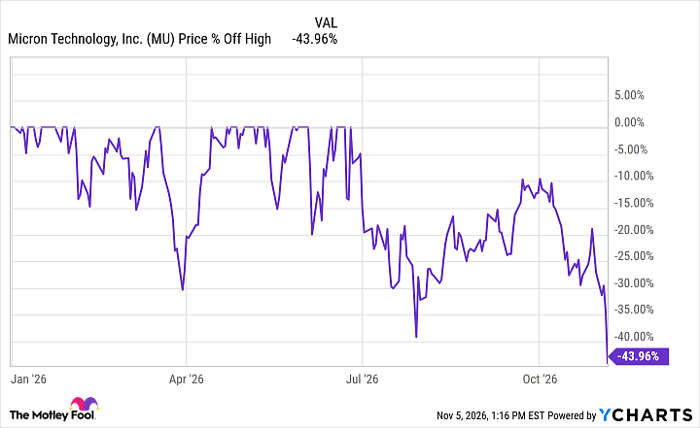
MU data by YCharts
Micron now trades around $682, down 44% from its all-time high. This pullback now makes Micron stock considerably less expensive than it was just a few weeks ago. This lowers one of the practical arguments for splitting the stock.
While I wouldn't rule out a Micron stock split at some point, I don't think investors should expect an announcement simply because Sandisk recently approved one. For now, I'd focus on Micron's ability to sustain its earnings momentum rather than speculate about an impending stock split.
Should you buy stock in Micron Technology right now?
Before you buy stock in Micron Technology, consider this:
The Motley Fool Stock Advisor analyst team just identified what they believe are the 10 best stocks for investors to buy now… and Micron Technology wasn’t one of them. The 10 stocks that made the cut could produce monster returns in the coming years.
Consider when Netflix made this list on December 17, 2004... if you invested $1,000 at the time of our recommendation, you’d have $353,560!* Or when Nvidia made this list on April 15, 2005... if you invested $1,000 at the time of our recommendation, you’d have $1,115,850!*
Now, it’s worth noting Stock Advisor’s total average return is 852% — a market-crushing outperformance compared to 203% for the S&P 500. Don't miss the latest top 10 list, available with Stock Advisor, and join an investing community built by individual investors for individual investors.
See the 10 stocks »
*Stock Advisor returns as of November 6, 2026.
Adam Spatacco has positions in Nvidia. The Motley Fool has positions in and recommends Micron Technology and Nvidia. The Motley Fool has a disclosure policy.
Recommended Articles


