


Why Did Tesla, SpaceX Plunge? 'Musk Selloff' Erases $456 Billion in Two Days as Democratic Win Heightens Regulatory Risks
TradingKey - Elon Musk heavily backed Republican candidates in the 2026 U.S. midterm elections, but failed to prevent Democrats from winning control of Congress, leaving his business empire facing fresh market pressure. Over the past two trading sessions, Tesla (TSLA) and SpaceX (SPCX) shares fell consecutively, erasing approximately $456 billion in cumulative market value.
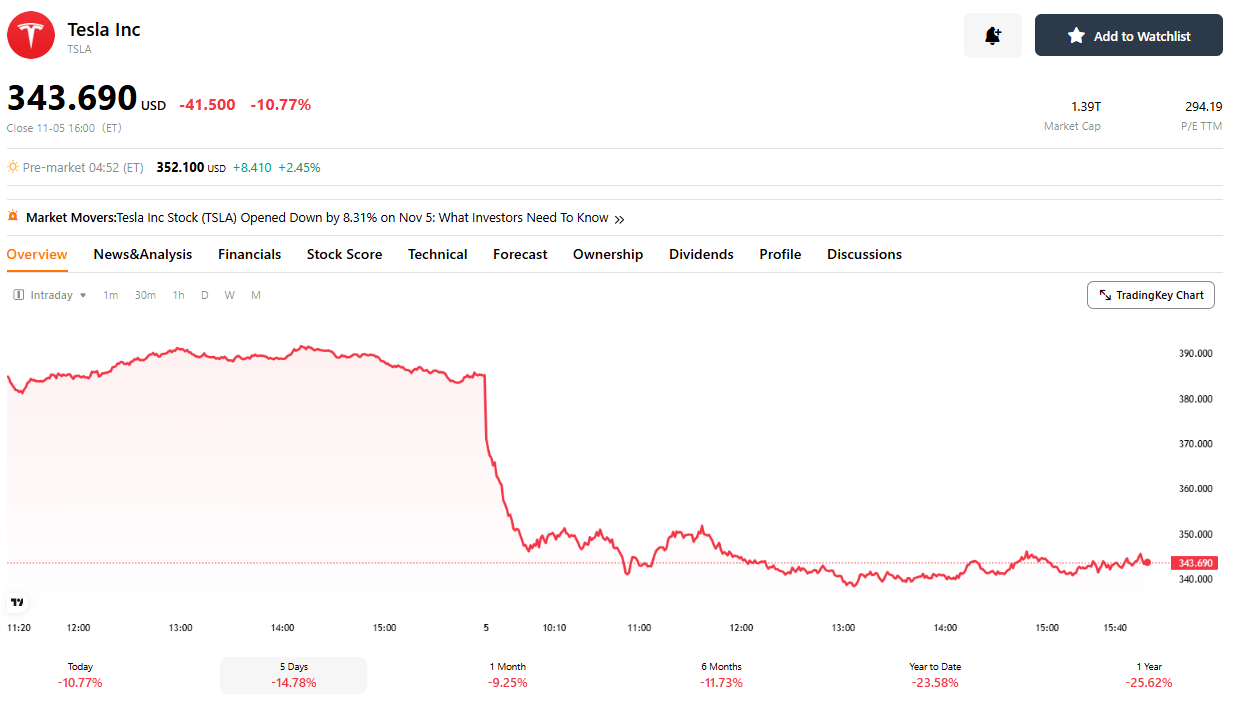
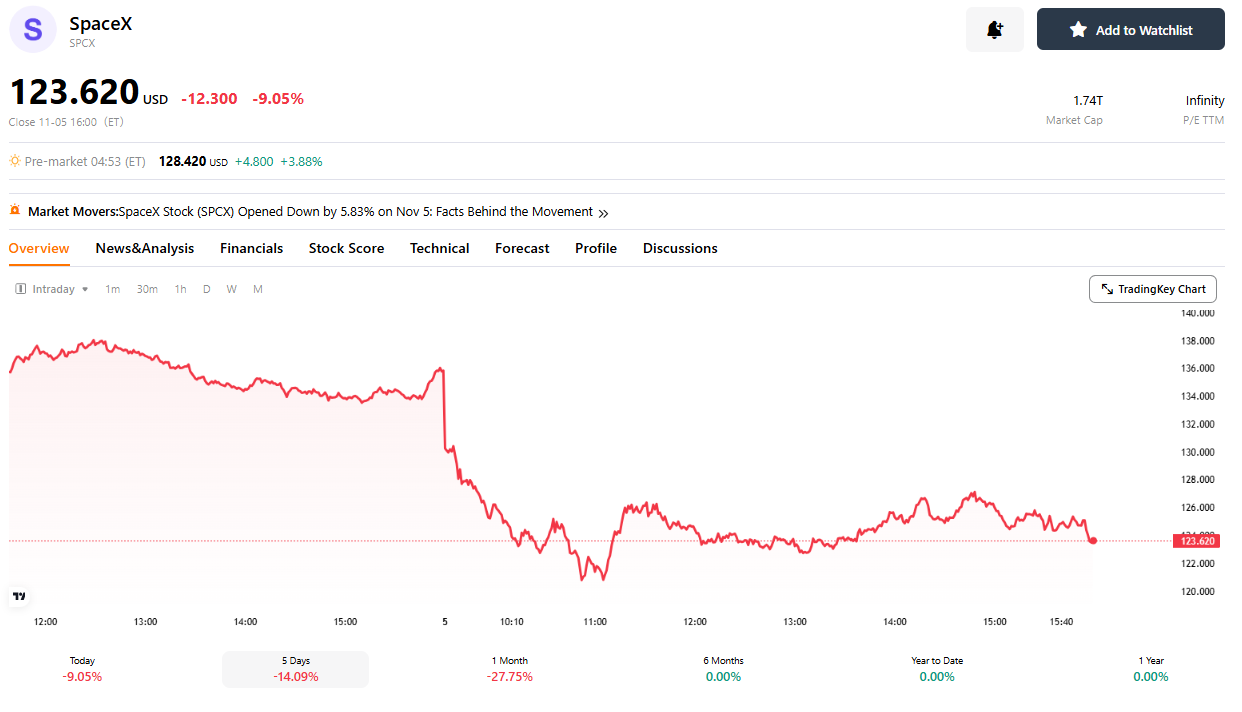
Source: TradingKey
This market move, dubbed the 'Musk Selloff' by Wall Street, was dragged down by a broader tech rout and also reflected investors reassessing the regulatory, government contract, and data center construction risks Musk's companies could face after Democrats took control of both chambers of Congress.
Meanwhile, Musk's personal fortune also shrank notably. According to Forbes estimates, his net worth fell about 9% on Thursday to $789.5 billion. Although he remains atop the global wealth rankings, this market correction means that the volatility stemming from his fortune being heavily tied to the valuations of Tesla and SpaceX has resurfaced once again.
Tesla and SpaceX Face Dual Selloff as Political Bets Backfire
On Thursday, U.S. stocks were already in the midst of a sharp correction, with the Nasdaq 100 Index falling 6.4% and the Philadelphia Semiconductor Index tumbling about 12.3%, both posting their worst single-day performances since March 2020.
However, the pressure on Tesla and SpaceX stemmed from more than just the tech sell-off. Over the past few years, Musk has continually deepened ties with Trump and the Republican Party, and once helped lead the Department of Government Efficiency. Campaign records show that in the 2026 midterm elections, he poured approximately $445 million into federal races alone, in addition to investing more funds through other organizations and into state-level elections.
This massive political investment ultimately failed to yield the expected results. According to tallies by Reuters, among the 43 Republican House candidates backed by Musk, 33 have been defeated, and six of the seven Senate candidates have also lost.
The Democrats ultimately won control of both chambers of Congress and indicated that they may investigate Musk and his companies. SpaceX is a major contractor for the U.S. government, with businesses spanning defense launches, Starlink satellites, and military communications. Meanwhile, Tesla requires approvals from local and federal regulators for its autonomous driving and Robotaxi operations. The shift in the political landscape means that regulatory risks for both companies must be repriced into valuations.
The market is also concerned that Democrats could investigate Musk's conduct during his tenure at the Department of Government Efficiency, the awarding process for SpaceX's government contracts, and the use of Starlink in the Russia-Ukraine conflict. While these investigations may not immediately impact corporate revenue, they could heighten uncertainty surrounding business approvals and government partnerships.
Texas 'Turns Blue' as Data Centers and Merger Plans Face Tests
Compared with shifts in congressional power, the election results in Texas have a more direct impact on Elon Musk's business empire. Both Tesla and SpaceX are headquartered in Texas, and Musk has also made the state a key base for rocket launches, AI computing, semiconductor manufacturing, and autonomous driving operations.
In this election, Democrat Gina Hinojosa defeated incumbent Governor Greg Abbott, while James Talarico won the Senate race against Musk-backed Republican candidate Ken Paxton. Musk poured more than $200 million into these Texas elections, yet failed to prevent Democrats from securing key victories.
During her campaign, Hinojosa made data center regulation a key issue, advocating a pause on approving certain new projects until frameworks for electricity costs, water usage, local permitting, and tax incentive systems are refined. The new administration may also scrutinize SpaceX's environmental impact near Starbase under stricter standards and re-evaluate subsidies and tax arrangements previously granted to Musk's companies.
This could affect the Terafab project planned by Tesla and SpaceX in Grimes County, Texas, which aims to integrate a mega data center with semiconductor manufacturing facilities and involves potential investment of up to $119 billion. If approval timelines lengthen, grid interconnection fees rise, or incentives are scaled back, both the project's capital expenditure and launch schedule could be altered.
Data center restrictions are not unique to Texas. Across multiple state and local elections in the U.S., candidates calling for tighter regulation of AI facilities emerged victorious. Goldman Sachs estimates that temporary restrictions at the state and local levels could affect approximately 45% of planned new data center capacity in the U.S., though the actual impact may prove only transitory.
Meanwhile, a potential merger between Tesla and SpaceX faces heightened uncertainty. Musk previously remarked that integrating the two companies into a comprehensive platform spanning automotive, energy, rockets, satellite communications, and artificial intelligence was a "good idea." However, given the massive scale of both companies and Musk's significant control over each, any such transaction would involve related-party issues, minority shareholder rights, government contracts, and antitrust scrutiny.
Recommended Articles


