


Berkshire Hathaway's Stock Portfolio Is Worth About 3 Times What It Paid. The Gains Alone Equal About 19% of the Company.
Key Points
Like any other institution or individual investor, Berkshire Hathaway must pay taxes on realized gains from sales of its stock holdings.
While current unrealized gains are sizeable, Berkshire Hathaway usually scales out of large positions at a fairly slow pace, minimizing the tax impact in any given quarter or year.
Regardless, the conglomerate’s current stock holdings are the smallest piece of the company’s total current value.
- Motley Fool Issues Rare "Total Conviction" Buy Alert ›
Anyone familiar with Berkshire Hathaway (NYSE: BRKA) (NYSE: BRKB) probably knows it owns a bunch of individual stocks largely hand-picked by former CEO Warren Buffett, or more recently, with some input from current CEO Greg Abel.
Have you ever thought about how these holdings are taxed though? It's not like a mutual fund or exchange-traded fund, which require a yearly reckoning. As a C corporation, Berkshire's stock holdings are taxed much like an individual investor's are. That is, the capital gains tax bill is incurred for the tax year in which the asset is sold.
Missed AI’s "Act 1"? Act 2 Could Be 15x Bigger. Most investors think they missed the AI boat because they didn't buy Nvidia in 2005. But according to our analysts, we’re only at the end of "Act 1"—the R&D phase. "Act 2" is the global rollout. Continue »
Regardless, there's a pretty big future tax liability sitting on Berkshire's books right now. Just don't worry about it if you're a shareholder. It's unlikely you'll even notice when the time comes to sell any of these positions.
The surprising numbers
As of the middle of this year, Berkshire Hathaway was sitting on $323.8 billion worth of individual stocks, including Coca-Cola, Apple, and American Express. It only paid a total of $106.5 billion for these picks over the course of the past many years, however, translating into unrealized net gains of $217.3 billion that will eventually become realized, taxable gains. For perspective on that figure, Berkshire's total market cap at the time was $1.1 trillion. All of these numbers have changed somewhat since then, although not by much.

Image source: Getty Images.
Current shareholders don't need to worry too much about capital gains taxes chipping away at the conglomerate's net profits, however. Like his predecessor, Abel moves big positions around pretty slowly, using time to the company's full advantage.
And this raises the question: If its stock portfolio is currently worth $361.3 billion, while the organization's market cap stands at nearly $1.2 trillion, what accounts for the remaining $828.7 billion in Berkshire Hathaway's market valuation?
Another $365.5 billion of it is cash or near-cash equivalents, such as short-term government bonds. That means the other $463.2 billion reflects the perceived value of all the privately owned businesses that are part of the Berkshire Hathaway family, including Clayton Homes, insurer GEICO, Duracell batteries, and Dairy Queen, just to name a few.
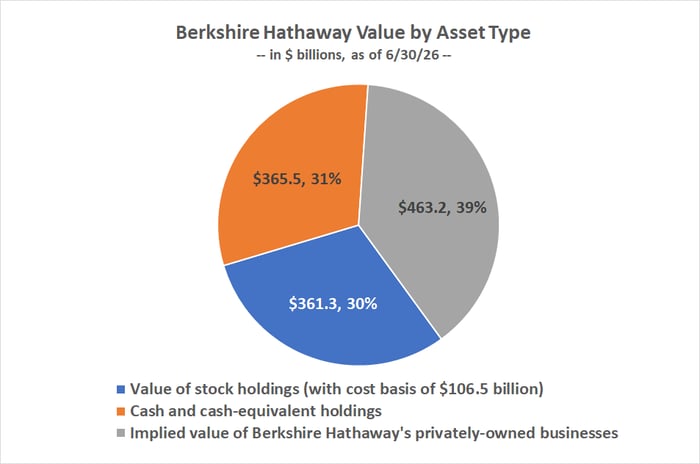
Data source: Berkshire Hathaway. Chart by author.
Yes, you're seeing that right -- Berkshire's stocks are the smallest piece of its total value, and the businesses you rarely hear about are the largest.
Moreover, this $463.2 billion in wholly owned enterprises is on pace to produce on the order of $48 billion in operating earnings this fiscal year. From an income-based perspective, these privately owned companies may still be collectively undervalued by the market, even if their typical profit-growth rates are in the modest single digits.
Interesting, but irrelevant
But that big looming tax bill? Again, don't worry too much about it. It's unlikely you'll even notice it if and when the time comes. The conglomerate's sold out several positions this year alone, and investors didn't bat an eye. In fact, Berkshire's unrealized net gains were also $202.7 billion five years ago, when its stock portfolio was worth $307.9 billion. Plenty of those positions, however, have changed in the meantime.
Should you buy stock in Berkshire Hathaway right now?
Before you buy stock in Berkshire Hathaway, consider this:
The Motley Fool Stock Advisor analyst team just identified what they believe are the 10 best stocks for investors to buy now… and Berkshire Hathaway wasn’t one of them. The 10 stocks that made the cut could produce monster returns in the coming years.
Consider when Netflix made this list on December 17, 2004... if you invested $1,000 at the time of our recommendation, you’d have $342,020!* Or when Nvidia made this list on April 15, 2005... if you invested $1,000 at the time of our recommendation, you’d have $1,270,017!*
Now, it’s worth noting Stock Advisor’s total average return is 885% — a market-crushing outperformance compared to 208% for the S&P 500. Don't miss the latest top 10 list, available with Stock Advisor, and join an investing community built by individual investors for individual investors.
See the 10 stocks »
*Stock Advisor returns as of November 5, 2026.
American Express is an advertising partner of Motley Fool Money. James Brumley has positions in Coca-Cola. The Motley Fool has positions in and recommends American Express, Apple, and Berkshire Hathaway. The Motley Fool has a disclosure policy.
Recommended Articles


