


Starlink's Subscriber Growth Is Explosive. Could SpaceX Unlock a Second Growth Engine?
Key Points
Starlink subscribers reached 13.6 million at the end of September, showing explosive growth.
Despite subscriber growth, Starlink's ARPU has been (mostly) on the decline.
If Starlink and Space Exploration Technologies can innovate and give subscribers a reason to pay more and reverse the larger ARPU trend, it could be a huge tailwind for the bottom line.
- Motley Fool Issues Rare "Total Conviction" Buy Alert ›
Space Exploration Technologies (NASDAQ: SPCX) investors looking at Starlink's growth probably won't find much to complain about. Its consumer subscriber count reached 13.6 million at the end of September, increasing approximately 89% from a year earlier. Consumer revenue jumped approximately 57% during the third quarter. That's hardly a business stuck on the launchpad.
But there's a surprising figure beneath those impressive results: Starlink's average revenue per user (ARPU) was lower than a year earlier.
Missed AI’s "Act 1"? Act 2 Could Be 15x Bigger. Most investors think they missed the AI boat because they didn't buy Nvidia in 2005. But according to our analysts, we’re only at the end of "Act 1"—the R&D phase. "Act 2" is the global rollout. Continue »
That deserves attention. It could also reveal an opportunity if Starlink can continue attracting customers while increasing the revenue each subscription generates. The latest quarter offered an encouraging development.
Image source: Space Exploration Technologies.
More customers, less revenue per subscription
Starlink's ARPU declined from $83 in the third quarter of 2025 to $69 in the third quarter of 2026 -- a roughly 17% decrease.
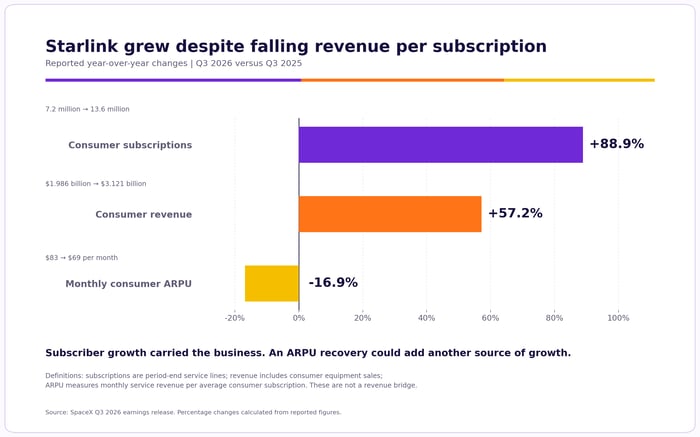
Data source: Space Exploration Technologies SEC filings. Chart source: Author using ChatGPT for editing.
The longer history shows this wasn't an isolated dip. Annual average ARPU declined from $91 in 2024 to $81 in 2025, according to SpaceX's prospectus. It then reached $66 during both the first and second quarters of 2026.
Why was the average falling while the business was growing so quickly? SpaceX attributed the year-over-year decline to international expansion and lower-priced service plans. Adding subscriptions in lower-cost markets can pull down the average even as those customers generate additional revenue. That makes the decline more understandable.
Starlink has been broadening its reach, with subscriber growth more than overcoming the pressure on revenue per subscription. Still, investors would certainly welcome a helping of both subscriber growth and improving ARPU.
Small changes, substantial dollars
Third-quarter ARPU increased from $66 to $69 sequentially, an improvement of approximately 4.5%. Meanwhile, Starlink added 1.6 million consumer subscriptions. Management attributed the ARPU improvement to favorable customer mix, with subscriber growth coming from more developed markets.
One quarter doesn't establish a lasting recovery or establish a target. But for a moment, let's consider what a partial rebound could mean as the subscription base expands.
Just as a thought experiment, consider that at 20 million consumer subscriptions, Starlink's current $69 monthly ARPU would represent approximately $16.56 billion in annual service revenue. Recovering to its 2025 average of $81 would lift that figure to $19.44 billion -- an additional $2.88 billion from the same subscription base. In other words, each ARPU dollar may be more important than investors give it credit for.
Those calculations assume the stated subscriptions and that ARPU remain constant for a full year. However, the calculations exclude equipment revenue and represent revenue, rather than profit.
That said, that's a substantial opportunity. But what could actually help Starlink capture it?
Give customers a reason to spend
A recovery wouldn't require every customer to swallow a price increase.
Customer mix is one potential contributor, as the latest quarter demonstrated. Continued growth in higher-revenue markets could help support the average even while Starlink expands elsewhere.
That said, Starlink's service plans provide another avenue. Starlink already differentiates residential offerings through speed and network priority, including 100-Mbps and 200-Mbps plans in select areas. Residential Max offers maximum available speeds and the highest residential network priority. Those differences give customers reasons to consider paying for more capable service.
Innovation could strengthen that proposition. SpaceX expects its V3 satellite rollout to expand capacity and service capabilities, while Starlink's Performance hardware specifications describe network improvements that are intended to enable gigabit speeds. That could create opportunities for premium services, although future pricing and customer adoption remain uncertain.
Additional capacity could also support lower-priced plans and more subscriptions rather than higher ARPU. But at some point, a SpaceX investor has to put faith in management to innovate and find the equilibrium in pricing and market opportunities.
What investors should watch
Starlink's challenge is to find the balance: keep attracting customers while giving more of them a reason to choose higher-value services.
Going forward, one of the most powerful developments for Starlink and SpaceX would be proving it has durable competitive advantages in the form of pricing power. Rising ARPU alone wouldn't prove pricing power, particularly if the improvement comes from customer mix. Stronger evidence would be customers accepting higher prices or upgrading while subscription growth remains healthy.
For investors, that's the development to watch. Starlink has already delivered substantial growth, while revenue per subscription has declined. If both figures start climbing together, SpaceX's consumer connectivity business could have considerably more fuel in the tank.
Should you buy stock in Space Exploration Technologies right now?
Before you buy stock in Space Exploration Technologies, consider this:
The Motley Fool Stock Advisor analyst team just identified what they believe are the 10 best stocks for investors to buy now… and Space Exploration Technologies wasn’t one of them. The 10 stocks that made the cut could produce monster returns in the coming years.
Consider when Netflix made this list on December 17, 2004... if you invested $1,000 at the time of our recommendation, you’d have $334,793!* Or when Nvidia made this list on April 15, 2005... if you invested $1,000 at the time of our recommendation, you’d have $1,257,420!*
Now, it’s worth noting Stock Advisor’s total average return is 874% — a market-crushing outperformance compared to 209% for the S&P 500. Don't miss the latest top 10 list, available with Stock Advisor, and join an investing community built by individual investors for individual investors.
See the 10 stocks »
*Stock Advisor returns as of November 1, 2026.
Daniel Miller has no position in any of the stocks mentioned. The Motley Fool has no position in any of the stocks mentioned. The Motley Fool has a disclosure policy.
Recommended Articles


