


Down 33.3% This Year, Is Netflix the Best Value Stock to Buy in November?
Key Points
Netflix now trades at a discount to the S&P 500.
The company is prioritizing revenue, operating margins, and engagement over its total subscriber count.
A shift in strategy from subscriber quantity to quality will pay off for long-term investors.
- Motley Fool Issues Rare "Total Conviction" Buy Alert ›
If you did a double-take after reading the headline, you're not alone. Labeling Netflix (NASDAQ: NFLX) as a value stock rather than a growth stock is a palpable step change given Netflix's market-crushing gains since going public in 2002.
Missed AI’s "Act 1"? Act 2 Could Be 15x Bigger. Most investors think they missed the AI boat because they didn't buy Nvidia in 2005. But according to our analysts, we’re only at the end of "Act 1"—the R&D phase. "Act 2" is the global rollout. Continue »
But Netflix is down 33.3% year to date at the time of this writing. And over the last five years, Netflix has lost 4.4% while the S&P 500 (SNPINDEX: ^GSPC) has produced an 80% total return.
Here's why Netflix has transformed from a growth stock into a value stock, why the sell-off has gone from bad to worse, and if Netflix is a good buy now.
Image source: Netflix.
Netflix trades at 17.5 times forward earnings
There are plenty of ways to distinguish between growth stocks and value stocks. Some methodologies focus on valuations, others focus on sales and earnings growth rates. Netflix has continued to grow its earnings even as its stock price has fallen. It trades at just 17.5 times forward earnings, which is a discount to the S&P 500's 18.7 forward price-to-earnings ratio. But valuations only tell part of the story.
Growth companies are valued more for the earnings they could produce in the future than for what they are producing today. And that was certainly the case when Netflix was consistently losing money, had negative free cash flow, but was rapidly acquiring subscribers and branching into new markets.
Netflix disrupted home entertainment with mail-order DVDs. And then it pioneered streaming by building a library of licensed content. And then it began producing its own content and winning awards with multiple hit shows and movies.
Starting in 2025, Netflix stopped reporting its quarterly subscriber numbers and average revenue per subscriber -- signaling that its period of hypergrowth was over. Netflix even said in its first quarter 2024 shareholder letter that revenue and operating margins are now its primary financial metrics, and engagement, as measured by time spent on Netflix, is the best metric for gauging customer satisfaction.
I agree with Netflix that viewing time better represents the quality of subscribers and platform engagement rather than the subscriber metric alone. And there's evidence that Netflix's newfound strategy centered around profitability is working -- as Netflix's sales and earnings have continued climbing up and to the right. But its stock price is moving in the opposite direction despite the strong results.
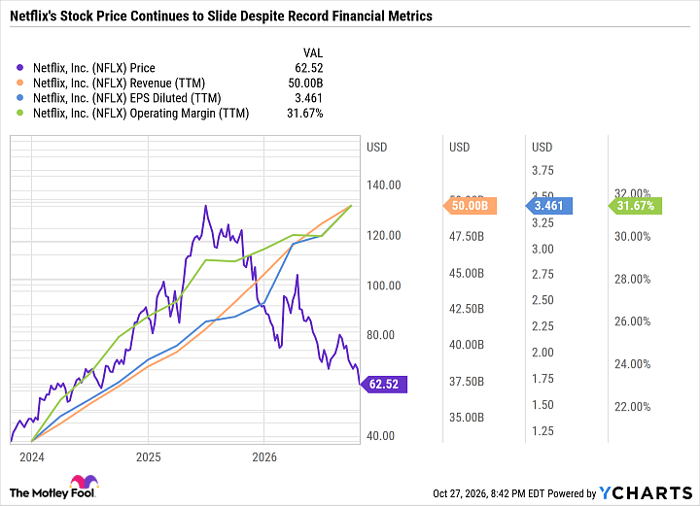
NFLX data by YCharts
When a stock's price gets disconnected from its excellent financial results, it means that investors are concerned about the future of the business, whether its growth will slow, or that the results it is currently producing aren't sustainable. That's why Netflix has gone from commanding a steep market premium for years to now trading at a discount to the S&P 500.
Like Apple, Netflix can mature with grace
Sometimes, investors treat a growth stock-turned-value stock like a supernova that fades into a flickering shell of its former self. And while there are plenty of cases of once-rapidly growing companies that ran too hot and burned into oblivion, there are also countless examples of former paradigm-disrupting businesses that settled into high-quality compounders.
Under Steve Jobs, Apple (NASDAQ: AAPL) was a highly innovative company that transformed mobile phones and personal electronics. But most of Apple's value creation for shareholders occurred under Tim Cook, who focused on creating an integrated ecosystem of products and services that supported steady, high-margin earnings growth and cash flows to fund stock buybacks. Apple is no longer dependent on a single product launch or idea, just as Netflix no longer depends on a single hit movie or TV show to keep subscribers engaged.
Netflix will never be the rapid, highly disruptive company it used to be. But that doesn't mean it's an investment opportunity folks should ignore. In fact, I could see Netflix being a market-beating stock to own over the next decade.
Netflix has the perfect business model for maintaining its industry leadership in streaming. It generates predictable revenue streams from subscribers, which it can use to budget its content spend across a variety of genres to keep subscribers engaged. It also has less expensive subscriptions that include advertising to make the price point more affordable. So while there's no shortage of professionally produced and user-generated content, it's also a mistake to assume that Netflix will ultimately face a period of rapidly declining subscribers.
Netflix has the makings of a market-beating value stock
Netflix has a winning formula for generating steady earnings growth -- which is perfect for value investors. And now that it has lost its market premium and is priced like a value stock, the bar has been lowered for what investors expect from Netflix.
With the streaming service stock at multiyear lows and the market resetting expectations, Netflix stands out as one of the best value stocks to buy now.
Should you buy stock in Netflix right now?
Before you buy stock in Netflix, consider this:
The Motley Fool Stock Advisor analyst team just identified what they believe are the 10 best stocks for investors to buy now… and Netflix wasn’t one of them. The 10 stocks that made the cut could produce monster returns in the coming years.
Consider when Netflix made this list on December 17, 2004... if you invested $1,000 at the time of our recommendation, you’d have $334,631!* Or when Nvidia made this list on April 15, 2005... if you invested $1,000 at the time of our recommendation, you’d have $1,312,844!*
Now, it’s worth noting Stock Advisor’s total average return is 893% — a market-crushing outperformance compared to 213% for the S&P 500. Don't miss the latest top 10 list, available with Stock Advisor, and join an investing community built by individual investors for individual investors.
See the 10 stocks »
*Stock Advisor returns as of October 31, 2026.
Daniel Foelber has positions in Netflix. The Motley Fool has positions in and recommends Apple and Netflix. The Motley Fool has a disclosure policy.
Recommended Articles


