


These 3 Big Risks Could Cause the Next Bear Market. I'm Investing Anyway.
Key Points
In 2022, the year of the most recent bear market, we saw an 18% downturn in the S&P 500 index.
Today’s stock market faces a few big risks, like concentration in tech stocks, uncertainty about AI, and rising interest rates.
Over the past 98 years, the S&P 500 has delivered annualized returns of about 10%.
- Motley Fool Issues Rare "Total Conviction" Buy Alert ›
Investing in the stock market means you always have to keep an eye out for risks. Stocks don't always go up. Sometimes we have to contend with a long-term bear market, in which stocks fall 20% (or more) from recent highs.
The most recent bear market was in 2022, when the S&P 500 index (SNPINDEX: ^GSPC) declined about 18% for the year on a total return basis. The tech-heavy Nasdaq-100 did even worse, with a loss of about 32% by total return.
Missed Nvidia in 2009? This Rare Signal Is Flashing Again. In 2009, a "Double Down" signal flashed for a little-known chipmaker called Nvidia. For the first time in years, that same "Total Conviction" signal is flashing for a company 1/100th the size of Nvidia. Continue »
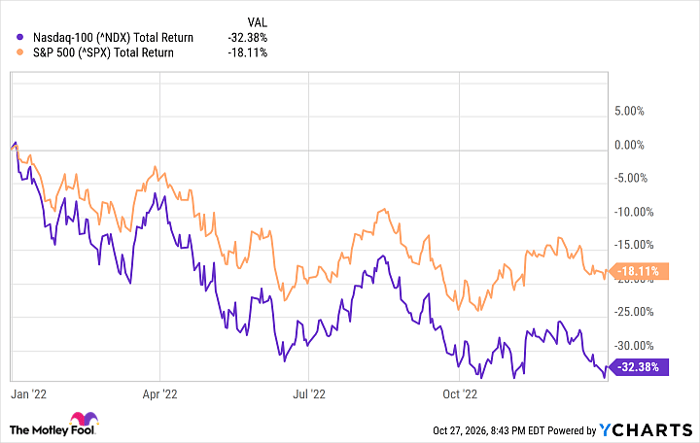
^NDX data by YCharts
Could we be on the verge of another 2022-style stock market crash? No one knows for sure, but there are a few reasons to be wary. Here are a few of the biggest risks facing today's stock market -- and why I'm investing anyway.
Image source: Getty Images.
Risk 1: AI topheaviness
Artificial intelligence (AI) has become the biggest growth driver in the U.S. stock market. Goldman Sachs (NYSE: GS) research from September found that the largest AI hyperscalers had spent about $800 billion in capital expenditures since the beginning of the year, and almost 50% of S&P 500 companies' earnings-per-share growth in 2026 came from AI-related investment. Tech and AI-related stocks make up about 45% of the S&P 500.
Can this AI-related spending boom keep going? What if it slows down? What if the most influential AI companies fail to deliver the hoped-for profitability from AI tools?
Risk 2: Rising interest rates
The Federal Reserve hiked interest rates in September and may do so again by the end of 2026. Longer-term interest rates based on government bond yields, like the 10-year Treasury yield, have spiked in 2026. (The 10-year Treasury yield has risen about 0.92% in the past year.) This could slow the economy, as consumers and businesses face higher borrowing costs.
Are higher interest rates enough to push the economy into recession or hurt stock prices? Not necessarily. But they are a risk factor. When bonds start to deliver higher yields, stocks become less attractive to investors. This can hurt share prices, at least in the short run.
Risk 3: Historically high valuations
The stock market's recent run of success might also be creating a new risk factor. According to the cyclically adjusted price-to-earnings (CAPE) ratio, which uses a 10-year average for earnings, the S&P 500 looks richly valued compared to historical averages. This ratio has recently been hovering at levels that it hasn't reached since 2000 -- right before the dot-com crash.
It's possible that the S&P 500 is not overpriced. No single stock market metric has a perfect track record of predicting future crashes. But can the winning streak continue? Or will share prices come back down to earth?
Why I'm investing anyway
It's understandable to have concerns. The stock market is never risk-free, and today's economic uncertainty around the future of AI might feel especially risky. But I'm staying invested. And I'm going to keep buying more stocks with low-cost index funds as often as I can -- even if the stock market is on the verge of a correction or crash.
Here's why I'm investing anyway: Since 1928, the S&P 500 has delivered average annual returns of 9.98%. In the past five years, even with the bad bear market of 2022, the Vanguard S&P 500 ETF (NYSEMKT: VOO) has delivered average annual returns of about 13.8%.
In other words, the stock market has always bounced back. If you're a long-term investor (like me) and you can afford to leave your investment accounts alone for many years to grow and compound, I believe that stocks (including exchange-traded funds) are likely to be a good long-term choice compared to most other assets.
There are always risks, but stocks also have big upside. The future could be brighter than today's pessimists expect. Stocks have built wealth through much bigger crises and much deeper uncertainty than we face today.
Missed Nvidia in 2009? This Rare Signal Is Flashing Again
In 2009, a "Double Down" signal flashed for a little-known chipmaker called Nvidia. If you’d invested $5,000 then, you’d be sitting on $2,777,360 today.*
Now, for the first time in years, that same "Total Conviction" signal is flashing for a company 1/100th the size of Nvidia. It’s a key player in the $1.8 trillion space race, and with the stock recently sitting 20% off its highs, the window to get in early is closing fast.
Continue »
*Stock Advisor returns as of October 30, 2026.
Ben Gran has no position in any of the stocks mentioned. The Motley Fool has positions in and recommends Goldman Sachs Group and Vanguard S&P 500 ETF. The Motley Fool has a disclosure policy.
Recommended Articles


