


Opinion: While the Odds of a SpaceX-Tesla Merger Are Climbing, Combining 2 Wrongs Won't Make a Right on Wall Street
Key Points
Trillionaire Elon Musk, who oversees Space Exploration Technologies (SpaceX) and Tesla, has a phenomenal track record of making investors richer.
On paper, a SpaceX-Tesla merger would make sense, with strategic synergies highlighting a potential deal.
However, Musk’s propensity to overpromise and underdeliver, coupled with the otherworldly valuations of both companies, makes combining them a terrible idea.
- These 10 stocks could mint the next wave of millionaires ›
Few innovators are more synonymous with success than trillionaire Elon Musk. He successfully built electric-vehicle (EV) maker Tesla (NASDAQ:TSLA) into a trillion-dollar company and shattered Wall Street's record books when Space Exploration Technologies (NASDAQ:SPCX), better known as SpaceX, went public on June 12.
The next step in Musk's storybook success may very well be combining the two trillion-dollar companies he currently oversees. As of Oct. 24, traders on Polymarket assigned a 59% chance of a SpaceX-Tesla merger announcement by June 30, 2027.
Missed AI’s "Act 1"? Act 2 Could Be 15x Bigger. Most investors think they missed the AI boat because they didn't buy Nvidia in 2005. But according to our analysts, we’re only at the end of "Act 1"—the R&D phase. "Act 2" is the global rollout. Continue »
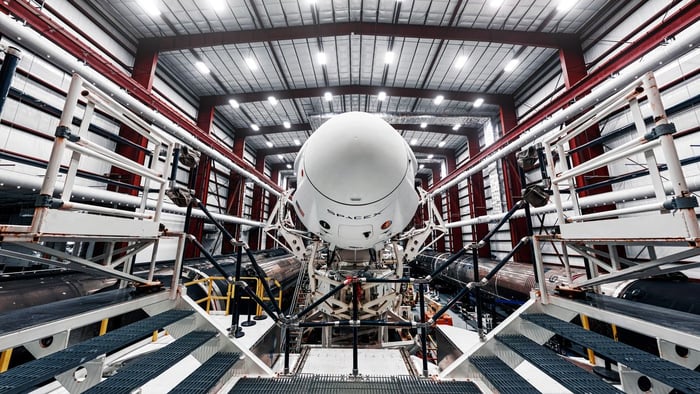
Image source: Getty Images.
While this merger would provide advantages on paper, combining two wrongs won't make a right on Wall Street.
What would a SpaceX-Tesla merger bring to the table?
Let me preface this discussion by noting that no merger or acquisition is in any way guaranteed. However, special committees of independent directors at both businesses are examining the possibility of a merger that could create one of the largest public companies on the planet.
One of the most obvious lures of this combination is that Musk's time and innovative prowess would no longer be divided between multiple public companies. Retail investors have shown a willingness to ride Musk's coattails.
BREAKING: Elon Musk says SpaceX, $SPCX, and Tesla, $TSLA, have formed special committees to discuss a potential merger between the two companies. "I do think there’s a lot of merit to combining the companies as we are pretty much in the superintelligence singularity, and there’s a lot to be gained from cooperating," Musk said. "Do I think it would be a good idea? Yes, but at the end of the day, the shareholders have to be supportive of this," Musk said.
— The Kobeissi Letter (@KobeissiLetter) October 20, 2026
From a financial standpoint, combining Tesla's treasure trove of cash and its rich history of recurring profits could lessen SpaceX's need for capital, as well as mask the company's history of losses.
There are also several strategic synergies in combining SpaceX's and Tesla's operations. For instance, SpaceX's factory automation could rapidly scale Starship production. A merger would also pool artificial intelligence resources from both companies, likely improving efficiency.
On paper, a merger makes sense -- and would likely make CEO Elon Musk even richer. But it would also, in my view, create a terrible company with more questions than answers.

Image source: Getty Images.
A SpaceX-Tesla merger would be the ultimate growth trap for retail investors
While I can't deny that Musk has delivered for his shareholders, combining these two trillion-dollar companies wouldn't sweep Musk's biggest flaw under the rug. Namely, his inability to fulfill innovative promises.
For instance, Tesla commands a nearly $1.5 trillion valuation, but is currently growing its sales by only 10% to 15% annually and trades at 172 times Wall Street's consensus earnings for 2027. Tesla's bloated valuation is based on Musk's promises of Level 5 full self-driving, Optimus robots being sold en masse, and millions of autonomous robotaxis on public roads. None of these claims have come to fruition, which is a common theme with SpaceX's and Tesla's CEO.
$TSLA Tesla Q3 FY26: • Revenue flat Y/Y at $28.0B ($0.2B miss) • Gross margin 20% (+3pp Y/Y) • Operating margin 3% (-3pp Y/Y) • CapEx +110% Y/Y to $4.7B • Free cash flow -62% Y/Y to $1.5B • Non-GAAP EPS $0.48 ($0.03 beat) https://t.co/i3jVa0YuBk
— App Economy Insights (@EconomyApp) October 21, 2026
Merging these two businesses would also sap SpaceX of some of its near-term growth potential. While Tesla's track record and balance sheet would lend credibility to an as-yet-unproven operating model, its stagnant EV sales and shrinking automotive margins would act as an anchor to SpaceX's future operating results.
The otherworldly valuation of the combined entity would also make it highly susceptible to an outsize move lower when the next stock market correction or bear market arrives. SpaceX is trading at a price-to-sales ratio of 60, while Tesla's aforementioned price-to-earnings ratio of 172 can't be justified with its current growth prospects.
Combining two companies whose stories can't be justified now won't make for a positive story later.
We just issued 'double down' alerts on 3 stocks — find out if Tesla made our list
Ever feel like you missed the boat in buying the most successful stocks? Then you’ll want to hear this.
On rare occasions, our expert team of analysts issues a “Double Down” stock recommendation for companies that they think are about to pop. If you’re worried you’ve already missed your chance to invest, now is the best time to buy before it’s too late. And the numbers speak for themselves:
- Nvidia: if you invested $1,000 when we doubled down in 2009, you’d have $566,599!*
- Apple: if you invested $1,000 when we doubled down in 2008, you’d have $66,212!*
- Netflix: if you invested $1,000 when we doubled down in 2004, you’d have $337,166!*
Right now, we’re issuing “Double Down” alerts for three incredible companies, available when you join Stock Advisor, and there may not be another chance like this anytime soon.
See the 3 stocks »
*Stock Advisor returns as of October 29, 2026.
Sean Williams has no position in any of the stocks mentioned. The Motley Fool has positions in and recommends Tesla. The Motley Fool has a disclosure policy.
Recommended Articles


