


Oracle Stock Price Forecast: $225 Billion Revenue Target Sparks Nearly 11% Gain, ORCL Poised to Challenge Four-Month High of $170
TradingKey - Oracle (ORCL) closed up 10.73% on Wednesday at $144.54, posting its largest single-day gain since May. The main catalyst driving the stock's rebound was the company's announcement of more aggressive long-term financial targets at its Investor Day, along with a clear timeline for turning free cash flow positive. Against the backdrop of persistent market concerns over excessive AI infrastructure spending and a growing debt burden, Oracle sought to prove to investors that large-scale expansion can ultimately translate into revenue growth and cash returns.
Oracle's newly announced long-term targets place a clear emphasis on growth potential. The company expects revenue to reach at least $225 billion by fiscal year 2030, representing a compound annual growth rate of approximately 35% from fiscal 2026 to 2030. Over the same period, adjusted operating margin is expected to exceed 40%, and adjusted earnings per share will top $21. This revenue target is higher than some previous Wall Street expectations, reflecting the company's continued confidence in the growth prospects of its AI cloud infrastructure business.
Meanwhile, Oracle reaffirmed its guidance for fiscal year 2027, expecting revenue of at least $90 billion and adjusted earnings per share of $8.10. While this annual target did not significantly beat market expectations, the company's outlook on its growth pace over the coming years is noticeably more bullish. As demand for computing power from AI enterprises continues to rise, Oracle aims to further expand its share in the AI compute market by expanding data centers and providing cloud infrastructure services.
Previously, the market's biggest concern regarding the company was that building AI data centers requires massive capital expenditures, potentially creating a significant time lag between revenue growth and cash inflow. Oracle's capital expenditures have already exceeded $55.7 billion in fiscal year 2026, and the market expects them to increase further in fiscal 2027. Such massive investments mean that even with robust demand for AI services, the company will need continuous financing to complete infrastructure construction and fulfill customer contracts.
At this Investor Day, Oracle Chief Financial Officer Hilary Maxson provided clearer cash flow targets. The company expects free cash flow to turn positive in the second half of fiscal year 2028 and exceed $30 billion in fiscal 2029. Under Oracle's plan, capital expenditures will peak between fiscal years 2027 and 2028 before gradually slowing down, creating favorable conditions for cash flow improvement.
Oracle also pledged to keep new capital markets financing under $20 billion through fiscal year 2030, with debt and equity financing split roughly evenly. Vendor financing, customer-provided hardware, and customer prepayments will also help the company reduce upfront cash outlays for data center projects.
In addition, the company plans to deliver approximately 7 gigawatts of data center computing capacity to customers over the next few years, while expanding hardware options for its AI compute services by incorporating custom chips such as Google TPUs. If the relevant capacity comes online smoothly, Oracle will have an opportunity to accelerate the fulfillment of cloud computing orders from OpenAI and other customers, driving simultaneous growth in revenue and profit margins.
However, there is still a long way to go before these long-term targets are realized. Oracle expects capital expenditures to rise to approximately $91.9 billion this fiscal year, while its long-term debt has reached about $117 billion, with a credit rating of just BBB-, the lowest rung of investment grade.
The company's five-year credit default swap spreads remain elevated, reflecting that the bond market has not fully cleared its concerns over debt service capacity. Furthermore, some data center projects face challenges such as power grid connection, regulatory approvals, and construction delays, while reliance on a small number of large customers like OpenAI presents a degree of revenue concentration risk.
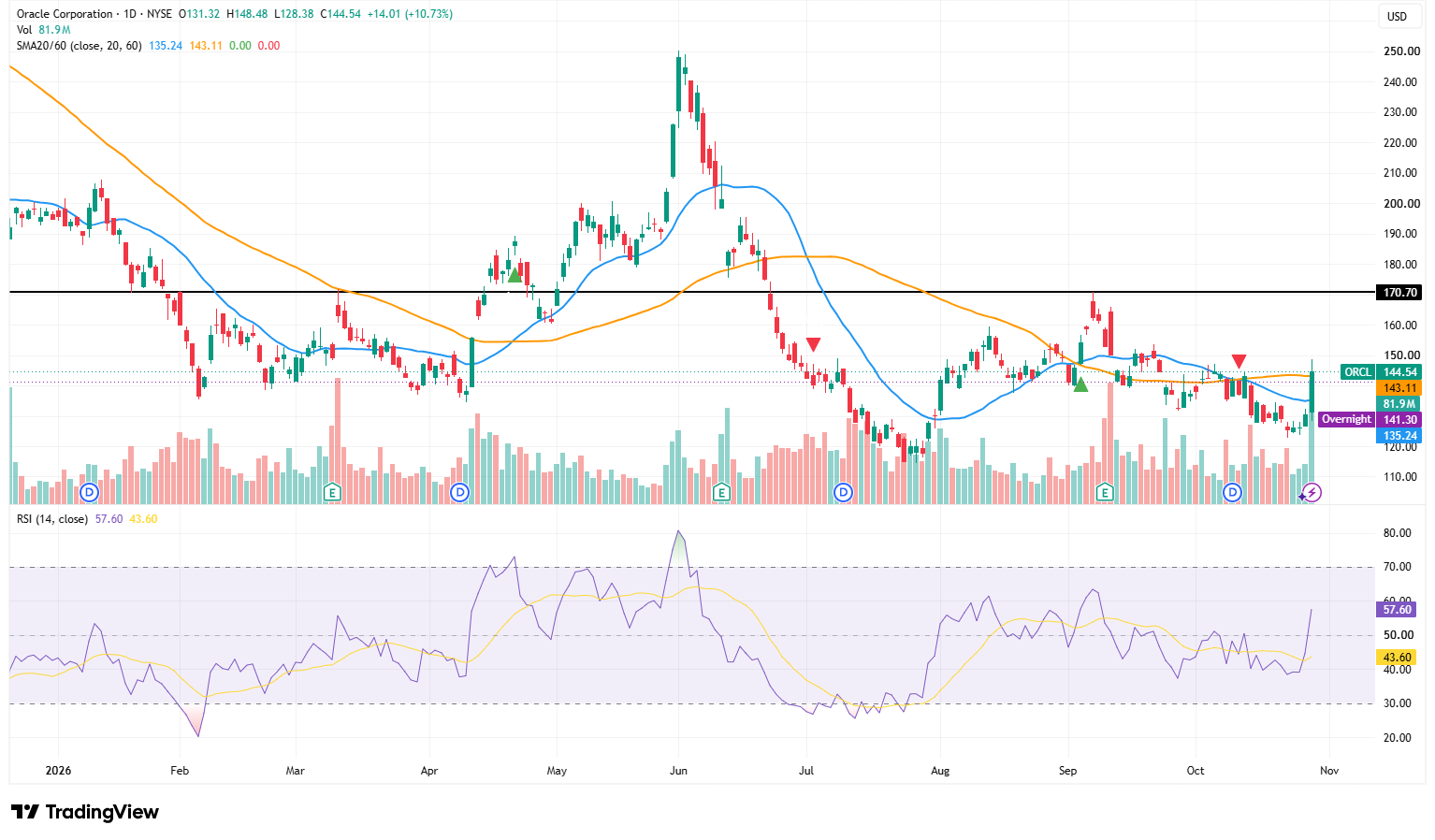
Source: TradingView
From a technical perspective, ORCL has reclaimed its 20-day moving average of $135.24 and 60-day moving average of $143.11, with its short-term trend turning from weak to strong. However, the stock has yet to effectively break through the resistance zone of $148–$150, and a long upper shadow also indicates profit-taking in this region.
The RSI rose to 57.60, crossing above its signal line at 43.60, showing a clear improvement in momentum while remaining outside overbought territory. If the stock holds firmly above $150 on heavy volume, upside targets will be $157–$160 and $170.70 in sequence; an advance from the current price to $170.70 still represents roughly 18% upside.
On the downside, initial support lies at $141–$143, followed by the 20-day moving average at $135. If it falls below $135, this breakout attempt could fail, leading to a retest of the $128–$131 zone.
Recommended Articles


