


2 Millionaire-Maker Custom Silicon Stocks Powering the AI Infrastructure Supercycle
Key Points
Broadcom is a leading designer of ASICs and has delivered a total return of more than 13,400% over the last 15 years.
TSMC is the world's leading manufacturer of chips and has posted a total return of more than 4,700% since 2011.
- Motley Fool Issues Rare "Total Conviction" Buy Alert ›
Graphics processing units (GPUs) are the core hardware that is used to train advanced artificial intelligence (AI) models, but they're not the only semiconductors that are useful when it comes to AI. Application specific integrated circuits (ASICs) are chips that are custom designed to excel at specific tasks.
ASICs aren't as versatile or generally powerful as GPUs, but they can actually be significantly more powerful and efficient when it comes to handling the tasks they were designed for. Broadcom (NASDAQ: AVGO) and Taiwan Semiconductor Manufacturing (NYSE: TSM) are two leading players in the custom silicon space that have delivered huge wins for investors thanks in part to their wins with ASICs.
Missed AI’s "Act 1"? Act 2 Could Be 15x Bigger. Most investors think they missed the AI boat because they didn't buy Nvidia in 2005. But according to our analysts, we’re only at the end of "Act 1"—the R&D phase. "Act 2" is the global rollout. Continue »

Image source: Getty Images.
1. Broadcom
In addition to providing networking hardware and software services, Broadcom has emerged as a leading provider of custom ASIC designs.
- The company has partnered with Alphabet to produce the software giant's Tensor Processing Units (TPUs).
- In addition to Alphabet, Broadcom also counts Meta Platforms, OpenAI, and Anthropic among its ASIC customers.
- It's been scoring huge sales and earnings growth in conjunction with rising demand for its custom chips and AI-related networking solutions.
In this year's third quarter, Broadcom's artificial intelligence semiconductor revenue rose 221% year over year to $16.7 billion, largely driven by demand for its custom AI accelerator chips and AI networking solutions. Meanwhile, net income rose roughly 216% to hit roughly $13.1 billion. For the fourth quarter, the company said that it expected AI revenue to increase 236% annually to reach $21.7 billion.
Over the last 15 years, Broadcom has delivered a dividend-adjusted total return of roughly 13,470%. That means that if you invested $25,000 in the stock a decade ago and held on to your position, it would now be worth roughly $3.4 million.
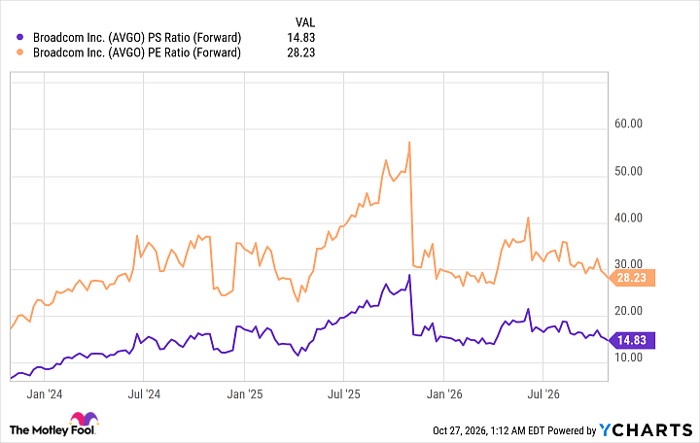
AVGO PS Ratio (Forward) data by YCharts
Broadcom has actually seen some substantial valuation pullbacks in conjunction with concerns about valuations across the broader AI industry, but it still trades at roughly 28 times this year's expected earnings and 15 times expected sales. While the company still has a growth-dependent valuation, it has a very strong net income margin profile and has been growing revenue at an impressive clip that could support valuation gains.
2. Taiwan Semiconductor Manufacturing
Taiwan Semiconductor Manufacturing, or TSMC as it's often called, doesn't design ASICs or any other kind of semiconductor. Instead, the company manufactures its customers' chip designs -- and it absolutely dominates the chip manufacturing space.
When it comes to high-end ASICs from Broadcom, Marvell Technology, and other designers, TSMC is the go-to choice for chip fabrication. This means that TSMC stands out as a strong pick-and-shovel play for benefiting from the growth of the custom semiconductor market, as well as the growth of the broader chip industry.
According to many estimates, TSMC controls over 90% of the market for high-end semiconductors designed for artificial intelligence and other high-performance computing applications. The company's status as the leading global provider of advanced AI chips has translated into stellar stock performance.
TSMC stock has delivered a total return of roughly 4,720% over the last 15 years. If you had invested $25,000 in the stock 15 years ago, your holdings would now be worth roughly $1.2 million.
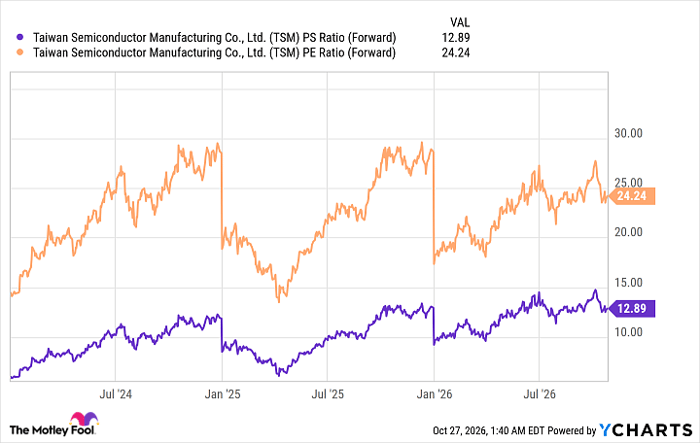
TSM PS Ratio (Forward) data by YCharts
As with Broadcom, TSMC has seen some recent valuation volatility connected to concerns that an AI valuation bubble could be on the verge of bursting. On the other hand, the business retains a dominant position in the chip fabrication that is crucial to global technology supply chains -- and strong demand trends and margins could help the stock go on to reach new highs.
Should you buy stock in Taiwan Semiconductor Manufacturing right now?
Before you buy stock in Taiwan Semiconductor Manufacturing, consider this:
The Motley Fool Stock Advisor analyst team just identified what they believe are the 10 best stocks for investors to buy now… and Taiwan Semiconductor Manufacturing wasn’t one of them. The 10 stocks that made the cut could produce monster returns in the coming years.
Consider when Netflix made this list on December 17, 2004... if you invested $1,000 at the time of our recommendation, you’d have $337,166!* Or when Nvidia made this list on April 15, 2005... if you invested $1,000 at the time of our recommendation, you’d have $1,339,143!*
Now, it’s worth noting Stock Advisor’s total average return is 904% — a market-crushing outperformance compared to 213% for the S&P 500. Don't miss the latest top 10 list, available with Stock Advisor, and join an investing community built by individual investors for individual investors.
See the 10 stocks »
*Stock Advisor returns as of October 28, 2026.
Keith Noonan has no position in any of the stocks mentioned. The Motley Fool has positions in and recommends Alphabet, Broadcom, Marvell Technology, Meta Platforms, and Taiwan Semiconductor Manufacturing. The Motley Fool has a disclosure policy.
Recommended Articles


