


Microsoft Stock Tests $509 as Azure Growth and AI Safety Strategy Support the Bull Case
TradingKey - Microsoft enters September 15 with the latest completed close at $505.41 on September 14, up 1.97%, essentially matching the supplied $505.42 chart reference. Currently, MSFT stock recovered from the $486.23 and $488.30 support zones and is headed Higher into the critical zone of $504.20 and $509.82. This zone combines Fibonacci resistance and a downtrend line. A strong case can be made regarding MSFT’s fundamentals as a leading large-cap AI stock with 43% growth in Azure, Microsoft 365 Copilot at more than 30 million paid seats, and $678 billion in commercial RPO.
Azure Growth Remains the Core Fundamental Driver
For the fiscal fourth quarter, Microsoft recorded $90.0 billion in revenue, 18% year-over-year growth, while operating income increased by 18% to $40.6 billion. After eliminating the impact of OpenAI-related investments, adjusted EPS increased to $4.74, a gain of 23%.
Azure continued to dominate as cloud-related services recorded a 43% increase over the year prior. MSFT also shared preliminary Azure revenue for the quarter at $29.4 billion, with full-year Azure revenue of about $101.9 billion.
This is important because the demand for AI is no longer a future expectation. It is actively expanding reported cloud growth at a magnitude that is nearly impossible for most other companies to replicate.
Q1 Guidance Suggests Another Step Higher
MSFT has set a first quarter revenue target of about $90.4 billion at the midpoint of its $89.85-$90.95 billion range and an expected 44%-45% constant-currency growth rate for Azure, versus a 43% growth rate in the previous quarter. This is believed to continue the trend of growing demand and constrained capacity.
This is the primary bullish argument for me. Microsoft isn’t saying that there could be demand for AI in the future. They are already building a robust Azure business that is greater than 40% and over $100 billion.
Copilot Has Become a Real Monetization Engine
Microsoft 365 Copilot has exceeded 30 million paid seats, a major milestone because Microsoft can monetize AI within software that has billions of users, including Word, Excel, Teams, and Outlook, and within GitHub and Dynamics.
Copilot creates a unique advantage for Microsoft over new AI firms because there is no need to sell AI to an existing user base millions strong. Copilot can be easily stood up and create a new revenue stream for Microsoft.
The $678 Billion Backlog Adds Exceptional Visibility
Increased visibility is provided by future cloud and software revenue, thanks to an 84% increase from last year and an influx of $678 billion of remaining commercial performance obligations. The more important issue is delivery of infrastructure. According to reports, Microsoft is looking to increase global data-center power capacity to about 38 gigawatts by 2032, more than triple its current footprint. This is a considerable commitment which demonstrates an increasing supply concern over demand.
CapEx Is the Biggest Fundamental Risk
In Q4, reported CapEx spending by Microsoft was approximately $41 billion, with finance leases. Cash outflows used for all other property and equipment was approximately $35.8 billion. It is expected that fiscal Q1 CapEx will be over $50 billion.
Microsoft has the capacity to sustain this spending, given that in Q4 operating cash flows were an impressive $55.4 billion, however the investment return will impact this thesis. Additionally, AI within the infrastructure ecosystem has the potential to provide a spike within gross margins.
Therefore, capital efficiency is potentially the largest of the current concerns within the MSFT thesis. Within this scenario, if the adoption of Copilot and usage of Azure maintain growth and exceed usage by above 40%, then spending will be justified. If sustainable growth is not consistent within the scenario of elevated spending, then debate regarding return on capital will exceed concern.
Microsoft Is Reducing Dependence on a Single AI Provider
Another important shift in the MSFT strategy is a shifting bias towards a broader range of AI ecosystem vendors. The company has an overall reliance on OpenAI, but has formed additional partnerships with Anthropic and Mistral, alongside Microsoft-developed and open-source models available through Azure.
This makes Azure a better neutral enterprise AI provider since customers can select models based on cost, performance, or governance needs.
In the long run, I consider this a positive venture for stakeholders since it provides more diversity and reduces the risk of using a single frontier model company.
AI Safety Could Become an Enterprise Advantage
On September 14, Microsoft AI CEO Mustafa Suleyman said that future Microsoft AI systems would have to allow correction, should not resist shutdown, and should remain understandable to humans. Suleyman unveiled a draft AI Code of Conduct, and this is relevant commercially and ethically. More enterprise customers and government clients care about safety and control, and are increasingly concerned with the auditability and the sovereignty of the systems, as well as the ability to exercise human override.
Microsoft has the potential to differentiate itself in the marketplace because the company already has control over the identity, the cloud, the productivity software, enterprise security, and the environments used to deploy models.
The Macro Backdrop Is the Main Near-Term Headwind
Over the last month, market participants have begun pricing in multiple Federal Reserve rate hikes. With Brent trading above $100 and the yield on the U.S. 10-year Treasury trading above 5%, this is a material upward pressure on Microsoft's valuation. Although the company’s earnings are growing strongly, a multiple of about 28x trailing earnings becomes more sensitive if the risk-free yield moves higher.
The stock’s relative strength on September 14 is noteworthy, but there is some macro headwind pressure until the yield curve normalizes.
Microsoft Technical Analysis: $509.82 Is the Breakout Trigger
At the end of trading on September 14, Microsoft was trading at $505.41, most of the way to the $505.42 reference chart level. The stock rebounded from key support at $486.23 and $488.30. The 2-hour chart has pushed into a confluence zone between $504.20 and $509.82.
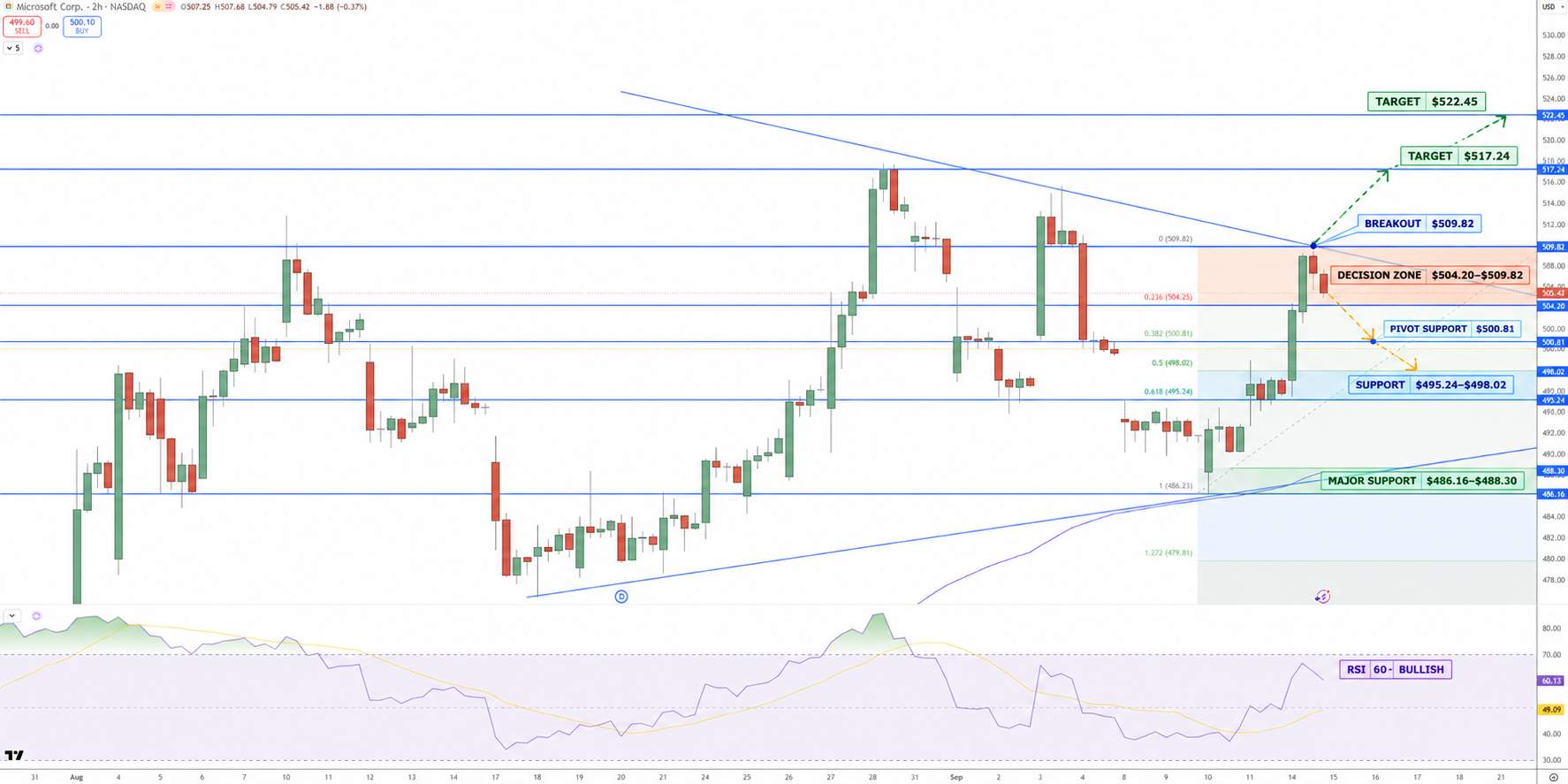
Microsoft Price Chart - Source: Tradingview
The key level is $509.82. From a 2-hour trading perspective, if the level is cleared on a sustained close, the trendline will also be breached, indicating that the trading range has been broken to the upside, with subsequent resistance expected at $517.24 and $522.45.
RSI hovering around 60 remains above the signal line at around 49 indicating constructive momentum without being in overbought territory.
On the downside, the first pivot comes in at $504.20, followed by the 38.2% Fib level at $500.81. Under that, $498.02 and $495.24 define the next support zone. Going further, we have the important support zone at $486.16 to $488.30.
Key Levels
· Latest closed price: $505.41
· Pivot: $504.20
· Support: $500.81
· Secondary Support: $498.02
· Deeper Support: $495.24
· Major Support Zone: $486.16 to $488.30
· Resistance: $509.82
· First Target: $517.24
· Higher Target: $522.45
· RSI: Around 60, constructive and not overbought
Why is Microsoft stock in focus now?
Microsoft builds an AI infrastructure while growing Azure at 43%, selling Copilot to 30+ million, has a strong cash flow position, a $678B backlog, and a new AI governance framework, while 5% Treasury yields remain a valuation headwind.
What level confirms further MSFT upside?
A 2-hour close above $509.82 would confirm a break of the downtrend line and point toward $517.24, followed by $522.45. Losing $500.81 would instead point toward a pullback to $498.02 to $495.24.
Bottom Line
Microsoft’s September 15 setup is still fundamentally strong and technically constructive. However, the stock is now testing a key resistance zone. Azure is speeding up, Copilot is gaining traction, Microsoft has a massive $678 billion backlog wth exceptional visibility, and Microsoft’s AI governance strategy could become a significant edge for Microsoft in the enterprise. The largest risks are massive CapEx and a significantly more challenging interest rate environment. On a technical analysis basis, I am cautiously bullish above $500.81, but to confirm continuation, Microsoft needs to trade above $509.82 to reach $517.24 and $522.45. If the stock price retracts below the falling trend line, we could retest the support zone of $500.81 to $495.24.
Recommended Articles


