


Rivian vs. Lucid: This Stock Is Clearly the Better Buy
Key Points
Industry pioneer Tesla proved that scaling electric vehicle sales is possible.
EV sales today hinge on a company's ability to target the robotaxi industry.
- 10 stocks we like better than Rivian Automotive ›
Investors looking for high-growth electric vehicle (EV) stocks should pay attention to what made Tesla (NASDAQ: TSLA) a $1 trillion business. CEO Elon Musk laid out Tesla's recipe for success in a 2006 blog post titled, "The Secret Tesla Motors Master Plan (just between you and me)." In the post, Musk detailed Tesla's three biggest priorities:
- Build a sports car
- Use those proceeds to build an affordable car
- Use that money to build an even more affordable car
While it took longer than Musk initially expected, Tesla executed this vision perfectly. The company released the Roadster sports car in 2008 at a price of roughly $100,000. The Model S followed in 2012 at around $60,000. The Model 3 debuted in 2017 at just $35,000.
Missed Nvidia in 2009? This Rare Signal Is Flashing Again. In 2009, a "Double Down" signal flashed for a little-known chipmaker called Nvidia. For the first time in years, that same "Total Conviction" signal is flashing for a company 1/100th the size of Nvidia. Continue »
Tesla gradually scaled its business to sustainably produce low-cost vehicles at a profit, eventually making it the world's largest EV company. Tesla then had the scale, capital, and brand recognition to invest in other opportunities such as robotaxis and autonomous semitrucks.
EV competitors Lucid Group (NASDAQ: LCID) and Rivian Automotive (NASDAQ: RIVN) have yet to replicate Tesla's orchestrated rise. But the upside potential for investors is clear. Tesla's market capitalization currently hovers around $1.2 trillion. Rivian, meanwhile, is valued at just $23 billion, with Lucid's market cap recently falling below $2 billion.
If you're looking to invest in the next Tesla, one stock sticks out above the rest.
This EV stock looks like the next Tesla
Tesla is currently involved in a wide array of opportunities with huge long-term upside potential, most notably robotaxis and self-driving technology. The ability to pursue these opportunities, however, came after the company scaled its manufacturing capacity to produce affordable vehicles. From this perspective, Rivian is arguably well ahead of Lucid.
This year, both Lucid and Rivian released new vehicles. The differences between the new models couldn't be clearer. Lucid launched its Gravity SUV, a high-end luxury model with a base price of nearly $126,000. Including taxes, fees, and options, total costs could easily surpass $150,000. In short, this is hardly a vehicle that can help Lucid build mass scale.
Rivian, meanwhile, launched its R2 SUV, with a starting price of around $45,000. Higher-end versions of the R2 cost closer to $60,000. With 69% of Americans hoping to spend less than $50,000 on their next vehicle purchase, Rivian at least has a chance of achieving mass sales. That's especially true given that the company plans to release two additional models -- the R3 and R3X -- with even lower starting prices.
While Lucid is also planning lower-cost models, its inability to do so thus far should generate some skepticism. Production of such a vehicle, originally slated for 2026, has already been postponed to late 2027.
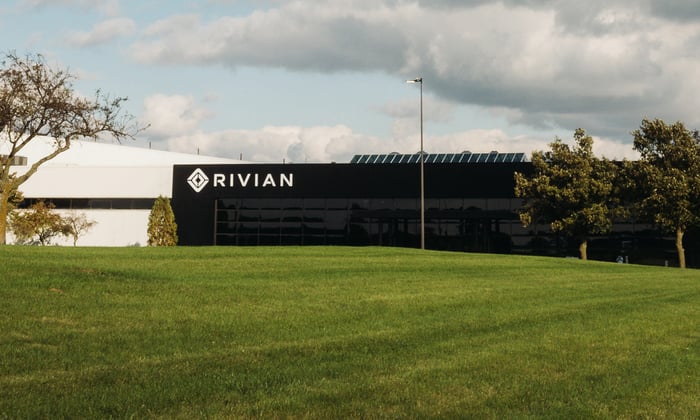
Image source: Rivian.
Rivian is ahead in scaling its manufacturing base. But how is each company positioned to succeed in the quickly emerging robotaxi market? Again, the lead likely goes to Rivian. Both Rivian and Lucid have invested in their self-driving technology platforms. With a market value 10 times Lucid's, however, Rivian has superior access to capital to invest aggressively in this area. It could raise more than Lucid's entire market valuation by diluting shareholders by just 10%.
Rivian's lead can be gleaned from its recent deal with Uber Technologies (NYSE: UBER). Uber lacks its own manufacturing capabilities to support its emerging robotaxi fleet. In response, it has invested directly in EV makers to ensure a future supply of vehicles. This year, Uber agreed to purchase up to 50,000 Rivian R2s. Uber also forged a deal with Lucid, but that deal only called for 35,000 vehicles.
Uber is clearly diversifying its bets, but the fact that it bet more heavily on Rivian should be a sign of its trust in Rivian's manufacturing capabilities and its software development trajectory. Despite a higher valuation, Rivian shares look more attractive given the company's larger manufacturing scale, low-cost model launches, and a seemingly more advanced self-driving tech platform.
Should you buy stock in Rivian Automotive right now?
Before you buy stock in Rivian Automotive, consider this:
The Motley Fool Stock Advisor analyst team just identified what they believe are the 10 best stocks for investors to buy now… and Rivian Automotive wasn’t one of them. The 10 stocks that made the cut could produce monster returns in the coming years.
Consider when Netflix made this list on December 17, 2004... if you invested $1,000 at the time of our recommendation, you’d have $417,413!* Or when Nvidia made this list on April 15, 2005... if you invested $1,000 at the time of our recommendation, you’d have $1,341,294!*
Now, it’s worth noting Stock Advisor’s total average return is 950% — a market-crushing outperformance compared to 212% for the S&P 500. Don't miss the latest top 10 list, available with Stock Advisor, and join an investing community built by individual investors for individual investors.
See the 10 stocks »
*Stock Advisor returns as of September 13, 2026.
Ryan Vanzo has no position in any of the stocks mentioned. The Motley Fool has positions in and recommends Tesla. The Motley Fool recommends Uber Technologies. The Motley Fool has a disclosure policy.
Recommended Articles


