


Prediction: Nvidia Stock Could Be Worth This Much by January 2028
Key Points
Nvidia says that its forecast for the next fiscal year is supply-constrained, not demand-constrained.
The 70% revenue target is what management believes Nvidia can confidently deliver given current supply chain dynamics.
Nvidia stock could move considerably higher over the next year, and its valuation multiples wouldn't even need to expand.
- 10 stocks we like better than Nvidia ›
So far this year, Nvidia (NASDAQ: NVDA) stock has put up a solid but unspectacular 17.3% gain. That sounds decent until you remember its performance during earlier innings of the artificial intelligence (AI) revolution, when shares were routinely doubling or tripling in a calendar year.
Nvidia's rocket-ship phase has cooled due to a mix of things: growing competition from custom silicon at the major cloud players, lingering questions about whether hyperscaler capital expenditures (capex) can stay this aggressive, the law of large numbers, and some trepidation around circular financing deals.
Missed Nvidia in 2009? This Rare Signal Is Flashing Again. In 2009, a "Double Down" signal flashed for a little-known chipmaker called Nvidia. For the first time in years, that same "Total Conviction" signal is flashing for a company 1/100th the size of Nvidia. Continue »
It seems like investors are no longer willing to pay a premium in the same way they did when every quarter felt like the start of another exciting chapter. Yet the setup beneath Nvidia's quiet price action looks much more interesting than you might expect.
The company just gave a full-year-ahead forecast for the first time, and the number was big enough to make skeptics do a double-take. Let's break down why Nvidia stock may be quietly loading for a sizable move heading into calendar year 2027.
Image source: Nvidia.
Nvidia's growth is all about supply, not demand
Nvidia's fiscal 2028 guidance calls for approximately 70% revenue growth. For context, this is well above what Wall Street had been modeling and puts the company on a path toward $700 billion in sales. CEO Jensen Huang was unquestionably direct about why Nvidia chose this number: Customer demand is pointing toward higher implied growth than 70%, but this level is simply what the supply chain can confidently deliver.
Memory shortages and other critical component bottlenecks are the binding constraint in building AI factories, not a lack of orders for graphics processing units (GPUs). In other words, 70% is the company's conservative, supply-limited plan. If more wafers and memory become available, Nvidia's actual numbers could easily run higher.
Why Nvidia may outperform its own guidance next year
Two engines are running hotter than Nvidia's official outlook implies. First, capex for the top five hyperscalers -- Amazon, Alphabet, Microsoft, Meta Platforms, and Oracle -- is estimated to land around $800 billion this calendar year and $1.3 trillion in 2027. Nvidia already captures a healthy slice of this spend, and its next-generation Vera Rubin platform should allow it to take even more as big tech's budget gets deployed.
At the same time, the company's ACIE customers -- AI clouds, industrial customers, and sovereign enterprises -- are starting to grow even faster than the hyperscaler side of the business. During the second quarter, the ACIE segment delivered 25% sequential growth (versus 13% from the hyperscale cloud providers) and now represents roughly half of data center revenue. This mix shift is giving Nvidia a broader, less concentrated customer base.
In addition, new use cases are starting to consume GPUs in ways that were considered science fiction just a couple of years ago. Agentic AI workloads require far more inference and reasoning horsepower. Nvidia's new Vera central processing units (CPUs) are designed exactly for this purpose.
Moreover, space exploration is moving from theories depicted in slide decks to actual hardware sales, with talk of orbital data centers and on-orbit inference. Robotaxi fleets from Alphabet and Tesla are also moving from pilot to scaled deployment, and every one of those vehicles is essentially a rolling cluster of GPUs on wheels.
For now, these opportunities represent incremental demand that could easily push Nvidia's performance past the official target as these applications reach large-scale deployment.
What could Nvidia stock be worth by January 2028?
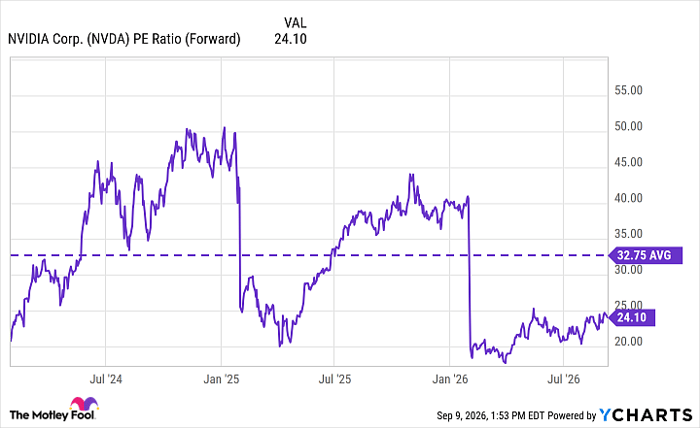
Wall Street's consensus earnings per share (EPS) estimate for Nvidia's fiscal 2028, which ends in January of that year, sits at $15.52. This implies 67% growth compared to this year's EPS target of $9.31. Throughout the AI revolution, Nvidia's forward price-to-earnings (P/E) ratio has averaged 33. If I took a 25% haircut off that average to better reflect a larger, more mature company, that leaves you with a 25x forward P/E multiple. This is roughly where Nvidia trades today.
Data by YCharts.
If I apply that multiple to the $15.52 estimate, then Nvidia stock lands around $388 a share. If Nvidia's multiple expands back toward its average, then shares would be worth closer to $512. From today's price of $225, this implies gains of between 72% and 127% by the time fiscal 2028 earnings are in the rearview mirror.
Here's the subtle takeaway: Nvidia's earnings power is large enough to produce a very different stock price even if its valuation multiple doesn't expand at all. Against this backdrop, the muted price action of 2026 may turn out to be a temporary pause before the next leg up. For this reason, I think Nvidia looks like a no-brainer stock to buy hand over fist right now, as meaningful gains appear to be on the horizon.
Should you buy stock in Nvidia right now?
Before you buy stock in Nvidia, consider this:
The Motley Fool Stock Advisor analyst team just identified what they believe are the 10 best stocks for investors to buy now… and Nvidia wasn’t one of them. The 10 stocks that made the cut could produce monster returns in the coming years.
Consider when Netflix made this list on December 17, 2004... if you invested $1,000 at the time of our recommendation, you’d have $417,413!* Or when Nvidia made this list on April 15, 2005... if you invested $1,000 at the time of our recommendation, you’d have $1,341,294!*
Now, it’s worth noting Stock Advisor’s total average return is 950% — a market-crushing outperformance compared to 210% for the S&P 500. Don't miss the latest top 10 list, available with Stock Advisor, and join an investing community built by individual investors for individual investors.
See the 10 stocks »
*Stock Advisor returns as of September 12, 2026.
Adam Spatacco has positions in Alphabet, Amazon, Microsoft, Nvidia, and Tesla. The Motley Fool has positions in and recommends Alphabet, Amazon, Meta Platforms, Microsoft, Nvidia, Oracle, and Tesla. The Motley Fool has a disclosure policy.
Recommended Articles


