


40,000 Employees Today and 4 Million Agents Tomorrow: Nvidia CEO Jensen Huang Believes Agentic AI Will Soon Become the Norm in the Workplace
Key Points
Agentic AI refers to automated systems powered by AI that largely act independently to carry out tasks.
Many AI bulls believe agentic AI will change the way we all work.
Agentic AI is most efficient when it utilizes central processing units (CPUs), a business Nvidia has recently launched in a big way.
- 10 stocks we like better than Nvidia ›
Artificial intelligence (AI) has come on fast and furious.
Just four years ago, it felt like people were trying their first large language model (LLM). Now, AI is everywhere, and it still feels like the world hasn't come close to fully tapping its potential.
Missed Nvidia in 2009? This Rare Signal Is Flashing Again. In 2009, a "Double Down" signal flashed for a little-known chipmaker called Nvidia. For the first time in years, that same "Total Conviction" signal is flashing for a company 1/100th the size of Nvidia. Continue »
Few are more bullish on artificial intelligence than Nvidia (NASDAQ: NVDA) CEO Jensen Huang, who regularly talks about the future of AI. One aspect of AI that Huang has been discussing in particular is agentic AI, or autonomous systems capable of performing human-like digital tasks.
AI agents have soared in popularity. Huang thinks they will soon be quite common in the workplace.
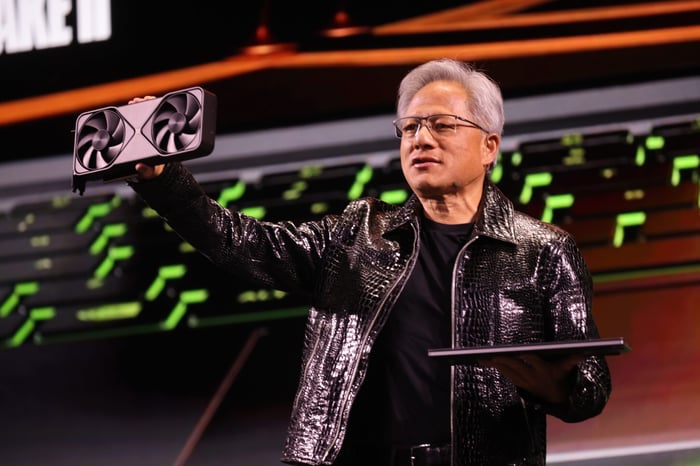
Nvidia CEO Jensen Huang. Image source: Nvidia.
Agentic AI will soon be our sidekicks
On Nvidia's latest earnings call, Huang said he has seen an inflection point rapidly approaching, in which the bulk of AI will shift from being prompted by people to being prompted by AI agents. People are already using agentic AI to automate workflows.
Today, the vast majority of AI is prompted by people. I believe that this last month, it has crossed. Most AI are now agentic. But in the future, every company will have a whole bunch of agents. We have 40,000 employees, roughly. In the future, we'll have 400,000 agents, 4 million agents. And those agents are running continuously. They're running in the background.
Just as the internet transformed how we work today, AI can take it a step further. Workers can already use agents to summarize their emails or Slack threads, organize folders, generate automated responses to frequent questions, conduct deep research, and much more.
Now, in light of what recently happened with OpenAI and the open-source AI community Hugging Face, in which a bunch of rogue agents escaped a confined testing space and launched a cyberattack on Hugging Face, I am sure (or at least I hope) companies will be cautious about how much access they give agents, because there are cybersecurity risks.
But companies will inevitably be tempted to automate as much as possible, which could lower expenses by making people more efficient.
It's also likely to enable people to get more done in less time, so there's going to be a push and pull between the desire to use agents and the need to maintain proper security measures.
Huang is backing up his words with action
Huang is not just discussing agentic AI to drum up more excitement about AI.
Nvidia is making a big investment in agentic AI through its recently released Vera central processing unit (CPU), designed specifically for running agents. CPUs, the chips that power legacy devices such as laptops and phones, have come back into fashion thanks to agentic AI.
Graphics processing units (GPUs) are the main general-purpose chips that power the reasoning component of AI and allow AI models to explore many solutions simultaneously.
While GPUs are still responsible for this component of agentic AI, CPUs are critical to carrying out the tasks the AI triggers, whether that involves accessing files, browsing the web, or managing workflow orchestration.
Nvidia surprisingly launched its Vera CPUs last quarter, boasting that they were 1.8x faster than industry standards and had 5 times the bandwidth per watt of any other data center CPU.
Management also reiterated that it still sees $20 billion in potential revenue from Vera CPUs in its current fiscal year, with the potential to more than double that number in fiscal year 2028. This instantly makes the company one of the leading suppliers of CPUs.
Analysts at Bank of America also released a research report in June, saying they believe the CPU market will grow fivefold between this year and 2030, from $35 billion to $170 billion.
It's never clear what the future holds, but everything Huang has said and the actions Nvidia has taken show they are extremely bullish on agentic AI.
Should you buy stock in Nvidia right now?
Before you buy stock in Nvidia, consider this:
The Motley Fool Stock Advisor analyst team just identified what they believe are the 10 best stocks for investors to buy now… and Nvidia wasn’t one of them. The 10 stocks that made the cut could produce monster returns in the coming years.
Consider when Netflix made this list on December 17, 2004... if you invested $1,000 at the time of our recommendation, you’d have $417,413!* Or when Nvidia made this list on April 15, 2005... if you invested $1,000 at the time of our recommendation, you’d have $1,341,294!*
Now, it’s worth noting Stock Advisor’s total average return is 950% — a market-crushing outperformance compared to 210% for the S&P 500. Don't miss the latest top 10 list, available with Stock Advisor, and join an investing community built by individual investors for individual investors.
See the 10 stocks »
*Stock Advisor returns as of September 12, 2026.
Bank of America is an advertising partner of Motley Fool Money. Bram Berkowitz has no position in any of the stocks mentioned. The Motley Fool has positions in and recommends Nvidia. The Motley Fool has a disclosure policy.
Recommended Articles


