


Jack Henry's 2026 Outlook: Cloud-Native Platform Drives Record Core Banking Wins
Key Points
Jack Henry provides mission-critical software with high recurring revenue and strong client retention.
The company faces margin pressure from rising personnel costs and increased competitive spending.
The current valuation is lower than its five-year average and should recover if the company maintains its current earnings growth rate.
- 10 stocks we like better than Jack Henry & Associates ›
Picture a community bank in the heart of the Midwest. It needs to process a local mortgage, manage a depositor's payroll, and secure those transactions against an evolving landscape of digital fraud. It doesn't build its own software to handle this burden. Instead, it pays Jack Henry & Associates (NASDAQ:JKHY) to run the technology behind the scenes.
Based in Monett, Missouri, Jack Henry & Associates provides the essential core banking and payment processing platforms that keep thousands of small and regional financial institutions moving. As of Sept. 8, the stock trades at $159.8, maintaining a steady, low-volatility profile that has delivered a 6% return over the past year.
Our proprietary Hidden Gems scoring system assigns Jack Henry & Associates an overall Superscore of 78 out of 100, placing it in the Strong category. The Superscore is an AI-powered score that evaluates a company's overall strength by combining financial performance, product market position, technological capabilities, leadership quality, and relative valuation. It represents the unification of all our scores into a single score for public companies, with five rating bands: Exceptional (90-100), Strong (75-89), Above Average (60-74), Average (40-59), and Cautious (0-39). This score places the company in the Top ~13% of all companies we score, or ahead of roughly 87 out of every 100 companies in our database. The Superscore is a useful data signal worth investigating, and the analysis below pairs its strengths with its constraints so you can decide if the business fits your own goals.

Image source: Getty Images.
Why JKHY Has a 78 Superscore
- Dominant market reach: It serves over 7,200 financial institutions, securing a durable position as a mission-critical partner that is rarely swapped out once a workflow is established.
- Proven revenue visibility: It reported remaining performance obligations of $8.44 billion as of June 30, 2026, providing a multi-year cushion of recurring revenue that persists through economic cycles.
- Rapid payment growth: The company's faster-payments revenue surged 50% in fiscal 2026, proving that its strategy to lead in modern, real-time financial services is gaining significant client traction.
- Disciplined capital stewardship: Management maintains a rigorous focus on returns, exemplified by a 23% return on invested capital and a track record of returning excess cash to shareholders through buybacks and dividends.
- Strong sales momentum: It secured a record 58 competitive core wins during fiscal 2026, confirming that its transition to a cloud-native platform is successfully attracting new business from incumbents.
Why Is JKHY's Superscore Not Higher?
- Stretched valuation multiples: The stock trades at a trailing P/E of 22.7, a valuation that leaves little margin for error if its moderate growth trajectory faces any sudden cooling.
- Crowded competitive landscape: It faces persistent threats from agile fintech start-ups and specialized risk vendors that are increasingly chipping away at modular segments of its product ecosystem.
- Margin pressure: Rising personnel and infrastructure costs caused gross margins to dip to 42% in fiscal 2026, signaling that maintaining its moat requires higher spending than in previous years.
- Limited AI differentiation: It functions primarily as a steward of client data rather than an owner, limiting its ability to derive proprietary, agentic value that could disrupt its own legacy-heavy business model.
Jack Henry is a highly capital-efficient business, earning outsize profits on a small base of hard tangible assets. This efficiency allows the company to turn each point of revenue growth into durable returns, which helps explain why the market often assigns a premium to the stock despite the risks. While this operating leverage is a core strength, the elevated valuation multiple remains a risk that only partially offsets the company's operational discipline.
Table 1: Hidden Gems Database Scores for Jack Henry & Associates (JKHY)
| Score | Score (out of 100) | Rank | Supporting Data Point |
|---|---|---|---|
| Product (1Y) | 81 | Top ~18% | Strong innovation momentum with R&D spending up 8%. |
| Product (5Y) | 74 | Top ~24% | Consistent transition to cloud-native platforms over five years. |
| Financial (1Y) | 81 | Top ~11% | Exceptional financial health with 19% operating cash flow growth. |
| Financial (5Y) | 75 | Top ~15% | Reliable 6.5% revenue CAGR from 2022 to 2026. |
| Leaders | 68 | Top ~49% | Highly data-driven roadmap centered on the Jack Henry Platform. |
| AI | 22 | Bottom ~25% | Limited proprietary data restricts potential for independent AI-driven value. |
| Valuation Risk | 64 | Top ~30% | Trades at a trailing P/E of 23x, reflecting steady organic growth. |
Is JKHY Right For Your Portfolio?
This stock warrants a closer look if...
- You are looking for reliable compounders among the best small-cap tech stocks that prioritize long-term recurring revenue over hyper-growth.
- You value companies with high client retention rates that operate as the essential, invisible infrastructure of the financial system.
You may want to keep researching before buying if...
- You are sensitive to valuation risk and worry that a trailing P/E of 23 might overprice the company's moderate, steady growth expectations.
- You prefer companies that own proprietary data sets and are aggressively positioning themselves as leaders in the agentic AI economy.
The Superscore is just one input to your research; please weigh this data against your own financial goals and risk tolerance before making any investment decision.
My 5-year prediction for JKHY stock
Jack Henry is a high-quality, relatively defensive compounder. While the fintech space has witnessed the proliferation of artificial intelligence (AI), it may seem counterintuitive that Jack Henry & Associates has stood the test of time and continues to grow. In fact, don't let the low AI score of 22 fool you.
Most AI applications in the banking space are usually customer-facing. For example, opening an account, getting a loan, and resolving fee-related problems are all increasingly handled by AI chatbots. However, beneath this layer lies the core banking software that maintains ledgers, authenticates transactions, moves money, and manages compliance. That's the platform Jack Henrey provides, and AI can't easily replace it.
Additionally, by partnering with Alphabet's (NASDAQ:GOOG)(NASDAQ:GOOGL) Google Cloud, management is modernizing its systems with a cloud-based platform that enables more seamless integration for banks and third-party fintechs.
Essentially, Jack Henry's business model is "boring" but potentially powerful. As complexities in the fintech and banking space increase, its platforms remain the trusted integration layer, as witnessed by the record 58 new sales deals in fiscal 2026. I would expect earnings growth to accelerate.
During last month's earnings call, management stated that most deals in fiscal 2026 stemmed from a "competitive takeaways“ strategy that relies on directly taking over market share, assets, or customers from existing competitors. This is in contrast to the traditional growth route that involves deals with brand-new entities, branches, or digital footprint from scratch. The new playbook seems to have just begun with a significant runway for growth.
At nearly 23 times trailing 12-month earnings, the stock may seem richly valued, but it's far cheaper than what it traded for five years ago. So the current valuation may be an anomaly, as the average trailing P/E ratio over the last five years is 31.8.
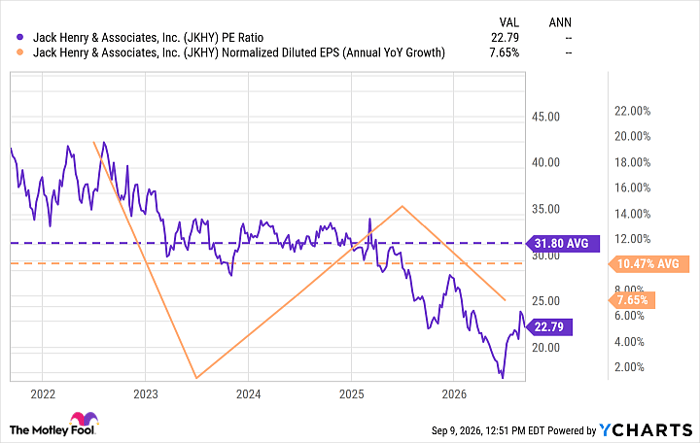
JKHY PE Ratio data by YCharts.
Even if the market assigns a reasonable valuation of 27 times 2031 earnings, using the current annual earnings growth rate of 7%-8% should still reflect a 70% upside from today's stock price levels.
The Hidden Gems Superscore reflects The Motley Fool's proprietary AI-driven evaluation of a company across product, financial, leadership, and valuation pillars as of the article date and may change over time. Performance figures are point-in-time. Past performance does not guarantee future results.
Should you buy stock in Jack Henry & Associates right now?
Before you buy stock in Jack Henry & Associates, consider this:
The Motley Fool Stock Advisor analyst team just identified what they believe are the 10 best stocks for investors to buy now… and Jack Henry & Associates wasn’t one of them. The 10 stocks that made the cut could produce monster returns in the coming years.
Consider when Netflix made this list on December 17, 2004... if you invested $1,000 at the time of our recommendation, you’d have $414,015!* Or when Nvidia made this list on April 15, 2005... if you invested $1,000 at the time of our recommendation, you’d have $1,385,459!*
Now, it’s worth noting Stock Advisor’s total average return is 960% — a market-crushing outperformance compared to 213% for the S&P 500. Don't miss the latest top 10 list, available with Stock Advisor, and join an investing community built by individual investors for individual investors.
See the 10 stocks »
*Stock Advisor returns as of September 9, 2026.
Isac Simon has no position in any of the stocks mentioned. The Motley Fool has positions in and recommends Alphabet and Jack Henry & Associates. The Motley Fool has a disclosure policy.
Recommended Articles


