


'I am the house now': U.S. Treasury Secretary Scott Bessent Dares Investors to Short the Yen, as the Treasury Announces a Longer-Dated Bond Repurchase Up to $6 Billion
Key Points
During a recent speech, Treasury Secretary Scott Bessent said he knows how Japanese officials will act when the U.S. intervenes with the yen.
The Treasury Department also recently announced that it will repurchase up to $6 billion of longer-dated Treasuries on Sept. 10, exceeding expectations.
Both moves hope to rein in bond yields, which have risen to alarming levels.
- These 10 stocks could mint the next wave of millionaires ›
In recent months, U.S. Treasury Secretary Scott Bessent has not been afraid to intervene in the bond or foreign exchange markets.
In early August, the Treasury executed a coordinated purchase of Japanese yen with Japan's Ministry of Finance to strengthen the yen, which had been losing ground to the U.S. dollar.
Missed Nvidia in 2009? This Rare Signal Is Flashing Again. In 2009, a "Double Down" signal flashed for a little-known chipmaker called Nvidia. For the first time in years, that same "Total Conviction" signal is flashing for a company 1/100th the size of Nvidia. Continue »
The Treasury also plans to repurchase as much as $6 billion of longer-dated Treasuries at its next operation on Sept. 10, triple the normal amount, in an attempt to curb Treasury yields. While the moves have received their fair share of criticism, Bessent seems to have no plans to back down.
"... I am the house now," said Bessent, during a speech in front of Southern Methodist University's business school on Sept. 8. "So when we intervene with the Japanese yen, I have pretty good insight what the Japanese, what the Bank of Japan is going to do, what Japanese policymakers are going to do. Bet against me if you want."

Image source: The White House.
Trying to control yields at a delicate time
Thanks to mounting U.S. debt, which has topped $40 trillion, the Iran war, which has increased oil and gas prices, and higher inflation expectations, long-dated bond yields have surged.
The yield on the 10-year U.S. Treasury note, which influences mortgage rates, was nearly 4.85% as of this writing. Meanwhile, the yield on the 30-year U.S. Treasury bond was slightly above 5.30%.
Not only do higher bond yields increase borrowing costs for consumers and businesses, but they also increase interest on newly issued U.S. debt, which is the last thing the U.S. government, already running a nearly $1.8 trillion fiscal deficit, needs.
To try to calm investors and bring down yields, Bessent, a decorated currency trader who famously and successfully shorted the British pound in 1992, has had the Treasury interject in a few places.
First was Japan.
Japan holds over $1.1 trillion of U.S. debt. Japan's Finance Ministry holds U.S. Treasury bonds in its reserves, so if the yen weakens and the ministry wants to prop it up, it would likely need to sell Treasuries to fund that operation.
This could lead to higher Treasury yields because bond prices and yields have an inverse relationship: as the supply of Treasuries in the market grows, bond prices fall, and yields rise. It would also be a bad signal to other holders of U.S debt, who could also start selling Treasuries.
So, as the yen lost ground with the dollar, the U.S. Treasury coordinated a large-scale purchase of yen.
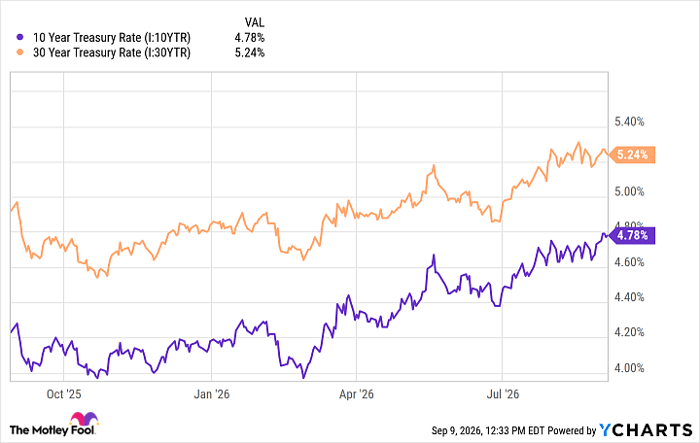
10 Year Treasury Rate data by YCharts
"Whenever people say, 'Oh, well, the Treasury secretary is taking a risk,' well, it's my dream. I have asymmetric information," Bessent said during the SMU speech.
The other way the Treasury has intervened is by increasing its repurchases of longer-dated Treasury bonds, which it conducts regularly to remove more illiquid bonds from the market, typically around $2 billion per operation.
On Sept. 9, the Treasury Department announced it would repurchase up to $6 billion.
Citing anonymous sources, CNBC previously reported that the repurchases could be funded by the Treasury's general account, meaning the Treasury would simply remove the illiquid bonds from circulation rather than issue new bonds to fund the purchases.
Will the house win?
Bessent's plans have met mixed reviews.
The dollar-yen exchange rate has strengthened from around $158.89 five days ago to about $153.63 as of this writing. However, as noted above, longer-dated bond yields are higher.
"Quadrupling or even quintupling the size [of the Treasury's repurchase] to the $8 billion to $10 billion range is not out of the question, but would represent a second major shift in the Treasury's debt strategy in just two weeks," analysts at the research firm Wrightson ICAP, which specializes in analysis of the Fed, economy, and Treasury financing trends, wrote in a research note earlier this week, according to CNBC.
"It would be an admission that the Treasury hadn't thought through its hasty August 19 announcement in the first place."
One issue with Bessent’s plan is that it sparks doubt. In theory, the Treasury's actions should lower yields and strengthen the yen. But these moves also make investors worry that if the Treasury has to intervene, it’s because it’s running out of options or the situation is getting out of control.
Only time will tell what happens, but if bond yields continue to move higher, I expect stocks to come under more pressure.
Where to invest $1,000 right now
When our analyst team has a stock tip, it can pay to listen. After all, Stock Advisor’s total average return is 960%* — a market-crushing outperformance compared to 213% for the S&P 500.
They just revealed what they believe are the 10 best stocks for investors to buy right now, available when you join Stock Advisor.
See the stocks »
*Stock Advisor returns as of September 9, 2026.
The Motley Fool has a disclosure policy.
Recommended Articles


