


Gasoline Prices Just Hit New Records, and They're Still Rising. Could They Trigger a Market Crash?
Key Points
This year's Labor Day gasoline prices were the most expensive in history by a long shot.
Oil prices are continuing to rise as the war in Iran drags on.
However, seasonal changes in the fuel market may arrive in the nick of time.
- 10 stocks we like better than S&P 500 Index ›
Gas prices set a record on Monday, and not in a good way.
According to the auto club AAA, the national average gas price on Monday was $4.1505 per gallon. That made it the most expensive Labor Day ever at the pump by a long shot.
Missed Nvidia in 2009? This Rare Signal Is Flashing Again. In 2009, a "Double Down" signal flashed for a little-known chipmaker called Nvidia. For the first time in years, that same "Total Conviction" signal is flashing for a company 1/100th the size of Nvidia. Continue »
Even worse, gasoline prices have climbed further since then, and evidence suggests they might climb even higher in the coming days.
Could these record-high fuel prices trigger a stock market downturn, or even a market crash? Here's what investors need to know.

Image source: Getty Images.
Gas prices are hitting record highs
Until this year, the average regular gas price on Labor Day had never been above $4 a gallon.
The previous record of $3.82 a gallon was set in 2012. This year's price beat that record by more than $0.33 a gallon.
But on Tuesday, the average regular gas price rose even further to $4.1514 per gallon, then jumped again on Wednesday to $4.2245. That's higher than it was a week ago ($4.1203 a gallon), higher than a month ago ($4.0121 a gallon), and much higher than a year ago ($3.1930 a gallon).
Meanwhile, benchmark crude oil prices have been steadily creeping upward. They briefly spiked above $99 a barrel on Tuesday, up from below $90 a barrel in early August. We could easily see $100-per-barrel crude again as the war in Iran continues to disrupt the Middle East.
Soaring oil prices and concerns about the Middle East caused the S&P 500 to post back-to-back losses on Friday and Tuesday. The Dow Jones Industrial Average dropped 628.2 points on Tuesday over similar concerns.
But there may be a silver lining for investors and drivers everywhere.
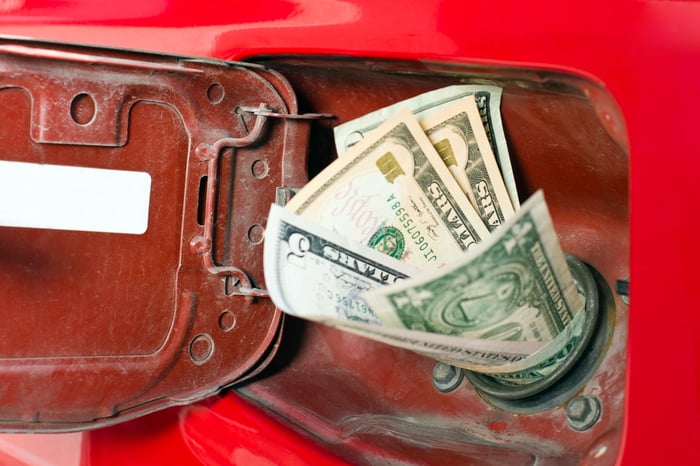
Image source: Getty Images.
Seasonal changes may relieve some pressure
If drivers can just make it through another week, relief may start to appear in the form of winter-blend gasoline.
The U.S. Environmental Protection Agency allows gas stations to begin selling winter-blend fuel on Sept. 16. Winter-blend fuel contains a different mix of ingredients than summer-blend fuel to help vehicles start more easily in cold weather. Luckily for drivers, those ingredients are cheaper, and usually cause prices at the pump to ease as more gas stations switch over to the less-expensive mixture through late September and October.
Also, Americans drive less in the fall than in the summer, which often lowers demand and lowers gasoline prices. That decline may have already started, according to the latest data from the Energy Information Administration, which showed gasoline demand fell last week from 9.04 million barrels a day to 8.92 million barrels a day.
So even if oil prices rise further, seasonal changes make it unlikely that gasoline prices will rise enough to trigger a market crash on their own.
That said, if gas prices are already elevated when an additional economic shock occurs -- such as a possible Federal Reserve interest rate hike or a new geopolitical crisis -- they might contribute to a subsequent market downturn or crash.
Of course, there's no way to know when a market downturn will occur or exactly what will trigger it. But investors should be aware that high gas prices could be a factor, while hoping that seasonal price relief arrives soon.
Should you buy stock in S&P 500 Index right now?
Before you buy stock in S&P 500 Index, consider this:
The Motley Fool Stock Advisor analyst team just identified what they believe are the 10 best stocks for investors to buy now… and S&P 500 Index wasn’t one of them. The 10 stocks that made the cut could produce monster returns in the coming years.
Consider when Netflix made this list on December 17, 2004... if you invested $1,000 at the time of our recommendation, you’d have $414,015!* Or when Nvidia made this list on April 15, 2005... if you invested $1,000 at the time of our recommendation, you’d have $1,385,459!*
Now, it’s worth noting Stock Advisor’s total average return is 960% — a market-crushing outperformance compared to 213% for the S&P 500. Don't miss the latest top 10 list, available with Stock Advisor, and join an investing community built by individual investors for individual investors.
See the 10 stocks »
*Stock Advisor returns as of September 9, 2026.
John Bromels has no position in any of the stocks mentioned. The Motley Fool has no position in any of the stocks mentioned. The Motley Fool has a disclosure policy.
Recommended Articles


