


Why Does Amazon Trade at a Discount to Walmart and Costco? Here's the Only Answer That Makes Sense.
Key Points
While Amazon's price-to-earnings ratio has fallen steeply since 2024, the ratios of Costco and Walmart have moved higher.
The reasoning behind these moves makes sense, too.
Amazon's valuation decline and its retail rivals' rises have arguably gone too far.
- These 10 stocks could mint the next wave of millionaires ›
Never let it be said the stock market doesn't keep things interesting.
The latest installment of the market's "huh?" series of developments concerns the current valuation levels of technology giant Amazon (NASDAQ: AMZN) compared to its brick-and-mortar retailing rivals Walmart (NASDAQ: WMT) and Costco (NASDAQ: COST).
Missed Nvidia in 2009? This Rare Signal Is Flashing Again. In 2009, a "Double Down" signal flashed for a little-known chipmaker called Nvidia. For the first time in years, that same "Total Conviction" signal is flashing for a company 1/100th the size of Nvidia. Continue »
Walmart stock is currently trading at 37 times this year's expected earnings, while Costco shares are priced at more than 44 times their projected earnings.
Amazon stock, conversely, is valued at only a little over 20 times analysts' estimates of this year's earnings -- roughly half the earnings multiple that the market is willing to pay for its (much) slower-growing peers.
What gives?
All of it is defensive-minded
You never truly know how a crowd comes to a collective decision. But you can come to some reasonable conclusions based on the commonly repeated themes in the news coverage and chatter about a particular company.
In this instance, Amazon's price-to-earnings ratio has been pared back heavily from its long-standing level of above 50 almost entirely because of the amount of money the company is spending on artificial intelligence infrastructure.

Image source: Getty Images.
That's not an unreasonable thing for investors to be concerned about, either. As of the latest update, Amazon now says it's budgeting for capital expenditures of $220 billion this year, the bulk of which will go toward technology meant to support its cloud computing unit's artificial intelligence offerings. For perspective on that figure, analysts expect Amazon to turn $828 billion in revenue into $134 billion in net earnings in its fiscal 2026, although its cloud business (as opposed to its e-commerce arm) is only on pace to report roughly $60 billion in operating income on sales of $160 billion.
In other words, it is making a sizable investment in artificial intelligence compute capabilities that haven't exactly cemented their marketable usefulness into place yet. Investors are just being cautious by not paying a premium for shares of a company that could end up delivering disappointing news.
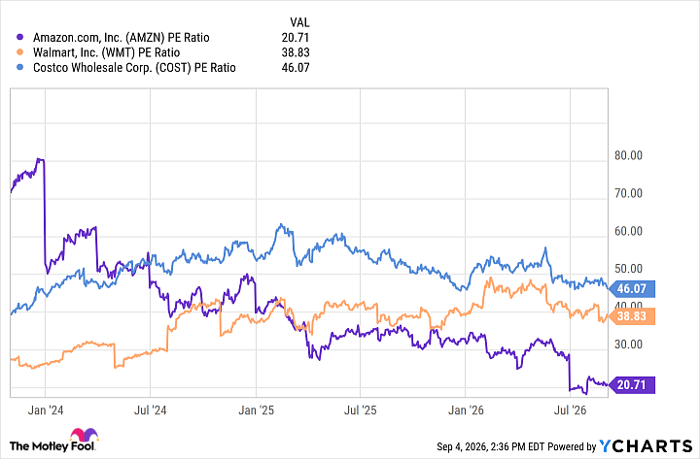
AMZN PE Ratio data by YCharts.
This concern is also at the heart of the reason Costco and Walmart shares have fought their way to unusually high valuations, by the way. Because many investors fear that an implosion of the artificial intelligence industry could create a ripple effect that upends the overall economy, they are gravitating toward businesses built to stay steady amid such a headwind. They're even paying premiums for stakes in such defensive companies.
No need to participate in the guessing game
The underlying logic is sound. It may not be necessary strategizing, though, particularly to the degree it's being done. At least most of the investments Amazon is making in artificial intelligence this year should produce some measure of return on investment sooner or later. And, while Costco and Walmart will be resilient no matter what macroeconomic conditions prevail, both stocks have reached valuations that far exceed their arguable worth as defensive holdings. Given their current price/earnings multiples, if the stock market as a whole runs into a serious headwind, there's certainly no guarantee that Walmart and Costco won't participate in any correction.
The smart-money move for the time being, therefore, may simply be to steer clear of all three of these names and instead look for stocks with performances that are a little less tethered to the concerns that the artificial intelligence frenzy is going to come to a screeching halt.
Don’t miss this second chance at a potentially lucrative opportunity
Ever feel like you missed the boat in buying the most successful stocks? Then you’ll want to hear this.
On rare occasions, our expert team of analysts issues a “Double Down” stock recommendation for companies that they think are about to pop. If you’re worried you’ve already missed your chance to invest, now is the best time to buy before it’s too late. And the numbers speak for themselves:
- Nvidia: if you invested $1,000 when we doubled down in 2009, you’d have $598,219!*
- Apple: if you invested $1,000 when we doubled down in 2008, you’d have $61,037!*
- Netflix: if you invested $1,000 when we doubled down in 2004, you’d have $421,997!*
Right now, we’re issuing “Double Down” alerts for three incredible companies, available when you join Stock Advisor, and there may not be another chance like this anytime soon.
See the 3 stocks »
*Stock Advisor returns as of September 7, 2026.
James Brumley has no position in any of the stocks mentioned. The Motley Fool has positions in and recommends Amazon, Costco Wholesale, and Walmart. The Motley Fool has a disclosure policy.
Recommended Articles


